2026 marks the dawn of a new era of stability and an unprecedented global talent search within the aviation industry. My research confirms this shift beyond any doubt. With record-breaking revenues set to exceed $1 trillion for the first time and over 5.2 billion passengers ready to take to the skies, the sector urgently needs its share of the 1 million new flight attendants required globally over the coming decade.
Do you know that every single new aircraft entering a fleet requires an average of 20 to 30 crew members to remain operational? The numbers are precise, and 2026 is the perfect year to stop waiting and finally start your journey in the clouds.
Age, Height, and 2026 Airlines Requirements
If you are here, you are likely asking the same questions that flood search engines and industry forums: “Is there an age limit for flight attendants?” or “What does it really take to become cabin crew today?” Perhaps you feel “out of time” or fear that physical requirements are an insurmountable obstacle. Many wonder: “How tall do you have to be?” or “What qualifications do I need?”
But let me tell you something, the sky in 2026 is more inclusive and meritocratic than ever. Airlines are seeking candidates with strong interpersonal skills, adaptability, and a relentless focus on safety.
Why should you read this guide?
My name is Carmen, and my story is proof that limits often exist only in our minds. After 5 years of attempts and numerous “No’s,” I finally wore my first uniform at 40, working for one of Europe’s most demanding airlines, Ryanair, before continuing my career as a ground handling agent. It was a dream come true! In this guide, you will find not only technical data but the real-world experience of someone who has lived every stage of this journey.
The modern Flight Attendant
A flight attendant, often called a hostess or steward, is a professional dedicated to safety, service, and passenger management. While the “textbook” definition focuses on service, a cabin crew member is much more than that. You are the face of the airline and the guardian of everyone on board.

Hostess vs. Flight Attendant - Is there a difference?
In reality, there is no substantial difference: “hostess” (or steward) and “flight attendant” are synonyms in the common language. However, the professional term used by airlines is Cabin Crew.
What does a Flight Attendant actually do?
If you think the job is just about serving drinks and smiling for eight hours, let me tell you, you’re in for a surprise.
That’s because in 2026, being a flight attendant means being a safety professional, a crisis manager, a mediator, and a caregiver, all while maintaining composure at 35,000 feet.
Remember that your primary mission is to keep people alive.
- Passenger safety management – You are the first and last line of defense in any emergency
- Strict execution of emergency procedures – from evacuations to medical crises, your training kicks in when seconds count
- Assisting passengers with special needs – elderly travelers, unaccompanied minors, passengers with disabilities—they rely on your vigilance and care
- Clear communication under extreme pressure – whether it’s turbulence, a medical emergency, or a security threat, your words must inspire calm and action
- Conflict resolution and de-escalation – handling disruptive passengers, defusing tension, protecting the safety of everyone onboard
When you’re in the air, there’s no calling for backup. It’s just you, your crew, and a metal tube flying through the sky. In those moments, your ability to activate a coordinated “lifeline” with your team can mean the difference between a manageable situation and a catastrophe, whether it’s a significant emergency or simply severe turbulence that’s shaken passengers to their core.
Flight Attendant Requirements
Many give up before applying because they rely on outdated information. Let’s look at the real flight attendant requirements for 2026.
Is there an age limit for flight attendants?
It’s time to bust one of the most persistent myths – the idea that the doors close after age 30. In 2026, there is no legal age limit to start this career. Airlines have shifted their focus from your birth date to your profile quality.
But why is your age a competitive advantage in 2026?
- Emotional Intelligence: You have handled stress in life and previous jobs. You know how to stay calm when a passenger is difficult.
- Problem Solving: Your background has taught you to find quick solutions—a vital skill in a dynamic cabin environment.
- Reliability: Statistics show that mature candidates tend to stay longer with a company, reducing turnover costs. To a recruiter, you are a “safe bet.”
I am living proof of this change. I was hired at 40 by Ryanair. Today, through my coaching, I guide not only 20-year-olds but also professionals over 35 and 40 who want to change their lives. Airlines are looking for operational maturity. If you can pass the EASA Medical (AME) and the reach test, your only absolute limit is your interview preparation.
How tall do you have to be? (The Reach Test)
Height is often a significant source of anxiety. While social media portrays a particular image, the industry is pragmatic in 2026. Height is not an aesthetic requirement, but it is a safety-critical necessity.
Most airlines now use the Reach Test instead of a static height measurement. You must be able to reach a height of approximately 210 cm (sometimes 212 cm) while standing on your tiptoes with one arm extended. This ensures that you can access emergency equipment, such as fire extinguishers or oxygen cylinders, stored in overhead bins.
Flight Attendant Medical Requirements and Health Standards
Flight attendants must obtain an aviation medical fitness certificate (also known as a cabin crew medical certificate) from authorized aviation medical centers or the Institute of Aviation Medicine (IML). This certification verifies:
- Vision and hearing standards – meeting specific aviation requirements
- General health status – ensuring physical capability for the demands of flying
- Absence of disqualifying medical conditions – confirming no health issues incompatible with cabin crew duties. The medical examination is conducted after you pass the airline’s selection process (Assessment Day) and must be performed by a certified Aviation Medical Examiner (AME) who is a physician specially trained in aerospace medicine. There is usually some of this medicine near your future base.
What qualifications do you really need to become a flight attendant?
To be clear, a high school diploma (or equivalent) is the baseline requirement for most airlines globally. A university degree? Not mandatory. In fact, some of the most exceptional cabin crew members I’ve met come from diverse, non-traditional backgrounds, and that’s precisely what makes this career so accessible and enriching. Anyone with a strong desire to achieve something extraordinary in their life can pursue this dream career! However, specific degrees can give you a competitive edge, particularly in:
- Foreign languages – opening doors to international routes
- Tourism and hospitality – building service excellence instincts
- Psychology or communication – understanding human behavior under stress
- International relations – navigating cultural nuances with ease
But what truly matters is that the airlines aren’t scrutinizing your transcript. They’re evaluating how you communicate, how you carry yourself under pressure, and whether you can be trusted in critical moments at 35,000 feet. Please pay close attention to all requirements.
What should you focus on to prepare for this career?
If there’s one skill that defines success in aviation, it’s COMMUNICATION, and at its heart lies language proficiency. In the cabin, you’re part of a complex network because pilots rely on your updates, ground staff await your signals, crew members from across the globe working in sync with you, all in situations where a single miscommunication could compromise safety.
ENGLISH is non-negotiable
English is the universal language of the skies. As a flight attendant, you’ll need to:
- Communicate seamlessly with multinational crews
- Understand and execute safety protocols without hesitation
- Manage emergencies and passenger concerns with clarity and composure
Your English doesn’t need to be flawless, but it must be clear, confident, and reliable when it counts most. Getting hired today has nothing to do with luck and everything to do with strategy. Most candidates are eliminated because they underestimate the Assessment Day and arrive unprepared.
Recruiters use “trap” questions like “Tell me about a time you failed” to test your personality. Many, including me a long time ago, lol, fail because:
- They give generic, “fake” answers.
- They don’t know how to leverage their maturity (especially over 35s).
- They panic during hypothetical emergency scenarios.
The key is to arrive at the interview with aviation terminology already internalized, demonstrating that you are a ready-to-use resource for the airline.
YOUR UNFAIRE ADVANTAGE
If you are serious about becoming a flight attendant in 2026, I am here to guide you. I offer tailored 1-on-1 coaching sessions (available in English, Italian, French, and Romanian) to help you master every single stage of the process. Together, we will polish your profile and run realistic interview simulations so that you walk into that Assessment Day feeling supported, prepared, and—most importantly—unstoppable.
Aviation Hiring 2026 - Top Airlines Recruiting Worldwide
While Europe is a powerhouse for recruitment this year, the talent search is a global phenomenon. If you are looking to spread your wings even further, here is the international outlook for 2026:
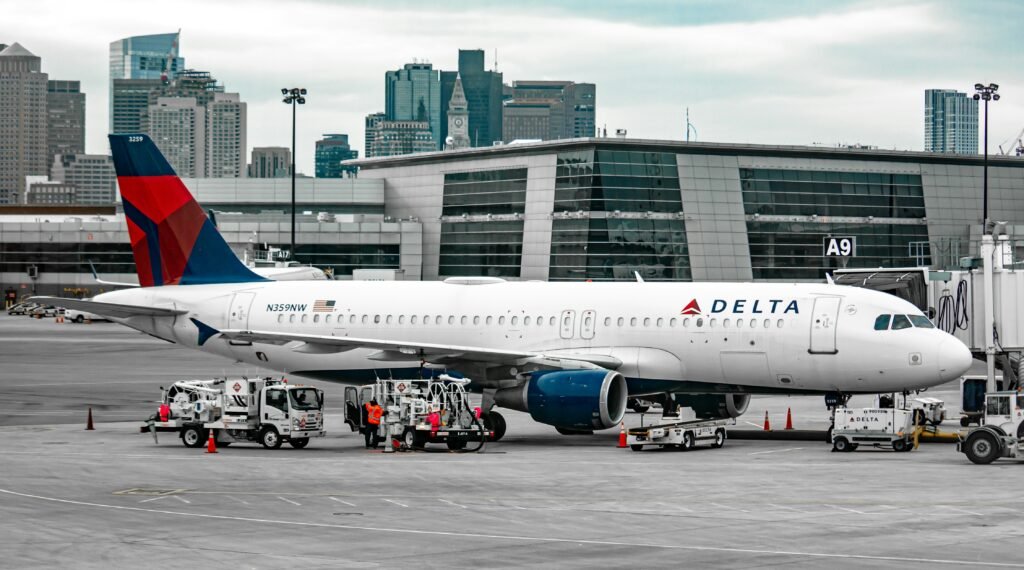
- Delta Airlines (USA): One of the most frequent questions from candidates is whether Delta is hiring for 2026. The answer is that major US carriers are actively planning their staffing needs to match the 5.2 billion global passenger forecast. Keep in mind that Delta is known for its selective process. Some candidates find it “hard to get hired” due to high standards, yet they remain top choices for those seeking a premium career.
- The North American Market: Beyond Delta, the US market is highly competitive. Many applicants are curious about the “acceptance rate” and specific “age limits” for major carriers. In 2026, the trend of “operational maturity” is crossing the Atlantic, with US airlines increasingly valuing experienced professionals to manage complex cabin environments.
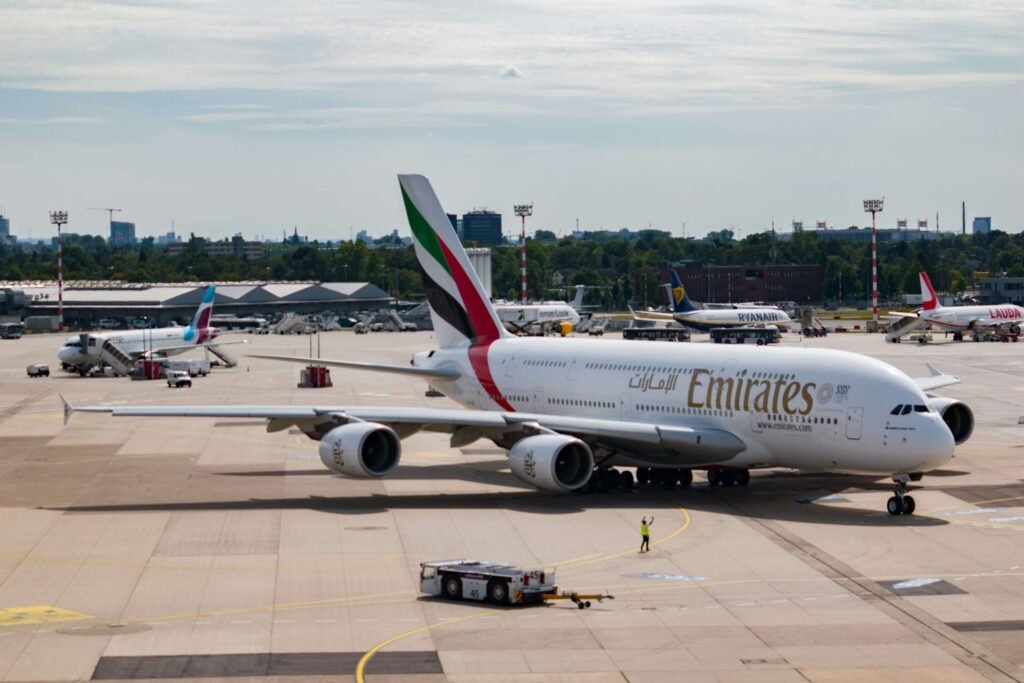
- Middle Eastern Giants (Emirates, Qatar, Etihad): These airlines continue to be the leaders in long-haul luxury. As global revenues hit the $1 trillion mark, these carriers are expanding their fleets with new wide-body aircraft, each requiring a significant increase in international cabin crew.
- Asian Expansion: With the surge in international travel, Asian carriers are also heavily recruiting to meet the demand of a decade that requires 1 million new crew members globally
- The North American Market: Beyond Delta, the US market is highly competitive. Many applicants are curious about the “acceptance rate” and specific “age limits” for major carriers. In 2026, the trend of “operational maturity” is crossing the Atlantic, with US airlines increasingly valuing experienced professionals to manage complex cabin environments.
- Middle Eastern Giants (Emirates, Qatar, Etihad): These airlines continue to be the leaders in long-haul luxury. As global revenues hit the $1 trillion mark, these carriers are expanding their fleets with new wide-body aircraft, each requiring a significant increase in international cabin crew.
- Asian Expansion: With the surge in international travel, Asian carriers are also heavily recruiting to meet the demand of a decade that requires 1 million new crew members globally.
Ready to Take Off
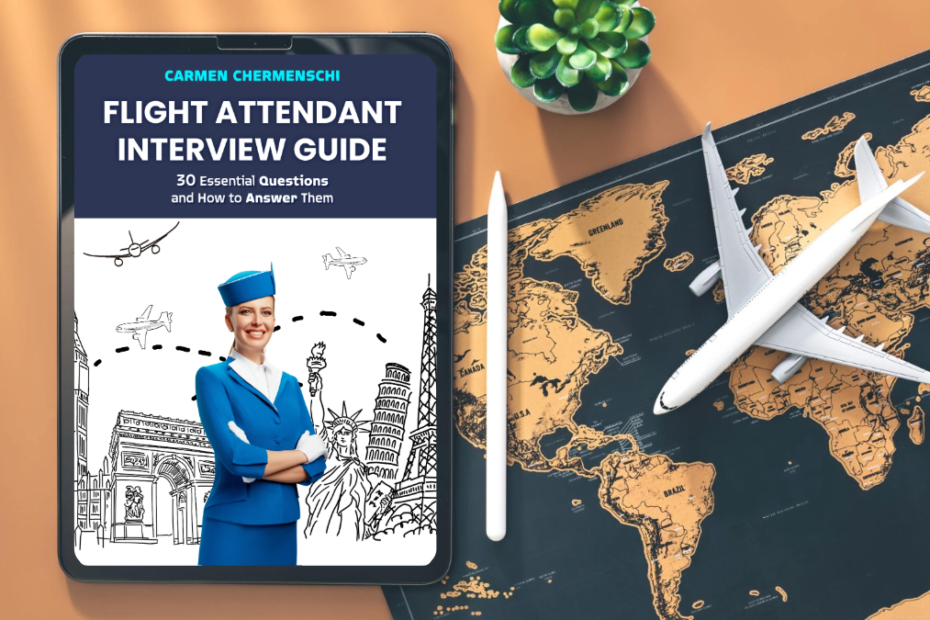
"30 Essential Questions and How to Answer Them"
It took me 5 years and plenty of mistakes to understand exactly what recruiters are looking for. I’ve put together the 30 questions and the proven answers that allowed me to finally pass my Assessment Day at 40.
Take the first step, even if you don't feel ready
You don’t have to be perfect to apply. When I started, I had no idea how complicated the process would be, and information online was scarce. I chose to move forward with my own resources anyway. I failed several interviews, but each one taught me how to improve until I reached my goal. Your dream job is waiting!