Many believe that a dazzling smile, fluent English, and a polished appearance are all it takes to ace the Assessment Day and finally earn your wings. But here is a confession – I thought the same thing when I first decided to become a Flight Attendant. And that single misconception is precisely what sent me home empty-handed… more than once.
If you are reading this, chances are you have already submitted your application, or you are obsessively checking your inbox every five minutes waiting for that life-changing invitation. I know that feeling all too well. Beyond the excitement and adrenaline, a thousand questions are racing through your mind. You are likely already visualizing yourself in that crisp uniform, pulling your crew trolley through the airport terminal.
However, there is a harsh truth that isn’t discussed enough. The vast majority of candidates get cut specifically during the Cabin Crew Group Interview, often walking away without ever knowing why they didn’t make the grade.
What No One Tells You About the Assessment Day
The Assessment Day is not just a standard job interview. It is a behavioral test meticulously designed by aviation experts and psychologists to observe exactly how you react under pressure.
If you walk into that room without knowing what they are actually measuring, you are playing a game without knowing the rules. From my online research and the dozens of emails I receive, the same issue always arises: there is a lack of clear procedure regarding what really happens behind closed doors. The web is flooded with conflicting information about the Cabin Crew Group Interview, which only creates more confusion.
Why is the Cabin Crew Group Interview So Intimidating?
Countless candidates describe the airline group task as the most daunting part of the entire Assessment Day. Not because it is technically “difficult,” but because it is unpredictable. Those who have faced it describe the feeling of walking into a room where everyone else seems more confident, more extroverted, and better prepared.
- Some fear talking too much, while others are terrified of saying too little.
- Many freeze up because they don’t know whether to take the lead or step back to let others shine. There is the constant feeling of being watched in every gesture, even when you are silent.
- Many candidates leave convinced they nailed it, only to be rejected without explanation.
- Others pass despite feeling like they barely spoke a word.
The common thread in these shared experiences is that the difficulty doesn’t lie in the exercise itself, but in not knowing what is being evaluated. Most candidates arrive perfectly prepared regarding their outfit and CV, but completely unprepared for the psychological and relational dynamics that determine the selection. It is precisely this lack of clarity that generates anxiety, confusion, and the feeling of having zero control over the situation.
Here are the 5 common mistakes you can avoid:
1. The "Shark" Trap in the Group Task
You are sitting in a circle for the Cabin Crew Group Interview. You are assigned a task (like the NASA Test, the Desert Island scenario, or another problem-solving exercise). Thirty seconds in, there is always that one person who takes control, talks over everyone else, and tries to make decisions for the entire team. Systematically, there is always one. In the recruitment world, we call this person “The Shark”.
The Most Common Mistake. Most candidates react in two equally damaging ways:
They shut down and stop speaking, becoming invisible (The “Ghost”).
They try to compete by raising their voice to overpower the Shark.
Both behaviors get you penalized. Once you are escorted out, nobody understands what the fatal error was.
What do Recruiters actually want to see? Recruiters are not looking for a boss who commands, never! They are looking for Crew Resource Management (CRM) skills, like collaboration and calm leadership. There are specific, polite, yet firm phrases (the “scripts”) that allow you to neutralize the Shark, include the quiet members of the group, and emerge as the balancing force. These are small details, but they make a massive difference in your final score.

2. The Interview Starts Before You Enter the Room (The 6-Second Rule)
I vividly remember the 5 times I attended an Assessment Day, and I saw it all. From candidates showing up at a five-star hotel with inappropriate attire and messy hair, to people so shy they wouldn’t react to any stimulus. Many believe the evaluation begins when you officially introduce yourself, but in reality, it starts the exact moment you step onto the premises (or even in the parking lot).
Remember, recruiters are constantly profiling you:
How you sit (your posture).
How do you wait?
How you interact (or ignore) other candidates.
There is a non-verbal mistake I see all the time that screams boredom, insecurity, or disinterest: using your phone. And no, it’s not just about smiling. It’s about how you occupy space, how you carry yourself, and your overall grooming and presence before you even utter your name.
3. Panic During the Individual Role Play
You survived the group task. Now you enter the room for the one-on-one interview. Suddenly, the recruiter flips a switch and transforms into an angry, aggressive, or even rude passenger. In this phase, they are not testing your English grammar; they are testing your emotional stability. If you apologize too much, you look insecure. If you quote the rules (“It is forbidden”), you seem rigid. If you react impulsively, you are out.
What works is having a clear mental framework to follow, even when your adrenaline spikes. Dealing with a difficult situation isn’t a walk in the park, but without a strategy, it is incredibly easy to get flustered.
4. Logic Tests - The Fear of Math
Currency conversions, time zones, visual logic. Many candidates walk in already terrified just at the thought of this test, whispering to their neighbor, “I am terrible at math.” But here is the truth: these psychometric and aptitude tests aren’t designed to eliminate those who miss a calculation, but those who literally freeze up when facing a problem.
Time management and anxiety control count more than the perfect result. Recruiters are evaluating your ability to work under pressure. There are small tricks to tackle these tests while remaining calm and fast, but unfortunately, no one explains them to you on the day.

5. The Simplest Question… That Eliminates the Most Candidates
“Describe yourself in one word.”
It is one of the shortest questions of the entire Assessment Day and, precisely for this reason, one of the most dangerous.
Many take it lightly, convinced it’s just an ice-breaker, or they don’t prepare for it at all because they don’t expect it. In reality, in those few seconds, the recruiter is extracting crucial data: how self-aware you are, how well you understand the role, and how concise you can be.
The Mistake of “Empty Words” Most candidates answer by instinct: “Nice”, “Sunny”, “Precise”, “Perfectionist”. These are beautiful words, sure, but they are empty of meaning for an airline. These are terms recruiters hear a hundred times a day and tell them nothing about how you react when a flight is delayed, or a medical emergency occurs on board.
Airlines are not looking for “pleasant” people. They are looking for professionals who can adapt. Choosing the right word means demonstrating you understand what working in a cabin entails. Terms like “Adaptable”, “Resilient”, or “Collaborative” speak the language of aviation. They describe a mindset, not just an abstract character trait.
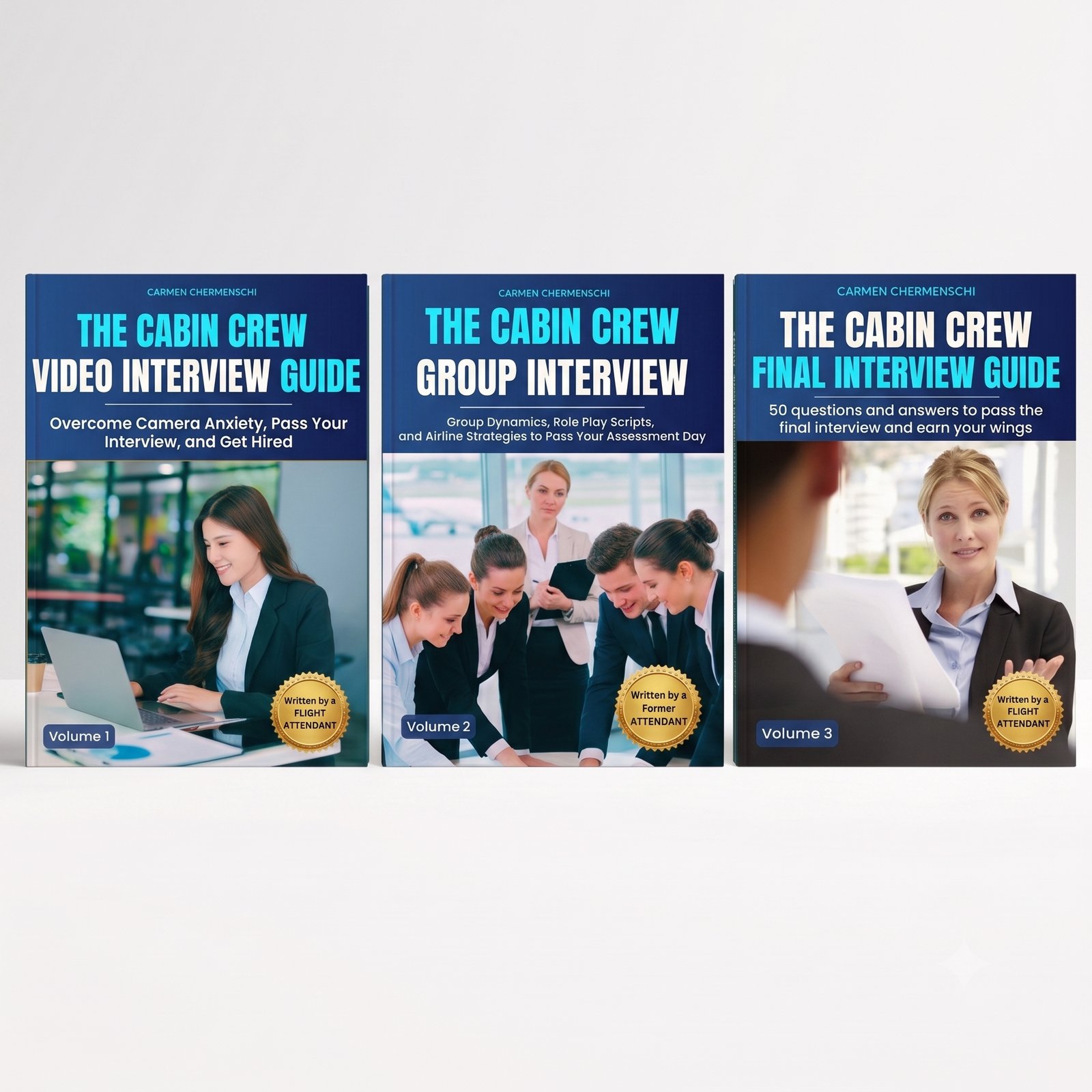
Three selection stages, one book for each
Video interview, group interview with role play, and final interview. Real questions, sample answers, and the mistakes that quietly end an application.
See the booksWant a plan built around your own application? Discover the coaching
What You Must Know Before the Assessment Day
Most candidates focus solely on the superficial aspects: the perfect outfit, flawless make-up, and a tidy CV. But the Assessment Day demands much more. It requires the ability to collaborate with total strangers, impeccable stress management, and a presence that conveys confidence.
This is precisely where many hit a wall. It’s not a lack of potential; it’s simply because no one has explained the rules of the game to them. You find yourself improvising, trying to look perfect without knowing what the recruiters are actually scoring you on.
The truth is, the Cabin Crew Group Interview is your moment to showcase your thought process and relational skills, without overpowering others (I will never stop repeating this: do NOT act like the BOSS). These are not skills you can improvise on the spot, but they become second nature when you know exactly what to expect.
Your Wings Are Closer Than You Think
I know that after reading about all these pitfalls and traps, the Assessment Day might feel like an impossible mountain to climb. It is perfectly normal to feel scared. You are investing not just your time, but your deepest hopes and dreams.
But let me tell you one thing, the Cabin Crew Group Interview is not a test for superheroes. Recruiters are not looking for perfection or robots who never make a mistake. They are simply looking for genuine people who can stay human even when the pressure mounts. The guide I mentioned is a powerful shortcut because it equips you with the technical tools, but you have to bring the heart.
Remember: whenever you feel insecure, think that I faced those rejections too. I also trembled before walking into that room. And yet, in the end, I pulled that crew trolley through airports halfway across the globe.
If you prepare methodically and stay true to yourself, no “Shark” or logic test can stop you.
See you on board! ✈️
FAQ
Because it eliminates improvisation. While 90% of candidates rely on guesswork, this guide provides the reverse engineering strategy. We start from exactly what recruiters are evaluating (the hidden checklist) and provide you with the exact scripts and game solutions to meet those specific criteria.
The actual exercise usually lasts 15 to 30 minutes, but remember: you are under strict observation for the entire Assessment Day.
They are not looking for the “correct” solution to the problem. They are assessing your Soft Skills like active listening, empathy, negotiation skills, and time management.
Strict Business Attire. A formal suit or skirt suit, impeccable grooming, and neat hair. You must convey professionalism and respect for the airline’s brand from the very first second.
Instead of trying to dominate, act as a Mediator. Involve candidates who are quiet and summarize the group’s ideas. Recruiters reward those who make the team win, not the individual “star.”
Avoid aggressive phrases like “You are wrong” or “I disagree.” Instead, use inclusive phrases like “That is a great point, and we could also add…” to build upon others’ ideas constructively.
Use breathing techniques (like Box Breathing) or positive visualization. Remember that anxiety often stems simply from a lack of preparation.
Usually, there is an immediate elimination round (often called “The Cut”). Those who pass this stage move on to the next steps, such as language tests, the individual Role Play, or the Final Interview.
Read more...
When I became a flight attendant at 40, the selection process looked nothing like it does today. I remember walking into that five-star hotel numerous times, nervous, knowing that someone would decide my future. The recruiters were right there in front of me. I could read their expressions, adjust my answers in real time – not easy, actually – and feel the energy in the room.That world doesn’t exist anymore, or at least, not in the way it used to. Young man ready for the online interview Today, before a single human being looks at you, you sit alone in your bedroom talking to a webcam and a countdown timer. Unfortunately, today the cabin crew video interview is where most candidates are eliminated, after the CV screening, which today has also evolved into an ATS system. A lot of applicants are completely lost at this point, because there is so little information about this stage. I want to change that for you. Pass the video interview The video screening is where most applicants are filtered out, often without ever knowing what went wrong. The Cabin Crew Video Interview Guide shows you how to handle camera anxiety, control your body language and record answers that read as confident on screen. See it on Amazon What a cabin crew video interview actually is It is called an asynchronous interview, or a one-way interview. Don’t expect someone to interview you, because there is no interviewer. A platform shows you a question on screen, gives you a few seconds to think, then starts recording. You usually have between sixty and ninety seconds, and in most cases you get one attempt. The two platforms you are most likely to meet are HireVue and Sonru, now part of Modern Hire. Your recording is then reviewed twice. Software analyses vocal clarity, pace, eye contact and the structure of what you said. Afterwards, a human recruiter watches the shortlisted videos for personality, warmth and cultural fit. So you are being assessed by both at once, and they are not looking for the same things. This is the reason why so many strong candidates fail here. They prepare for a conversation, but there is no one to talk to on the other side of the screen. Actually, what you are facing is a three-layer system. Software handles the first screening. A human recruiter reviews personality and fit. And only at the end, if you get there, does someone assess you in a room. Each layer looks for something different, which is why preparing for one does not prepare you for the next. The task is to be entirely yourself while still playing the game correctly, and those two things are harder to hold together than they sound. AI and Online Interviews Which airlines screen cabin crew on camera Recorded video screening is now standard across most of the industry. Here is where you are likely to meet it, and what changes between carriers. Airlines that ask you to record yourself A question appears on screen, a timer starts, and what you record is what gets judged. No interviewer, and usually one attempt. Airline What happens on camera Where it sits Emirates Emirates requirements and process Three to five recorded answers on HireVue, roughly 30 seconds to prepare and 90 to answer After the CV is screened by the applicant tracking system Qatar Airways How to become Qatar Airways cabin crew Recorded answers paired with an online English test Before any invitation to the assessment day Etihad Airways How to become Etihad cabin crew A short recorded interview built around very few questions After your online application is shortlisted Riyadh Air Riyadh Air recruitment A recording activity inside the online assessment, which candidates report can freeze without saving Early screening Ryanair Ryanair interview guide An online interview you complete whenever suits you, or a recruitment day in person instead After the personality and situational tests Aer Lingus A remote interview, reported as video in most cases and occasionally as a phone call After the numeracy, reasoning and personality tests KLM Recorded answers, taken after your English level has already been measured After the online tests and the English test TUI A virtual interview, and in some markets a recorded video of your motivation filmed on your phone Straight after the online tests flydubai A HireVue assessment with an English component Early screening Airlines where the camera works differently These stages are often described online as video interviews. They are not. Preparing for the wrong one costs you the stage. Airline What happens on camera Where it sits British Airways Ten video scenarios with multiple-choice answers. You watch, you do not record First stage, before the application form easyJet Live video calls with a recruiter on Microsoft Teams Mid-process, alongside the situational tests Wizz Air Wizz Air requirements Mostly in person at a recruitment day, with some candidates reporting a final online interview Recruitment day Whatever the airline, the format barely changes. What changes is the tone of the questions and how much weight each carrier puts on brand fit. Prepare for the format once and you are prepared for all of them. What the software is actually measuring Let me clear up a myth. The software is not reading your soul and it is not deciding whether you are a nice person. It is more interesting than that. It measures a narrow set of signals, and every one of them can be trained. Speech pace and pauses. Nervous candidates accelerate all the time, and that is normal. But be aware that a rushed delivery reads as low confidence. A short, deliberate pause reads as composure, which is exactly the quality recruiters and airlines look for in their future cabin crew. Vocal clarity. Poor audio is the most common technical failure of all. If the system cannot transcribe you cleanly, it cannot score you. Eye contact with the lens. Not the screen, not your own preview window. The lens. AnswerRead More »Cabin Crew Video Interview — How to Pass It in 2026
Quick answer To become Etihad cabin crew in 2026 you must be at least 21 years old, at least 163 cm tall, a high school graduate, and fluent in English. Etihad uses a plain height minimum with no arm-reach test. Selection runs through an online application, a video interview and an invite-only Assessment Day. New crew earn AED 10,000–14,000 per month tax-free, with free shared accommodation in Abu Dhabi. That is the short version, but if you are serious about this, the details are what separate the people who get hired from the people who go home wondering what went wrong. I have been on both sides of that door. I applied, I was rejected, and I sat there with no idea what I had done badly, because airlines never tell you. They rarely reply to rejected candidates, simply because there are so many. Later I flew, and later still I started preparing other people for the same selection. In this guide, I will walk you through every stage the way I wish someone had walked me through it. Let’s get into it. Etihad Cabin Crew Requirements in 2026 Here is exactly what you need, and I have put it all together in clear tables so you know exactly where to look. These are the current minimum requirements published on the official Etihad Careers page. Requirement Etihad 2026 Minimum age 21 at the time of application Minimum height 163 cm (about 5 ft 4 in) Arm-reach test None Education High school graduate, Grade 12 or equivalent English Fluent, written and spoken — around B2 Previous experience Not required Visible tattoos in uniform Not permitted Swimming Must be able to swim with a flotation device Base Abu Dhabi, UAE visa sponsored by the airline Age, Height and the Arm-Reach Question You must be 21 years old at the time of application, and Etihad does not publish an upper age limit. More on that further down, because it deserves its own section. The height rule is where Etihad differs from its neighbors, and where much published information is simply out of date. Surprising fact 1 Etihad has no arm-reach test, and several people have asked me why. Meanwhile, well-known cabin crew websites still state that Etihad runs a 212 cm reach test. That is no longer correct. Etihad uses a plain 163 cm height minimum, which makes it the easiest of the big Gulf carriers to self-assess. Emirates asks for 160 cm plus a 212 cm reach on tiptoes. Qatar Airways publishes no height at all and tests reach only. Etihad simply measures you. So if you are 163 cm, you meet the bar. You do not have to worry about stretching on tiptoes to touch a marked point on a wall, which is the single most stressful thirty seconds of an Emirates or Qatar assessment day. Education and English Level to Work with Etihad You need a high school diploma or equivalent. No university degree, in any subject, at any level. English must be fluent in writing and speaking. The simplest way to know whether your English is ready is to look at the level itself—around B2 is what the job requires in practice. A second language is a real advantage, and Etihad actively values bilingual candidates given the network it flies. The more languages you speak, the better your chances of getting through that first assessment. Now let me reassure you the way I reassure every person I coach. You do not need to sound like a native speaker. Recruiters know this. The airline is not hiring an English teacher. It is hiring someone who can understand a safety instruction under pressure, calm a frightened passenger, and hold a natural conversation with a stranger from any country in the world. If your English isn’t there yet, that doesn’t mean it can’t be there. It means not yet. I invested heavily in my own English before my interviews, and it was one of the best decisions I ever made. Tattoos, Grooming and Appearance This rule is stricter than most applicants assume, and, unfortunately, it catches people out every single recruitment cycle. Remember that grooming is as essential as the interview itself. I put my first effort into grooming and appearance for one simple reason. On the day itself, I did not want to be wondering whether everything was in place. I wanted every bit of attention free for the group exercise and, later, the final interview. It is not enough that a tattoo can be covered. Visible tattoos in uniform are not permitted, and a tattoo hidden with makeup or a plaster does not count as compliant. If you have a tattoo somewhere the uniform does not cover, research this carefully before you spend money traveling to an assessment day. Surprising fact 2 Etihad employs dedicated grooming officers who check crew before they board. Grooming is not a first-day formality that everyone forgets about afterwards. It is checked, routinely, for your whole career. When I applied to a low-cost airline, I saw several candidates disregard the published appearance policy, and their applications were stopped as soon as it was noticed. Nobody argued with them. Nobody gave them a second chance. Read the policy and take it literally. What Etihad Does Not Require This section exists because the aviation training industry has built a business on things you do not actually need. Surprising fact 3 Etihad is not affiliated with any cabin crew academy, and you do not need a diploma from a cabin crew school to apply. Graduates of such academies are welcome. So is everyone else who meets the published requirements. Nobody at the assessment day will ask which school you attended, and no certificate moves you forward in the process. You also do not need previous flying experience, a university degree, a specific nationality, or an expensive grooming course. What you need is to meet the requirements and to prepare properly for each stage of the selection. ThoseRead More »Etihad Cabin Crew Requirements 2026 | Salary & Process
You may not have realized this yet, but airlines do not hire when aircraft are full. They hire backward, from a training calendar decided months earlier. That is why cabin crew recruitment in Q4 matters more than ever for you if you finally want to work in Europe, the UK, or even the Gulf. A cabin crew course runs for four to six weeks, and after that, you still need line training. Work backward from a June 2027 roster, and you land in January. Work backward from a January course, and you land right here, at the application you send this autumn. Not many people know this, and that is exactly why you are reading this article. So when someone tells you the season is over, and you may as well wait until spring, they are reading the calendar upside down. The people who will be flying next summer are applying now, while everyone else waits. I see it every day with the people I coach, convinced that the start of the year is the best moment. The effort you make before the end of the year is what you will see next year, and that holds even if you do not get in on the first attempt. Think about it. You will always have time to adjust and to learn from your own mistakes, because you will keep improving. I made five attempts before I became a flight attendant at 40. So if I managed it, you can manage it too. I have no doubt about that. Cabin crew walking through the airport Why Q4 Is the Best Time to Apply in 2026 Let me share something from years in this industry that changed how I coach every single candidate. The selections happening now are the ones that feed next summer. You do not have to take my word for it because an airline is saying it out loud right now. easyJet’s careers page states that it is finalizing its cabin crew requirements for summer 2027 and is not currently recruiting. That does not mean it has stopped hiring. It means it is counting seats before it opens the doors. And at the end of August 2026, easyJet confirmed that applications would open in September for hundreds of new cabin crew roles across its UK bases for the 2027 season. That is the whole cycle, visible in public, for anyone who knows what they are looking at. This is your time to apply for the best airlines One thing has changed over the years, though, and I will say it plainly. Airlines no longer hire for a nice smile alone. Times have changed, and recruiters are looking for crew who stay clear-headed under pressure and are comfortable with different cultures and technology. And with thousands of applications arriving every week, screening software eliminates most people before a human ever sees them. That comes as news to anyone who thought it was enough to send a CV built for any old job and call it fine. Today, more than ever, knowing how to apply counts as much as knowing where to apply. Let’s start with the where. How to Read a Cabin Crew Recruitment Calendar Before the list, one thing that will save you a lot of time. Recently, I have watched too many people miss events they were perfectly qualified for, simply because they checked the wrong page at the wrong moment. A complete calendar of Q4 selections does not exist, and every airline announces on its own rhythm. For example. Ryanair Group and Lauda — publish assessment days, weeks, or months ahead and keep a permanent events page. This is the one calendar you can genuinely organize around. Wizz Air publishes about 4 to 6 weeks in advance, base by base. In practice, the page shows next month and little else. Check it weekly, not monthly. British Airways and easyJet do not run rolling open days. They open a campaign, fill it, and close it. Registering your interest between campaigns is the only way to know when the door opens. Emirates and Qatar Airways — publish month by month, worldwide, with new cities appearing constantly. There is no annual calendar to wait for. And here is the part I want you to take seriously. Several Wizz Air events this autumn closed early, with registration shut because too many people applied. Pristina, Santiago de Compostela, and Brasov, among others. Registering the same day an event appears is the most sincere piece of advice I can give you. That is exactly why I am building a calendar of the airlines that are hiring, kept up to date, so you will know where to find the right information for your application. Before that, save these links and check them every week. Ryanair Group recruitment events — careers.ryanair.com/recruitment-events Wizz Air recruitment days — careers.wizzair.com easyJet cabin crew — careers.easyjet.com British Airways cabin crew — careers.ba.com/cabin-crew Confirmed Q4 2026 Dates and Campaigns These are published as I write. Treat it as a snapshot of what each airline is doing this quarter, and always check the official page before you travel anywhere. Ryanair Group — assessment days confirmed in October across the network, including Palma de Mallorca on 1 October, Edinburgh on 2 October, Vienna on 6 October, Zagreb on 27 October and Zadar on 29 October. Ryanair openly states that these selections are for the autumn and winter months. easyJet — the summer 2027 campaign is the story of the quarter. Applications open from September for the UK bases, and in France, an expression of interest is already live. British Airways — the Cabin Crew Talent Pool is open now. It is not a job ad; it is the pool BA draws from first when a requirement arises. Wizz Air — recruitment days continue in almost 30 European locations, with Italian bases including Rome, Milan, Naples, Catania and Venice. Dates appear about a month ahead. Emirates and Qatar Airways — Open DaysRead More »Which Airlines Are Hiring Cabin Crew | Q4 2026