As someone who has spent years navigating the skies and ensuring passengers have the best experience possible, I can tell you firsthand – it’s a job like no other.
In this article, I am gonna tell you how to become a flight attendant in 2026 with no experience.
We are not waitresses in the sky
Let me share a bit about what it’s like and how you can turn those dreams of being a high-flying, globe-trotting professional into a reality. There’s much to cover, from the initial training to those first moments in the air. It’s not just about serving drinks and snacks; it’s reductive to think like that! It’s about mastering the art of hospitality, ensuring safety, and sometimes even serving as a travel guide.
So, if you’re ready to swap your 9-to-5 for the excitement of a career where no two days are the same, join me as we delve into the steps you need to take to become a flight attendant. Trust me, it’s an adventure worth embarking on!

Step 1: Meet the Basic Requirements
First, meet the basic requirements. Most airlines require you to be at least 18 years old, have a high school diploma or equivalent, and be proficient in English. You can become a flight attendant with no experience! Some airlines may have height and reach requirements to ensure you can perform your duties safely.
Surprising Fact: “Did you know? Some airlines allow flight attendants to start their careers as young as 18, while others prefer candidates with some college education or customer service experience.
Step 2: Polish your resume
Next, it’s time to polish your resume. This document is your first impression, so make it count! Highlight any customer service experience, as airlines value candidates who excel in interacting with passengers and addressing their needs. Language skills are a huge plus, especially if you speak multiple languages, as this can be beneficial for international flights.
Surprising Fact: “Did you know? Some airlines have specific preferences for additional languages spoken by their flight attendants based on their route networks. For instance, airlines operating many routes to South America might prioritize candidates fluent in Spanish or Portuguese.”
Anyway, relevant certifications also play a crucial role. If you have certifications in First Aid, CPR, or any other safety training, be sure to include them. These qualifications show that you are prepared to handle emergency situations.
Airlines are looking for candidates with strong interpersonal skills. This means being able to communicate effectively, work well in a team, and handle conflicts or stressful situations with grace. Your resume should also reflect a professional appearance. Consider including a professional photo if the application process requires one, and make sure your overall presentation is neat and polished.
Step 3: Apply to Airlines
Apply to airlines that hire for 2026. Visit the career sections of airline websites to find open positions. Tailor your application to each airline, emphasizing why you’d be a great fit for their team.
Step 4: Ace the Interview
Next, ace the interview. Airlines often conduct multiple rounds of interviews, including group interviews and one-on-one sessions. Practice common interview questions, and showcase your enthusiasm, customer service skills, and ability to work in a team.
Surprising Fact: the interview process for flight attendants can include role-playing scenarios to test how you’d handle in-flight situations. Being calm and resourceful is key!
And stay tuned, because in our next video, we’ll dive deep into how to ace the flight attendant interview. We’ll cover everything from common questions to best practices, ensuring you’re fully prepared to impress your future employers. Don’t miss it!
Top Flight Attendants Schools in the USA and Europe
To help you get started, here are some of the best flight attendant schools in the USA and Europe:
USA
Higher Power Aviation(HPA) is known for its comprehensive training programs, HPA specializes in preparing students for various aviation careers, including flight attendant training.
Sinclair Community College offers an Associate Degree in Aviation Technology with a focus on flight attendant training, combining academic coursework with hands-on experience.
Academics of Flight offers various aviation training programs, including flight attendant courses designed to meet industry standards.
Cypress College features a robust aviation and travel careers program that includes flight attendant training, helping students prepare for successful careers in the airline industry.
The Travel Academy focuses on travel and tourism education, offering flight attendant training that includes practical exercises and job placement assistance.
The Airline Academy partners with major airlines to provide comprehensive flight attendant training, including safety procedures and customer service skills.
Pan Am International Flight Academy provides aviation training programs, including flight attendant courses that cover safety protocols and in-flight service techniques.
Flight Simulation Company is known for its advanced simulation training. This company offers practical flight attendant courses focusing on emergency procedures and customer service.
Europe
Active Aviation Training offers customized flight attendant courses tailored to individual needs.
Heathrow Aviation Academy, located near one of the world’s busiest airports. This academy provides flight attendant training focusing on real-world applications and industry connections.
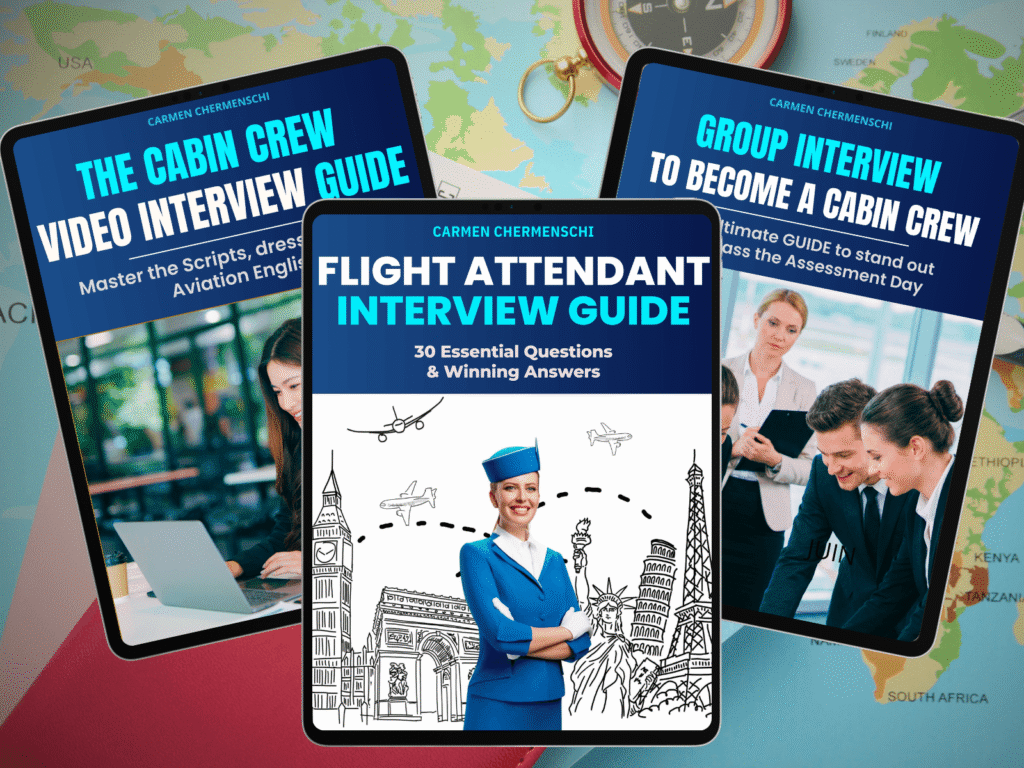
Ready to Take Off
BUNDLE
It took me 5 years and plenty of mistakes to figure out exactly what recruiters want.
Now, I’ve bundled the essential resources you need to pass every stage of the recruitment process and earn your wings as a flight attendant.
Step 5: Complete Training
Complete training. Once hired, you’ll undergo several weeks of intensive training. This includes learning safety procedures, emergency protocols, customer service skills, and more. Training is often conducted at the airline’s training facility.
Surprising Fact: Did you know? Some airline training programs are so rigorous that they have a higher dropout rate than some university courses! This intense training ensures that flight attendants are thoroughly prepared to handle any situation that arises in the air.
Step 6: Pass Certification Exams
Pass certification exams. To become a fully qualified flight attendant, you’ll need to pass both written and practical exams. These tests ensure you can handle emergency situations and provide excellent service to passengers.
Step 7: Start Flying
Start flying. After completing training and exams, you’ll receive your wings and start your career as a flight attendant. Expect to work on flights, including domestic and international routes.
Surprising Fact: “Did you know? On your very first flight as a flight attendant, you’re often in a supernumerary status, meaning you’re there to observe and support but not as part of the official crew. And the catch? This first flight is usually unpaid! It’s all about gaining hands-on experience before you fully dive into your new role.
A bonus surprising Fact: As a new flight attendant, you may be on reserve duty, meaning you’re on-call to fill in for regular crew members who are sick or on vacation. Flexibility is key! Let me know in the comments what do you think about staying to do nothing and still getting paid!
Step 8: Build Your Career
Build your career. With experience, you can advance to senior flight attendant positions, become a purser, or transition to roles in training or management. Airlines often offer opportunities for growth and development within the company.
Surprising Fact: Did you know? Some flight attendants go on to become airline executives! For example, Ed Bastian, the CEO of Delta Air Lines, started his career in the airline industry in the finance department but worked closely with flight operations and cabin crews, proving that the sky’s the limit for career advancement in aviation.

If you’re interested in other aviation careers, check out our comprehensive guide on various aviation roles.
Conclusion
Becoming a flight attendant in 2026 is an exhilarating adventure and a passport to a rewarding career. It was an amazing journey for me because I tried five times before finally achieving what I wanted more than anything – to earn my wings for flying.
With each step, I hope you’ve found a clear runway to lift your dreams off the ground. Embrace the thrill of new horizons, the joy of connecting with passengers, and the endless opportunities for personal and professional growth. Remember, the key ingredients are dedication, passion, and a commitment to continuous learning. Keep your spirit of adventure alive and let your journey in the skies begin!
If you enjoyed this article, you might also like:
If 2025 was the year of industry recovery, 2026 is officially the year of the “Great Aviation Expansion.” We’ve already entered the first quarter of the year, and the aviation job market is experiencing phenomenal growth. We are witnessing an unprecedented recruitment wave, in my opinion, the strongest of the past decade, with airlines worldwide urgently searching for cabin crew ahead of a record-breaking summer season. Let’s say that the difficult years are behind us, and airlines are finally moving forward. After our recent deep dive into How to Become a Flight Attendant in 2026, it’s time to get practical and take a closer look at who is actually hiring right now. Look, from those fancy Middle Eastern airlines to the huge European low-cost carriers and major US airlines, they’re all desperately looking for people. Cabin crew walking through the airport 2026 is the Year of the “Great Aviation Expansion.” That said, the rules of the game have evolved. At the start of 2026, airlines are no longer looking only for a great smile. They are searching for “Next-Gen Cabin Crew”. They are looking for professionals who are tech-savvy, culturally aware, and ready to help build a more sustainable future for aviation. Yes, society is changing, and this is only the beginning. But with thousands of applications flooding recruitment portals every single week, how can you make sure your CV gets past AI-based screening systems? In this Q2 Hiring Round-Up, we go straight to the point. We analyse the latest recruitment timelines and insider updates to highlight the most promising opportunities available right now. If your goal is to be in uniform by spring, your journey starts here. Which Airlines Are Still Hiring Flight Attendants in Q2 2026? If you are reading this article in April or May 2026, we have great news – you are still in time. The recruitment wave that defined Q1 2026 is carrying straight into Q2, and in many ways, this is the most strategic moment to apply. Airlines are now in their final push to have new cabin crew fully trained and ready before the summer peak season kicks in. What does this mean for you? In practical terms, the urgency on their side is even higher than it was in January. Here is what is confirmed for Q2 2026: Ryanair has Assessment Days scheduled through April and May across Europe, including Stansted (27 April). Training remains fully funded, with a daily allowance throughout the 6-week course. Wizz Air is running Recruitment Days in London Luton (15 April), London Gatwick (30 April), Sofia (2 April), and Varna (16 April) Emirates continues its Open Day campaign — no invitation required at most events. Check the official Emirates Group Careers page for updated dates in your area. Qatar Airways CV Drop events are actively ongoing. If you haven’t applied yet, now is the time. Riyadh Air is accelerating its massive global recruitment drive as they prepare for its highly anticipated operational launch. Throughout Q2, they are hosting exclusive Global Cabin Crew Recruitment Events across multiple cities worldwide, including recent and upcoming stops in Barcelona, Belgrade, Athens, Baku, and São Paulo. Think about it this way: if your goal is to be in uniform for the summer season, you need to start your application this week — yes, right now as you read this. Airlines hiring today will begin training courses in April and May, putting you in the air by late June or July. Like so many things in this fast-moving era, the window is still open. But it’s closing faster than you think. Emirates – The Leader in Cabin Crew Recruitment for 2026 Emirates plane landing Emirates has officially launched one of its most ambitious recruitment campaigns ever for the first quarter of 2026. To support the arrival of its new Airbus A350 fleet, the Dubai-based airline is looking to hire thousands of new cabin crew members to join its truly multicultural team. In early 2026, Emirates is prioritising Open Day recruitment events. Why? They are the most accessible way to get hired. In many cases, no invitation is required. You can bring your CV. Emirates Cabin Crew Requirements – 2026 Minimum age: 21 years old at the time of joining Reach test: Ability to reach 212 cm on tiptoes to safely access emergency equipment Education: High school diploma (Grade 12 or equivalent) Languages: Fluent English (spoken and written). Multilingual candidates have a strong advantage in the 2026 selection process Grooming: No visible tattoos while wearing the Emirates cabin crew uniform (cosmetic coverings or makeup are not permitted). Emirates is particularly strict on this policy For the 2026 intake, Emirates has shifted its focus strongly towards Cultural Intelligence. What does it mean? With Dubai as your base and flights to over 150 destinations, recruiters carefully assess your ability to work with colleagues from more than 160 nationalities. While this is important across the industry, Emirates places particular emphasis on it. MY ADVICE: highlight any hospitality experience on your CV. Emirates is investing heavily in candidates with a strong service background. If you’ve worked in luxury hotels, premium retail, or customer service roles, make sure these soft skills are clearly visible, ideally near the top of your CV. Emirates Selection Process – 2026 Open Day / Online Application: Initial screening of your CV and grooming standards Group Assessment: Practical exercises to evaluate teamwork and problem-solving skills English test & reach test: Verification of technical requirements Final Interview: Often conducted using a hybrid model (in person or via high-definition video interview) Qatar Airways – The World’s Best Airline Is Hiring Good news – in 2026, Qatar Airways continues to dominate global rankings as “The World’s Best Airline.” The company consistently stands out for its exceptional service standards, strong focus on staff wellbeing, and, above all, outstanding passenger experience. Following the recent expansion of Hamad International Airport (DOH), Qatar Airways has entered a primary recruitment phase to staff its new Boeing 787 and 777-X aircraft. What makes Qatar Airways unique in 2026?Read More »Which airlines are hiring flight attendants for Q2 in 2026
Do you know what the most exciting thing happening in aviation right now is? An airline that didn’t even exist in 2022 is already hiring cabin crew worldwide, running recruitment events from Algiers to Colombo, and directly challenging Emirates and Qatar Airways on their own turf. I’m talking about Riyadh Air. And if you’re reading this, you’re probably already thinking about applying. As a former flight attendant and as an aviation career coach, I’ll be honest with you. Rarely in the history of commercial aviation has an opportunity like this appeared. A brand-new airline, backed by virtually unlimited state funding, building its crew from scratch, this is a once-in-a-generation moment. In this article, I’m breaking down everything you need to know about Riyadh Air cabin crew recruitment in 2026. What are the real requirements (no sugarcoating, lol), the salary figures, and the training? Also, we’ll talk about the mistakes that get candidates eliminated before they even get started. Riyadh Air Flight Attendants in front of the airplane Surprising Facts About Riyadh Air Nobody Talks About Before we dive into the recruitment process, let me share three things about this airline that literally blew my mind. Remember that understanding who Riyadh Air is will make your entire application stronger. It’s 100% owned by Saudi Arabia’s Public Investment Fund (PIF) – the same sovereign wealth fund that bought Newcastle United, is building Neom (the futuristic city in the desert), and has a budget that is, for all practical purposes, unlimited. Riyhad Air’s Aircrafts The first aircraft in the fleet is named Jamila, which means beautiful in Arabic. It’s a Boeing 787-9 Dreamliner that inaugurated the Riyadh-London Heathrow route in 2025 in a soft-launch phase (employees and families only) to test all systems before the full public launch in 2026. The fleet order is staggering: 60 Airbus A321neo, 25 Airbus A350-1000, and 39 Boeing 787-9. That means thousands of cabin crew positions will open over the next few years. The airline’s goal is to connect the Kingdom to over 100 destinations across 6 continents as part of Saudi Vision 2030, which aims to attract 150 million visitors per year to the country. Everything You Need to Know About Riyadh Air Cabin Crew Requirements The number one question I get asked every other day is: Carmen, can I actually make it through the selection? My answer is always the same, and I have written many articles on this. It depends on how prepared you are. So, here’s what this airline is really looking for. Physical Standards for Aspiring Riyadh Air Cabin Crew Minimum height: 160 cm, with an arm reach of 212 cm on tiptoes. You need to reach the overhead bins and safety equipment, so start practicing your stretch! No visible tattoos in uniform, no visible piercings. Every worldwide airline is strict on this requirement Swimming ability required with a flotation device. This is a safety requirement, not an excuse to eliminate you GACA Medical Examination: Once you clear the recruitment process, you’ll undergo a full medical check by the General Authority of Civil Aviation Education and Experience High school diploma as a minimum. It is the standard across Middle Eastern carriers Full fluency in English, spoken and written. It’s the airline’s working language, and additional languages are a significant advantage At least 1 year of experience in hospitality or a customer-facing role Ab Initio candidates welcome: No previous cabin crew experience? You can still apply if you can demonstrate what Riyadh Air calls Obsessive Hospitality (a natural vocation for service) Is 40 Too Old to Be Cabin Crew? I see this question everywhere online: Is 40 too old to be a cabin crew? Can I become a cabin crew at 40? What is the age limit for cabin crew in Riyadh? Let me say this clearly – there is no strict upper age limit at Riyadh Air. As I’ve already written in many other articles on this website, there is no age limit across the aviation industry, and Riyadh Air is no exception. In fact, the airline actively recruits professionals aged 40 and 41 for exactly the qualities that come with experience – emotional maturity, composure under pressure, and the ability to handle high-net-worth travelers with class. When you’re flying premium routes, and your passengers are executives and dignitaries, life experience is a competitive advantage, not a liability. So if you’re 41 and hesitating, stop hesitating – the dream of becoming a flight attendant is open to everyone serious about aviation. The Skills Riyadh Air Is Looking for in 2026 Clearing the basic requirements is just the entry ticket. Now, what actually separates candidates who get through from those who get eliminated are these three qualities: Digital Fluency – Riyadh Air was born digital – no paper in the cabin, AI concierge services, and advanced in-flight entertainment systems. If technology makes you nervous, start getting comfortable with it now. Cultural Intelligence – You’ll be working alongside colleagues from dozens of nationalities and serving passengers from every corner of the world. Genuine cross-cultural sensitivity can’t be faked in an interview room. Pioneer Mindset – Being among the first cabin crew of a brand-new airline means dealing with procedures that change, processes still being built, and constant evolution. If you thrive in dynamic environments, say so, loudly. 💡 Coach Tip Don’t just list these qualities on your CV or in your interview. Bring concrete examples. If you need help articulating your experience for Middle Eastern carriers, my Interview Guide with 30 Questions and How to Answer Them ebook is the result of 5 Assessment Days and the determination it takes to become a cabin crew member. 2. How the Riyadh Air Recruitment Process Works in 2026 Let me be straight with you, the Riyadh Air recruitment process is not quick. Candidates who have gone through it report timelines ranging from 3 to 6 months from application to onboarding date. If you’re looking for a job that starts next Monday, this isn’t it. But if you’re serious about building a career at one of the most excitingRead More »Riyadh Air Cabin Crew Recruitment in 2026
Becoming an Emirates flight attendant is a highly sought-after career today, but the competition is fiercer than ever. Emirates hosts numerous selection days because it receives a massive volume of applications, yet its standards remain incredibly high. The airline has a mysterious aura that makes it one of the most selective in the world. Surely, you have crossed paths with their astonishing flight attendants at the airport and wondered if they stepped out of a fairy tale – perfectly groomed, always smiling, and radiating an elite standard of professionalism. If you are planning to apply in 2026, you need to know exactly what the recruiters are looking for. Like many other airlines, Emirates has updated its approach to selection to align with today’s global standards. Here is the official, confirmed list of Emirates cabin crew requirements for 2026, taken straight from the airline’s recruitment guidelines. Alongside these rules, I have included my insider coaching tips to help you stand out from the crowd. Emirates cabin crew walking through the airport A Note on Safety and Global Stability in 2026 Given the current geopolitical climate and recent headlines about the Middle East, it is perfectly natural to ask whether it is safe to move to Dubai and work as a flight attendant right now. The answer is a resounding yes. Dubai consistently ranks among the safest and most politically stable cities in the world, largely due to its status as a major global economic and tourism hub. Furthermore, Emirates has an uncompromising approach to crew security. The airline employs elite risk-assessment teams and instantly reroutes or suspends flights at the slightest hint of danger. When you wear the Emirates uniform, you are backed by a company that prioritizes your physical safety and well-being above all else. This guarantees a highly secure environment, whether you are on the ground or in the air. You can be sure that you are protected and safe as an Emirates cabin crew member. The Official Emirates Cabin Crew Requirements in 2026 Everybody wants to become Emirates cabin crew, but before you submit your CV or attend an Open Day, you must meet these non-negotiable criteria set by the Emirates Group: Age: You must be at least 21 years old at the time of joining (you can apply slightly before, but must be 21 when training starts). Height & Reach: A minimum height of 160 cm (5’2”) and the ability to reach 212 cm (6’11”) while standing on tiptoes. This is a strict safety requirement to reach emergency equipment. Language Skills: Fluency in written and spoken English is mandatory. Additional languages are a significant advantage. Education: A minimum of a high school diploma (Grade 12) or equivalent. Experience: At least 1 year of hands-on experience in hospitality or customer service. Appearance: No visible tattoos while wearing the Emirates cabin crew uniform (covering them with bandages or makeup is not permitted). Relocation: You must be willing to relocate to Dubai, UAE, and be able to meet the UAE’s employment visa requirements. What Emirates Really Wants Beyond the Resume Meeting the basic physical and educational requirements gets your foot in the door, but your personality is what ultimately secures the job. It is already known that in 2026, the Emirates cabin crew recruitment process will focus heavily on psychological and behavioral profiling. Today, recruiters are no longer just looking for a friendly smile, as was the case in the past. They are actively hunting for a natural team player attitude. Now, I am going to give you a surprising fact: with over 20,000 cabin crew members currently employed, it is mathematically possible to fly for an entire year without working with the same crew twice. This is also true for major low-cost airlines. When I was flying, I only had the chance to work with the same crew team about once a month. Imagine how much rarer it is for a massive company like Emirates! This means your adaptability is constantly tested. You must prove during the assessment that you can build instant rapport and establish trust with absolute strangers in a matter of minutes, a skill that goes far beyond basic politeness. What Does It Mean to Have Cultural Awareness for a Global Passenger Base? Equally critical is a deep sense of cultural awareness. Serving a highly diverse global passenger base is not just about knowing different dietary requirements. On a standard Emirates A380 flight, you might have passengers from 50 different countries onboard. That is why recruiters want to see empathy in action. They will test your ability to handle a misunderstanding caused by a language barrier. You will also be evaluated on how you adapt your communication style to respect different cultural norms, such as personal space or eye contact. The Importance of Resilience as You Plan to Become a Cabin Crew Member Finally, they are screening heavily for resilience. The aviation lifestyle is undeniably glamorous, but the physical reality is demanding. Many candidates do not realize that pushing a fully loaded meal cart up an incline aisle during turbulence requires significant physical stamina. I was injured in the past, not in the airport, but in Paris, while walking, and I had to stay for a long period without flying. When I came back, my resilience wasn’t the same anymore, and I remember the pain when pushing the heavy meal cart through the aisle. You must be able to handle aggressive jet lag, back-to-back night flights, and high-pressure medical emergencies at 40,000 feet, all while maintaining a positive, solution-oriented mindset. Showing recruiters that you have realistic expectations about the fatigue and the rigorous schedule will immediately set you apart from candidates who are only focused on layovers in the Maldives. You will be completely absorbed by your job – believe me, I know what I am saying! An Emirates aircraft maneuvering on the tarmac The 2026 Emirates Application Process Emirates is continuously updating its hiring funnel to handle the massive volume of global applicants. HereRead More »Emirates Cabin Crew Requirements 2026 – The Official Guide