


Becoming an Emirates flight attendant is a highly sought-after career today, but the competition is fiercer than ever.
Emirates hosts numerous selection days because it receives a massive volume of applications, yet its standards remain incredibly high. The airline has a mysterious aura that makes it one of the most selective in the world. Surely, you have crossed paths with their astonishing flight attendants at the airport and wondered if they stepped out of a fairy tale – perfectly groomed, always smiling, and radiating an elite standard of professionalism.
If you plan to apply in 2026, you need to know exactly what recruiters are looking for. Like many other airlines, Emirates has updated its approach to selection to align with today’s global standards. Here is the official, confirmed list of Emirates cabin crew requirements for 2026, taken straight from the airline’s recruitment guidelines. Alongside these rules, I have included my insider coaching tips to help you stand out from the crowd.

A Note on Safety and Global Stability in 2026
Given the current geopolitical climate and recent headlines about the Middle East, it is perfectly natural to ask whether it is safe to move to Dubai and work as a flight attendant right now.
The answer is a resounding yes. Dubai consistently ranks among the safest and most politically stable cities in the world, largely due to its status as a major global economic and tourism hub. Furthermore, Emirates has an uncompromising approach to crew security. The airline employs elite risk-assessment teams and instantly reroutes or suspends flights at the slightest hint of danger. When you wear the Emirates uniform, you are backed by a company that prioritizes your physical safety and well-being above all else. This guarantees a highly secure environment, whether you are on the ground or in the air.
You can be sure that you are protected and safe as an Emirates cabin crew member.
The Official Emirates Cabin Crew Requirements in 2026
Everybody wants to become Emirates cabin crew, but before you submit your CV or attend an Open Day, you must meet these non-negotiable criteria set by the Emirates Group:
- Age: You must be at least 21 years old at the time of joining (you can apply slightly before, but must be 21 when training starts).
- Height & Reach: A minimum height of 160 cm (5’2”) and the ability to reach 212 cm (6’11”) while standing on tiptoes. This is a strict safety requirement to reach emergency equipment.
- Language Skills: Fluency in written and spoken English is mandatory. Additional languages are a significant advantage.
- Education: A minimum of a high school diploma (Grade 12) or equivalent.
- Experience: At least 1 year of hands-on experience in hospitality or customer service.
- Appearance: No visible tattoos while wearing the Emirates cabin crew uniform (covering them with bandages or makeup is not permitted).
- Relocation: You must be willing to relocate to Dubai, UAE, and be able to meet the UAE’s employment visa requirements.
What Emirates Really Wants Beyond the Resume
Meeting the basic physical and educational requirements gets your foot in the door, but your personality is what ultimately secures the job. It is already known that, in 2026, Emirates’ cabin crew recruitment process will focus heavily on psychological and behavioral profiling. Today, recruiters are no longer just looking for a friendly smile, as they did in the past. They are actively hunting for a natural team player attitude.
Now, I am going to give you a surprising fact: with over 20,000 cabin crew members currently employed, it is mathematically possible to fly for an entire year without working with the same crew twice. This is also true for major low-cost airlines. When I was flying, I only had the chance to work with the same crew team about once a month. Imagine how much rarer it is for a massive company like Emirates!
This means your adaptability is constantly tested. You must prove during the assessment that you can build instant rapport and establish trust with absolute strangers in a matter of minutes, a skill that goes far beyond basic politeness.
What Does It Mean to Have Cultural Awareness for a Global Passenger Base?
Equally critical is a deep sense of cultural awareness. Serving a highly diverse global passenger base is not just about knowing different dietary requirements. On a standard Emirates A380 flight, you might have passengers from 50 different countries onboard. That is why recruiters want to see empathy in action. They will test your ability to handle a misunderstanding caused by a language barrier. You will also be evaluated on how you adapt your communication style to respect different cultural norms, such as personal space or eye contact.
The Importance of Resilience as You Plan to Become a Cabin Crew Member
Finally, they are screening heavily for resilience.
The aviation lifestyle is undeniably glamorous, but the physical reality is demanding. Many candidates do not realize that pushing a fully loaded meal cart up an incline aisle during turbulence requires significant physical stamina. I was injured in the past, not in the airport, but in Paris, while walking, and I had to stay for a long period without flying. When I came back, my resilience wasn’t the same anymore, and I remember the pain when pushing the heavy meal cart through the aisle.
You must be able to handle aggressive jet lag, back-to-back night flights, and high-pressure medical emergencies at 40,000 feet, all while maintaining a positive, solution-oriented mindset. Showing recruiters that you have realistic expectations about the fatigue and the rigorous schedule will immediately set you apart from candidates who are only focused on layovers in the Maldives.
You will be completely absorbed by your job – believe me, I know what I am saying!

The 2026 Emirates Application Process - Two Routes In
Emirates recruits through two different channels, and they don’t work the same way. You can apply online and wait to be invited, or you can walk into an Open Day and be assessed on the spot. The stages differ, the pressure differs, and the preparation differs. So, knowing which route you’re on is the first strategic decision you make — long before you meet a recruiter.
Route 1: The Online Application
I noticed that Emirates is continuously updating its hiring funnel to handle the massive volume of global applicants. Here is what to expect during the current evaluation stages.
Step 1: The Online Application and ATS Screening
Currently, the first hurdle is the Online Application. Submitting an up-to-date CV in English, along with professional photographs, may seem simple, but here is the catch: your application is initially screened by an Applicant Tracking System (ATS). If your CV uses overly complex formatting, graphics, or fails to include specific hospitality keywords, the algorithm may reject it before a human recruiter ever sees it. A clean, standard layout tailored exactly to the Emirates guidelines is your safest ticket to the next round.
💡 Coach Tip: If you need to know how to craft an ATS-proof CV to maximize your chances of getting through this first filter, which eliminates 90% of candidates before they even see a recruiter, make sure to check out my Resources page here.
Step 2: The HireVue Video Interview
If your profile passes the initial screening, you will be invited to the Video Interview (HireVue). This is a critical and often misunderstood stage. It is an on-demand, interactive video assessment in which you receive situational prompts and have only seconds to prepare your answer before the camera starts recording. What most applicants do not know is that you are not just being judged on what you say, but on your pacing, tone of voice, and ability to maintain eye contact with the lens under time pressure.
Treating this like a standard FaceTime call is the number one reason candidates fail. This requires specific, rehearsed on-camera techniques.
Step 3: The Live Assessment Day
If you master the digital interview, you’re invited to the highly anticipated Assessment Day. This live event includes group exercises, an English proficiency test for non-native speakers, height and reach checks, and a 1-on-1 interview. The secret to surviving the group exercise is often counterintuitive.
If you want to go deeper into the GROUP INTERVIEW on Assessment Day, I’ve put everything I know into a complete guide — you can find it here.
Always remember that assessors are often watching your body language while others are speaking, not just when you have the floor. They are looking for active listening, encouraging nods, and graceful handling of disagreements, effectively testing your future cabin dynamics in real time. Recruiters are psychologists.
Route 2: The Open Day

The Open Day is the in-person route, with no invitation and no waiting for you. You will arrive, and the assessment will begin the moment you walk through the door. Knowing what recruiters are looking for at each stage allows you to prepare intentionally rather than relying on luck.
Phase 1 — CV Drop
The CV Drop is often underestimated, yet it’s one of the most decisive moments of the entire day. In just a few seconds, recruiters form their first impression, and that impression often determines whether you’ll move forward. At this stage, what matters is not the CV itself but how you present yourself. Your smile should feel natural, your posture open and confident, and your energy calm but engaged. A short, well-structured introduction works best.
To give you an example:
Good morning, my name is Roxana. I have three years of experience in luxury hospitality, and I’m passionate about delivering high-level service to international guests.
You see? No long explanations. On the other hand, in this phase, your presence communicates more than your words.
Phase 2 — Group Assessment
Once you pass the CV Drop, you’ll enter the Group Assessment. Actually, this is the phase that has evolved the most in recent years. In 2026, Emirates shifted its focus to how candidates interact, collaborate, and think under pressure. Scenarios are now highly realistic and closely tied to onboard situations, reflecting “real life onboard”. You may be asked to discuss how to handle a demanding passenger, a cabin conflict, or a service issue during a long-haul flight.
For example:
A business passenger on an A350 is unhappy with their assigned seat and raises their voice, creating tension in the cabin. How do you react?
In these exercises, recruiters closely observe the process. They will evaluate how you listen, how you involve others, and how you balance empathy with company procedures. What Emirates values most in this phase is active listening, calm behavior under stress, respect for procedures, and team-oriented thinking.
NOTE: Trying to dominate the discussion or position yourself as the hero is one of the fastest ways to fail. Emirates looks for professional collaborators, not individual performers.
Phase 3 — English Test
The English test is designed to reflect real-life on-board conditions. It does not assess academic grammar or complex vocabulary, but your ability to communicate clearly and naturally in operational situations. Recruiters want to know how you would deal with emergencies on board.
For example, you may face:
- Role plays with recruiters
- Immediate situational questions
- Difficult passenger scenarios
- Medical emergency simulations
I can tell you that what makes the difference here is spontaneity. Candidates who rely solely on textbook English often freeze, whereas those accustomed to honest conversations respond more confidently and naturally. Speak naturally because you can have surprises.
The Final Interview
The final interview is competency-based, and it follows the STAR method (Situation, Task, Action, Result). Recruiters want concrete examples drawn from your real experience. Remember! Always be natural!
Typical questions include:
- Tell me about a time you handled a difficult customer.
- How do you work in a multicultural team?
- Why Emirates and not another airline?
- Describe a conflict with a colleague and how you resolved it.
My Advice
Prepare four or five strong STAR examples in advance. Choose situations in which you managed conflict, worked with diverse cultures, or exceeded service expectations. Candidates who answer with “Normally I would…” instead of “Once, when…” rarely progress. The hard part isn’t knowing the STAR method — it’s having the right story ready when the question lands. That’s why I wrote The Cabin Crew Final Interview: fifty questions, fifty answers, and the reasoning behind each one.
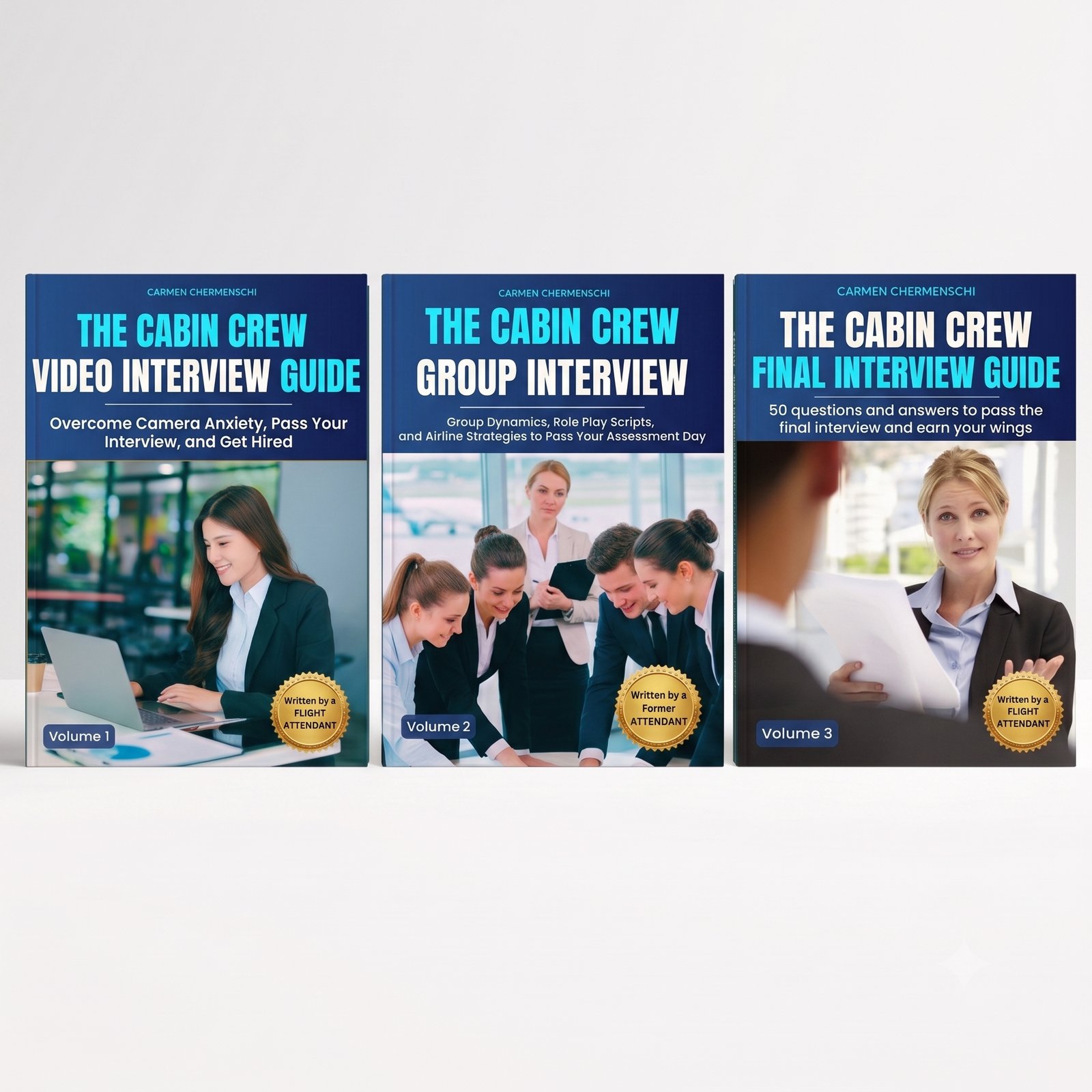
Three selection stages, one book for each
Video interview, group interview with role play, and final interview. Real questions, sample answers, and the mistakes that quietly end an application.
See the booksWant a plan built around your own application? Discover the coaching
How to Apply for an Emirates Cabin Crew Position in 2026
With over 2,000 Open Days scheduled across 150 cities this year, the opportunities are everywhere. But here is the reality check – only 1-2% of candidates actually make it. To be part of that 1%, you need to take it seriously. You need a real strategy (like in a battle):
- The 3-Week Rule –Once you find an Open Day near you, start your preparation at least 21 days in advance.
- Master the “Grooming” – First impressions are everything. Your look must be “Emirates-ready” from the second you walk in.
- Perfect Your STAR Stories – Don’t just give vague answers. Use the STAR method (Situation, Task, Action, Result) to prove your experience in luxury service. Believe me, it always works, and I used this technique in my 5 attempts to become a flight attendant.
- Be Natural – Recruiters are trained to spot “rehearsed robots.” Practice until your English and your stories flow naturally.
The “People-First” Era
As HH Sheik Ahmed bin Saeed Al Maktoum recently highlighted, Emirates is leaning into a “people-first” strategy. They are looking for world-class talent to redefine the future of aviation.
Are you ready? If you need any help, I am here for you.
Are You Ready to Earn Your Emirates Wings?
Applying for Emirates can feel incredibly overwhelming, especially when you look at the strict requirements and the thousands of people competing for the same spot. I see so many candidates rush to hit the “SUBMIT” button out of pure anxiety, terrified of missing out on this massive 2026 recruitment wave.
But here is my final, most important piece of advice to you: do not rush. You can easily make a lot of mistakes, even if you are not conscious of them.
Emirates has a strict 6-month waiting period if your application or interview is rejected. It is far better to wait an extra two weeks to perfectly tailor your ATS-friendly CV, practice your body language, and master your HireVue technique than to face a half-year ban just because you applied unprepared. Practice your English, too!
Why the Right Preparation Changes Everything
Remember, failing an interview does not mean you are not good enough. Usually, it simply means you lacked the right strategy. You don’t have to navigate this stressful journey alone. I failed my Assessment Day five times in the past due to missing information and a mentor to guide me. I know the exact anxiety that comes with that digital camera staring back at you, and I know how to transform that fear into strong confidence.
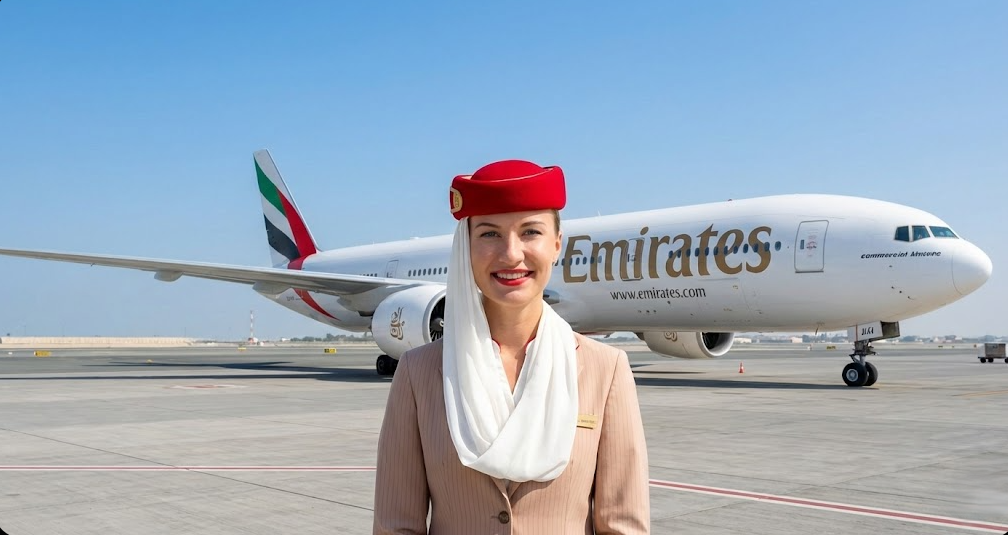
If you are serious about wearing the iconic red hat, I am here to guide you. I offer tailored 1-on-1 coaching sessions (available in English, Italian, French, and Romanian) to help you master every single stage of the process. Together, we will polish your profile and run realistic interview simulations so that you walk into that Assessment Day feeling protected, prepared, and unstoppable.
👉 Click here to book your 1-on-1 Coaching Session and let’s secure your ticket to Dubai!
FAQ - Emirates Cabin Crew 2026
Yes, Emirates is actively hiring throughout 2026. The airline is expanding its global network and fleet and has a strong long-term hiring plan to recruit thousands of new operational staff by 2030.
Emirates recruits continuously year-round. They host Open Days, Assessment Days, and review online applications globally almost every month to ensure they meet the high demand for new crew members across their expanding fleet.
Yes, getting into Emirates is highly competitive. Because it is one of the most prestigious airlines globally, they receive thousands of applications. Securing a job at Emirates requires an ATS-friendly CV, exceptional English skills, and a strong, team-oriented performance during the rigorous Assessment Day.
The baseline qualifications required include being at least 21 years old, holding a high school diploma (Grade 12), fluency in English, having at least 1 year of customer service experience, and being able to reach 212 cm while standing on tiptoes.
Officially, there is no strict maximum age for cabin crew stated in the Emirates guidelines. While the minimum age is 21, the focus is entirely on your physical fitness, adaptability, and ability to pass the strict aviation medical exams, rather than an upper age cap.
No, 40 is not strictly too old. You can absolutely become cabin crew at 40 or even older, such as 41 or 44. Emirates does hire older cabin crew, provided they meet the rigorous physical requirements, demonstrate a cosmopolitan mindset, and have the resilience required for long-haul flying.
Yes, airlines do assess your physical fitness, and a healthy BMI is important for cabin crew. While recruiters will not typically weigh you during the Open Day, you must pass a very strict EASA aviation medical examination before joining, which evaluates your overall health and proportions.
There is no specific weight limit in kilograms. Instead of a fixed number, airlines look for a healthy, proportional Body Mass Index (BMI) for cabin crew. Whether your weight is 70 kg or otherwise, it must be proportionate to your height to ensure you have the stamina to handle emergency equipment and heavy meal carts safely.
No, a BMI of 22 is not too skinny; it falls perfectly within the standard healthy weight range (18.5 to 24.9). As long as you are physically strong enough to perform all safety duties and pass the medical clearance, a BMI of 22 is excellent for the role.
Emirates enforces a strict 6-month waiting period if your application or interview is unsuccessful. It’s highly recommended to seek professional coaching and tailor your preparation before applying, rather than rushing the process and facing a half-year ban.
Emirates does not allow any tattoos that are visible while wearing the cabin crew uniform. This policy includes tattoos on the neck, wrists, ankles, behind the ears, and any other area covered by the standard uniform. The rule is strictly enforced during both recruitment and employment.
In 2026, Emirates cabin crew receive a tax-free salary along with company-provided accommodation, transportation, medical insurance, and travel benefits. The overall package remains one of the most competitive in the aviation industry, particularly for long-haul international operations.
The Dubai relocation question is a critical part of the Emirates interview. Recruiters use it to assess whether candidates are well prepared. Candidates who demonstrate research and realistic expectations are viewed more favorably than those offering generic enthusiasm.
The most common mistake is trying too hard to impress. Candidates who overtalk, dominate group exercises, or deliver rehearsed answers often perform worse than those who remain calm, authentic, and present.
No. The CCA (Cabin Crew Attestation) is a European certification issued under EASA rules — it doesn’t apply to Emirates. In the UAE, the equivalent is the GCAA Cabin Crew License, and you cannot obtain it on your own. The certification is issued only to crew already employed by a UAE operator, as part of the company’s own training. Emirates trains you after you’re hired, at no cost to you.
Keep reading