


Your first cabin crew payslip is unlikely to match what you imagined. You may already have an idea if you’ve had a payslip from a previous job. At the time of the Assessment Day, the recruiter quoted you a salary of €2,000. The bank app shows €1,540. Then next month, with the same job, it shows €1,820, and nobody warned you that some of what you earned wasn’t really your money to spend.
And you know what? This is how the job works worldwide.
Cabin crew compensation is one of the most misunderstood pay structures in any industry. It’s split into five to seven separate components, it changes every month with your roster, and the headline salary airlines advertise is rarely what hits your account. Below is exactly how cabin crew get paid – every euro, pound, dollar, or dirham, whether you fly for a European low-cost, a US legacy, a Gulf airline, or a regional charter. It doesn’t matter.

Why Cabin Crew Pay Is Not Like Any Other Job
Three structural realities make crew compensation fundamentally different from a 9-to-5 salary:
1. Pay has multiple components, not one – Base salary, flight pay, per diem, commission, premiums, bonuses, and non-cash benefits. I know it is complicated, but you need to understand each one separately to know what you’re actually earning.
2. Your roster determines your income. At the beginning, I had no idea what this meant. For example, a busy long-haul month and a quiet reserve month at the same airline can produce a 40% difference in take-home pay. The same job, the same airline, but surprisingly different paycheques.
3. Geography multiplies the complexity. A tax-free salary in the Gulf with free accommodation isn’t comparable to a higher gross figure in Europe, where high rent and income tax are a factor. The headline number lies in both directions.
This is why the question of how much cabin crew make is? The question is likely impossible to answer in one sentence. It took me many months to fully understand all that. But I promise you, once you understand the building blocks, you can decode any contract, any payslip, and any airline’s offer in minutes.

Three selection stages, one book for each
Video interview, group interview with role play, and final interview. Real questions, sample answers, and the mistakes that quietly end an application.
See the booksWant a plan built around your own application? Discover the coaching
What Are the Building Blocks of Cabin Crew Pay?
Before breaking down this complex topic, know that every airline assembles compensation from the same set of components, but in different proportions. Knowing what each one is and which airlines lean on which is the foundation of cabin crew financial literacy.
Base salary or hourly rate
This is the fixed component, paid every month regardless of how many flights you do, and it increases with seniority. In one month, you might only have standbys.
In Europe, base salary is typically expressed as a monthly figure, so roughly €900-€1,800 gross for entry-level crew, depending on the country and airline. In the US, base pay is structured differently: you’re paid an hourly rate that applies only during block time (more on this below), with no fixed monthly minimum beyond a contractual guarantee of around 70-80 flight hours per month.
The base alone rarely pays your rent, but it’s good to know that even if you don’t fly at all, airlines are obliged to pay it to you at the end of the month. During the Pandemic, for a short period, we were paid only to stay home, and it was a good thing because you weren’t running totally out of money.
Flight pay with block time, sector pay, and duty pay
There is a lot of confusion about this part of the salary. Know that it is the largest variable component, and it’s calculated in three main ways depending on where you fly:
- Block time pay (common in the US) – you’re paid by the hour, but the clock only runs from doors closed and brakes off (block out) to parked at the gate (block in). Boarding, deplaning, and ground delays are usually not paid at the same rate.
- Sector pay (common at European low-cost carriers) – a fixed amount per flight leg (sector) flown. Four-sector days pay more than two-sector days, regardless of how long each flight was.
- Duty pay (some charters and regionals) – you’re paid per duty hour, which includes time on the ground. This is rarer but better protects you against delays.
Per diem or daily or hourly allowance
A separate payment intended to cover meals and incidental expenses when you’re away from base. It’s usually paid per hour you’re away from base (US system) or per overnight/per duty day (European system). During my layovers, the per diem covered my meals and incidental expenses.
Typical rates: €2 to €3.50 per hour in the US, or €30 to €80 per day in Europe, with higher rates for high-cost destinations. Regarding Gulf carriers, they pay layover allowances that vary significantly by city, reflecting fair compensation for different locations.
Per diem is technically not salary – it’s expense reimbursement. In most countries, it’s tax-free within official limits, which can make it more valuable than the equivalent of gross pay. Since it’s meant for meals during trips, it’s important to budget it accordingly rather than as regular income.
Commission and onboard sales
A percentage of duty-free and buy-on-board revenue is shared among the operating crew. It’s typically 5-10% of total onboard sales. For example, at Ryanair, the duty-free commission is around 10% – not bad, isn’t it? This incentivizes the crew to get more involved in sales.
Commission is a major source of income for European low-cost carriers. At Ryanair, easyJet, Wizz Air, and similar, motivated crew on the right routes can add €200- €600 per month from commission alone. Some of my colleagues – not me (lol) – sometimes got 400 euros per month from commissions alone, pushing perfume sales onboard. In contrast, at legacy carriers and Gulf carriers, commission is smaller or absent because their service models differ.
Premiums and bonuses
Additional pay for specific responsibilities or conditions:
- Lead/Purser/Cabin Manager premium for senior cabin position
- Language premium for speaking the destination language (especially relevant at Gulf carriers)
- International or long-haul premium for widebody operations
- Night, weekend, or holiday premiums in some contracts
- Profit-sharing (notably at Delta, some others)
- Performance or longevity bonuses
These add anywhere from €50 to several hundred per month, depending on how many you stack.
The non-cash benefits are often the biggest hidden value
The compensation you don’t see on your payslip, but which materially affects your real take-home:
- Accommodation (universal at Gulf carriers, sometimes at relocated European bases)
- Transport to and from the airport
- ID90 staff travel for you and your family
- Health and dental insurance
- Pension or 401 (k) contributions and employer match
- Uniform provision and laundry
- Discounted hotel rates, gym, meals
Priced at retail, non-cash benefits at a Gulf carrier can be worth €10,000-€18,000 per year. At European low-cost airlines, they’re worth less but rarely zero.
Carmen’s note (ex-Ryanair): When I started, I made the mistake every new joiner makes – I looked only at the headline base figure and ignored everything else. The reality is that two crew members at the same airline, with the same start date and hourly base, can have a 30-40% difference in monthly take-home pay depending on how they bid, which routes they fly, and how seriously they take onboard sales.
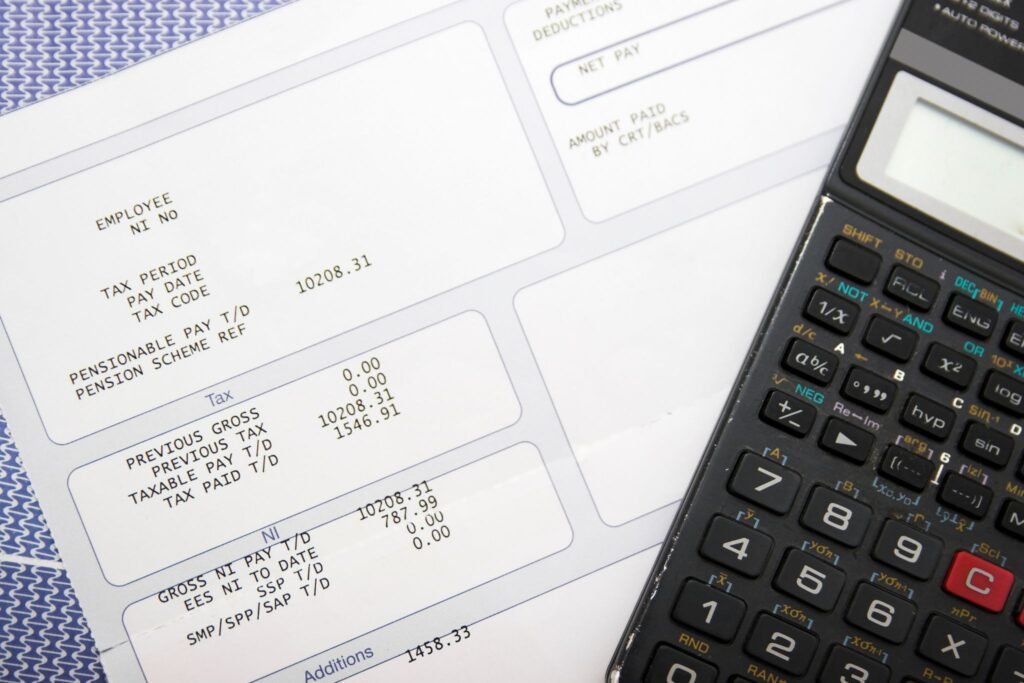
What Your First Cabin Crew Payslip Will Actually Look Like
I know, you’re now asking for practical information, so here’s a realistic anatomy of a first-month payslip for entry-level European cabin crew. But remember that numbers are illustrative, your airline, country, and contract will differ, but the structure is the same almost everywhere.
Earnings & Allowances
Deductions
Two things to notice that nobody warns you about:
The per diem isn’t really your money. Of the €1,400 that lands, €260 is allowance you’re expected to spend on meals during layovers. Your salary for living is closer to €1,140.
The variable lines swing month to month. Next month, with a busier roster, your flight pay might be €700 and commission €180. With a reserve-heavy month, both could drop to €200 combined — it’s normal, as you’ve already seen earlier in this article.
How Pay Differs by Airline Type
The same job title produces very different payslips depending on which kind of airline you fly for. Here’s what to expect across the four main models.
European low-cost carriers - Ryanair, easyJet, Wizz Air, Vueling
The model is low base, high variable, but a strong commission opportunity. You’ll fly short-haul, multiple sectors per day, often back to base the same evening. This is what attracted me from the first time I decided to become a flight attendant. The per diem is small because you rarely stay overnight. But commission can be material if you’re on the right routes, like summer Mediterranean, tourist destinations, holiday peaks — all sell well.
Entry-level total compensation typically ranges from €1,400 to €2,200 gross per month, with significant variation by season and base salary. Eastern European bases generally pay less in absolute terms but cost dramatically less to live in.
Carmen’s note: At Ryanair, I learned that the choice of base matters as much as the choice of airline. Crew on summer Italian or Spanish bases regularly out-earn crew on quieter Northern European bases by 25-35%, mostly through commission and longer flying days. If you’re joining a low-cost carrier, the base allocation is almost a financial decision. In Poland, Ryanair’s Buzz subsidiary uses a self-employment model.
European legacy carriers - British Airways, Lufthansa, Air France, KLM, Iberia, ITA Airways
The model is a higher base, more predictable monthly pay, stronger union protections, and a smaller commission (or none).
You’ll fly a mix of short and long-haul. Long-haul rotations bring meaningful per diem because you’re away from base for days at a time. On the other hand, pension and health benefits are stronger, and this little detail needs to be taken into consideration when you decide to become a flight attendant for them. Pay scales climb predictably with seniority.
Entry-level total compensation typically ranges from €1,800 to €2,800 gross per month, with long-haul months pushing toward €3,000+.
US legacy carriers - American, Delta, United, Southwest, JetBlue
The model is an hourly rate during block time, a generous per diem, and strong unions at most carriers.
The block-time-only system is the biggest adjustment for crew coming from elsewhere – you can be at work for 13 hours and only get paid for 7. Knowing that, some US carriers (Delta, American) now offer boarding pay at 50% of the hourly rate, which partially closes the gap.
Starting hourly rates currently range from $26 to $40 per hour, depending on the airline, with top-of-scale pay above $70-$80 after 12-13 years. Per diem typically runs $2.40-$3.40 per hour away from base.
Gulf carriers - Emirates, Qatar Airways, Etihad, Saudia
The model is a tax-free salary, a modest headline number, and a very large non-cash package.
Your base, flight pay, and layover allowances are all tax-free at source. Accommodation is provided (typically a shared apartment for new joiners), as are transport, medical, and most utilities. The headline salary in dirhams or riyals looks small in euro terms, but you’re not paying €1,200/month for rent, and the savings rate can be high if you’re disciplined.
The problem is that most of your wealth is in benefits that disappear if you leave the airline. There’s no pension, the contract is renewable, and the savings have to come from you, not the system. That’s why considering work with Gulf carriers should be taken very seriously, given those peculiarities!
Charter and regional carriers
This can vary significantly because some are seasonal contracts (six months on, six months off), and some pay per duty hour rather than per block time. Pay is often better for ground delays but worse for total annual income. Read the specific contract carefully, because there’s no industry standard here.

When Your Pay Drops (And When It Spikes)
Even within a single airline at a single seniority level, your monthly pay will fluctuate. It is the unwritten rule of the aviation industry. Knowing why your monthly paycheck will vary so much protects you from financial surprises.
For example, your pay drops in these months:
- Reserve assignments (minimum guarantee only, no extra flying picked up)
- Sick leave (paid at 50-100% of flight pay, depending on contract)
- Low season (winter at leisure airlines, post-holiday lulls)
- Training periods or recurrent training months
- Your first full year, when you have the lowest seniority and the worst bidding power
Your pay spikes in these months:
- Summer at any leisure-route carrier
- Long-haul rotations (high per diem accumulation)
- Holiday seasons (Christmas, Eid, Chinese New Year on Asian routes)
- When you pick up open trips at premium rates
- After you upgrade to a senior position (purser, lead)
Carmen’s note: The biggest financial mistake the new crew makes is comparing one good month to another and assuming the average. Money management for cabin crew should be like that of an entrepreneur. I recommend always building your budget on the lowest of the past six months, not the average. Reserve months are real, and they come whether you planned for them or not.
YOUR UNFAIRE ADVANTAGE
If you are serious about becoming a flight attendant in 2026, I am here to guide you. I offer tailored 1-on-1 coaching sessions (available in English, Italian, French, and Romanian) to help you master every single stage of the process. Together, we will polish your profile and run realistic interview simulations so that you walk into that Assessment Day feeling supported, prepared, and—most importantly—unstoppable.
Final Word on the Cabin Crew Monthly Money Management
The headline figure airlines advertise is rarely what you’ll actually take home, and rarely what matters when choosing between offers. What matters is the mix: how much is fixed versus variable, how much is taxable versus tax-free, how much depends on routes you might not get in your first year.
Once you can decode a payslip line by line, you can compare any two contracts on their real terms, budget for the months your pay drops, and negotiate from a position of understanding rather than guesswork.
Your next step is to learn how to manage that irregular income, so it actually builds something for you. That’s where the real financial difference between a first-year cabin crew and a tenth-year cabin crew comes from, and it has very little to do with the airline. Stay tuned — in the next articles, I’ll cover other key topics on this subject.
Carmen Chermenschi is the founder of Surprising Aviation – a platform for aspiring flight attendants, an ex-Ryanair flight attendant, and a former check-in agent (easyJet, Wizz Air, Turkish Airlines, Royal Air Maroc). She coaches aspiring cabin crew across Europe in four languages.
FAQ
Most airlines historically didn’t, but it’s changing. Some US carriers — Delta first, then American — now pay roughly 50% of the hourly flight rate during boarding. Most European airlines still bundle boarding into the base salary rather than paying it separately. Always ask: Does your hourly rate apply during boarding? before signing.
In most countries, per diem within official limits is tax-free because it reimburses meals, not wages. The limits vary by country and destination. If your airline charges more than the local tax authority’s published rate, the excess may be taxable. One-day turns without an overnight may also be treated as taxable income in some places. Check with your airline’s HR or a local accountant.
Realistic gross ranges, before benefits:
- Europe (low-cost): €17,000-€25,000/year
- Europe (legacy): €22,000-€32,000/year
- United States: $28,000-$45,000/year
- Gulf carriers: roughly AED 90,000-130,000/year, plus housing and benefits worth €10,000-€18,000 if priced at retail
Reserve-heavy years sit at the lower end; long-haul-heavy years at the upper end.
It depends. Most European airlines pay a reduced training salary. US legacy carriers vary – some pay nothing during initial training, some pay minimum wage or a stipend. Gulf carriers typically pay the full salary from day one and provide accommodation. Always confirm the training pay structure before accepting an offer.
Usually, no, unless the delay extends your scheduled duty period past contractual limits. Many airlines have minimum pay rules that kick in when actual duty time exceeds the scheduled rotation. Tarmac delays and gate holds are typically unpaid in the absence of a rig provision. Check your union contract or company manual for specifics.
Don't miss these
YOUR UNFAIRE ADVANTAGE
If you are serious about becoming a flight attendant in 2026, I am here to guide you. I offer tailored 1-on-1 coaching sessions (available in English, Italian, French, and Romanian) to help you master every single stage of the process. Together, we will polish your profile and run realistic interview simulations so that you walk into that Assessment Day feeling supported, prepared, and—most importantly—unstoppable.
easyJet Cabin Crew Requirements 2026 & Assessment Day
The essentials of easyJet cabin crew requirements To become easyJet...
Read MoreCabin Crew Roster Guide – How It Works (Complete Guide 2026)
Roster in a nutshell — A cabin crew roster is...
Read MoreJet2 Cabin Crew 2027 — Requirements, Selection and Pay
At a glance. Jet2 is recruiting cabin crew now for...
Read MoreCabin Crew Video Interview — How to Pass It in 2026
When I became a flight attendant at 40, the selection...
Read More