


Quick answer
To become Etihad cabin crew in 2026 you must be at least 21 years old, at least 163 cm tall, a high school graduate, and fluent in English. Etihad uses a plain height minimum with no arm-reach test. Selection runs through an online application, a video interview and an invite-only Assessment Day. New crew earn AED 10,000–14,000 per month tax-free, with free shared accommodation in Abu Dhabi.
That is the short version, but if you are serious about this, the details are what separate the people who get hired from the people who go home wondering what went wrong.
I have been on both sides of that door. I applied, I was rejected, and I sat there with no idea what I had done badly, because airlines never tell you. They rarely reply to rejected candidates, simply because there are so many. Later I flew, and later still I started preparing other people for the same selection. In this guide, I will walk you through every stage the way I wish someone had walked me through it.
Let’s get into it.
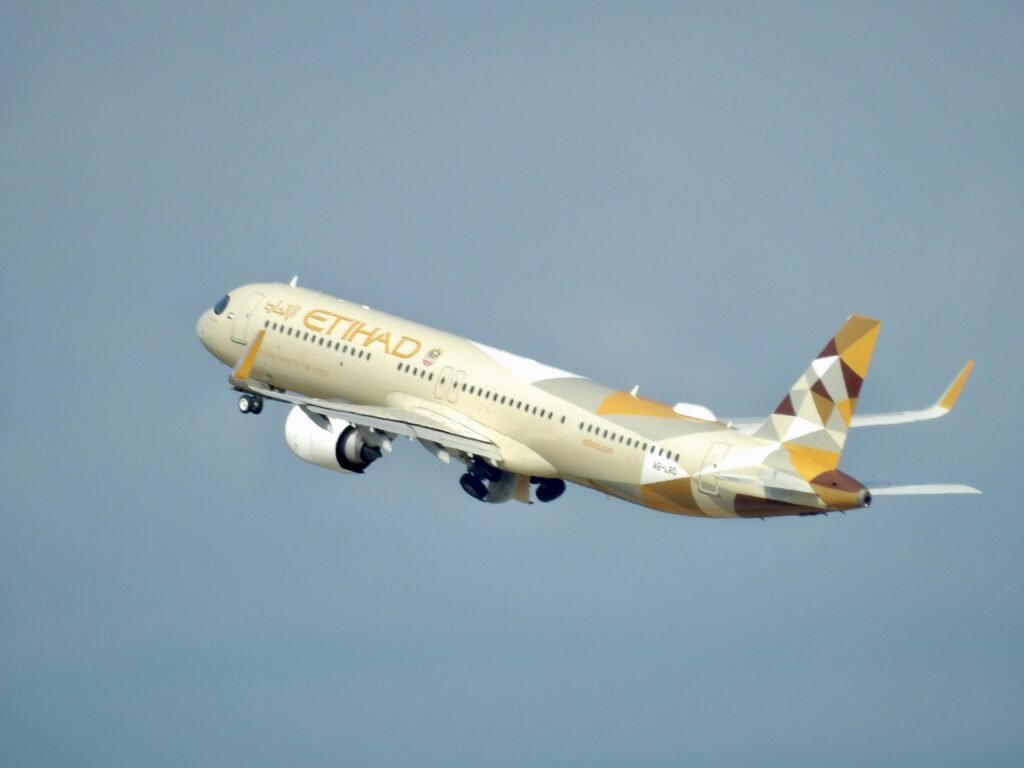
Etihad Cabin Crew Requirements in 2026
Here is exactly what you need, and I have put it all together in clear tables so you know exactly where to look. These are the current minimum requirements published on the official Etihad Careers page.
| Requirement | Etihad 2026 |
|---|---|
| Minimum age | 21 at the time of application |
| Minimum height | 163 cm (about 5 ft 4 in) |
| Arm-reach test | None |
| Education | High school graduate, Grade 12 or equivalent |
| English | Fluent, written and spoken — around B2 |
| Previous experience | Not required |
| Visible tattoos in uniform | Not permitted |
| Swimming | Must be able to swim with a flotation device |
| Base | Abu Dhabi, UAE visa sponsored by the airline |
Age, Height and the Arm-Reach Question
You must be 21 years old at the time of application, and Etihad does not publish an upper age limit. More on that further down, because it deserves its own section.
The height rule is where Etihad differs from its neighbors, and where much published information is simply out of date.
Surprising fact 1
Etihad has no arm-reach test, and several people have asked me why. Meanwhile, well-known cabin crew websites still state that Etihad runs a 212 cm reach test. That is no longer correct. Etihad uses a plain 163 cm height minimum, which makes it the easiest of the big Gulf carriers to self-assess. Emirates asks for 160 cm plus a 212 cm reach on tiptoes. Qatar Airways publishes no height at all and tests reach only. Etihad simply measures you.
So if you are 163 cm, you meet the bar. You do not have to worry about stretching on tiptoes to touch a marked point on a wall, which is the single most stressful thirty seconds of an Emirates or Qatar assessment day.
Education and English Level to Work with Etihad
You need a high school diploma or equivalent. No university degree, in any subject, at any level.
English must be fluent in writing and speaking. The simplest way to know whether your English is ready is to look at the level itself—around B2 is what the job requires in practice. A second language is a real advantage, and Etihad actively values bilingual candidates given the network it flies. The more languages you speak, the better your chances of getting through that first assessment.
Now let me reassure you the way I reassure every person I coach. You do not need to sound like a native speaker. Recruiters know this. The airline is not hiring an English teacher. It is hiring someone who can understand a safety instruction under pressure, calm a frightened passenger, and hold a natural conversation with a stranger from any country in the world.
If your English isn’t there yet, that doesn’t mean it can’t be there. It means not yet. I invested heavily in my own English before my interviews, and it was one of the best decisions I ever made.
Tattoos, Grooming and Appearance
This rule is stricter than most applicants assume, and, unfortunately, it catches people out every single recruitment cycle. Remember that grooming is as essential as the interview itself.
I put my first effort into grooming and appearance for one simple reason. On the day itself, I did not want to be wondering whether everything was in place. I wanted every bit of attention free for the group exercise and, later, the final interview.
It is not enough that a tattoo can be covered. Visible tattoos in uniform are not permitted, and a tattoo hidden with makeup or a plaster does not count as compliant. If you have a tattoo somewhere the uniform does not cover, research this carefully before you spend money traveling to an assessment day.
Surprising fact 2
Etihad employs dedicated grooming officers who check crew before they board. Grooming is not a first-day formality that everyone forgets about afterwards. It is checked, routinely, for your whole career.
When I applied to a low-cost airline, I saw several candidates disregard the published appearance policy, and their applications were stopped as soon as it was noticed. Nobody argued with them. Nobody gave them a second chance. Read the policy and take it literally.
What Etihad Does Not Require
This section exists because the aviation training industry has built a business on things you do not actually need.
Surprising fact 3
Etihad is not affiliated with any cabin crew academy, and you do not need a diploma from a cabin crew school to apply. Graduates of such academies are welcome. So is everyone else who meets the published requirements. Nobody at the assessment day will ask which school you attended, and no certificate moves you forward in the process.
You also do not need previous flying experience, a university degree, a specific nationality, or an expensive grooming course. What you need is to meet the requirements and to prepare properly for each stage of the selection. Those are two very different things, and the second one is where most candidates lose ground, because they relax and stop taking it seriously.
Is Etihad Still Recruiting Cabin Crew in 2026?
Yes. Etihad is actively recruiting worldwide in 2026 and running invite-only Assessment Days across multiple continents. Recent events have been held in Abu Dhabi, Vienna, Prague, Istanbul, Budapest, Frankfurt, Brussels, and Jeddah, among others.
The reason matters more than the list. Etihad has announced plans to roughly double its fleet by 2030. The airline currently employs around 5,300 cabin crew. A growing fleet needs more crew, and when an airline is in an expansion phase the doors open wider than usual.
That does not make the selection easy. It stays competitive. But it does mean the timing is on your side, and timing matters more than most candidates realize. Remember that applying during a hiring freeze and applying during a fleet expansion are two completely different experiences.
How to check for yourself. Open Day locations change every month and no third-party site is reliably up to date, including this one. Always confirm current openings on the official Etihad Careers portal before you plan anything.
The Etihad Recruitment Process, Stage by Stage
Most of the anxiety around this selection comes from not knowing what happens next. So let’s remove the mystery. Etihad’s process is a structured, multi-stage filter, and each stage tests something specific.
| Stage | What happens | What they are testing |
|---|---|---|
| 1. Online application | Form and CV through the careers portal | Eligibility, and whether your CV survives the automated filter |
| 2. Video interview | Often one-way, recorded, no human present | First impression, clarity, presence on camera |
| 3. Assessment Day | Presentation, English and aptitude tests | Language level, attention, professionalism |
| 4. Group exercise and role play | Team tasks and pressure scenarios | Collaboration, judgement, how you treat people |
| 5. Final interview | One-to-one, competency and situational questions | Reliability, motivation, fit with the airline |
Stage 1 — The Online Application and the ATS Filter
Everything starts on the official Etihad Careers portal. Etihad’s recruitment process is highly automated, which means your application has to pass through a system before a human ever reads it.
Be aware that a generic CV, not structured for an applicant tracking system (a robot), can be filtered out before a recruiter sees your name. To be clear, you are not being rejected by someone who read your story and decided you were not a fit. You are being rejected by software that could not read your document.
I really recommend that you apply early and make sure your CV is clean, correctly formatted, achievement-focused, and tailored to the role. I have put a free ATS checklist further down this page.
Stage 2 — The Video Interview
Many candidates are surprised that the first real hurdle is a video interview, and often a one-way recorded one where you answer questions to a camera with nobody on the other end.
This is where strong candidates stumble. You know what I mean! Speaking confidently to a webcam is completely different from speaking to a person. There is no nodding, no smile coming back, no reaction to tell you whether you are doing well. Anyone who has started making videos for social media knows exactly what I mean.
How you introduce yourself, how you handle a simple tell me about yourself, how you look and sound on camera — all of it is assessed, and it sets the tone for everything that follows.
This is the stage I break down question by question in my Video Interview book, because it is the one candidates most often prepare for by simply hoping it goes well.
Stage 3 — The Assessment Day
If your first-round performance stands out, you are invited to an invite-only Assessment Day, usually held in a hotel in a major city. The day typically includes a company presentation, English and aptitude assessments, group activities, and a final interview either the same day or shortly after.
One piece of advice about the presentation, and it is worth more than it sounds. Many candidates treat that hour as a moment to relax. Do the opposite. Listen, take notes, show interest and stay switched on. Recruiters are in the room, and they are watching how people behave when they think nobody is assessing them.
Stage 4 — The Group Exercise and Role Play
This is where careers are quietly made and lost, so I will share advice worth its weight in gold.
Do not try to be the loudest voice in the room. Do not try to command the group. But equally, do not disappear into silence, hoping that saying nothing means making no mistakes. Silence is a decision, and recruiters read it as one.
The main goal is to collaborate. Cabin crew work as a team, always, on every flight, with people they may have met forty minutes earlier. Recruiters are watching whether you listen, contribute courteously, and help the group reach a result rather than win an argument.
Role plays test the same thing under psychological pressure. Here, please be very focused and set aside any conditioning from others. You are there to have the job! How do you handle a difficult passenger, a disagreement with a colleague, or an unexpected service problem? There is no perfect script. They want to see how you think and how you treat people when things get tense. Because so much happens at once here — group dynamics, role plays, and the signals recruiters look for — this is the stage candidates find hardest to prepare for alone. It is why I gave it an almost 200-page volume of its own.
Stage 5 — The Final Interview
If you reach this stage, you are already among the top candidates, and that is worth saying out loud. Unfortunately, the reality is that most people never get here.
The final interview is usually one-to-one and almost always opens with something super simple—tell me about yourself or why you want to work for Etihad.
One friendly piece of advice. Do not memorize a script. Recruiters spot rehearsed answers within two sentences, and a memorized answer that goes wrong is far worse than an unpolished one that is real. Tell your story naturally, explain why you love working with people, and be specific about why this airline rather than any airline.
Expect competency questions — how you handle pressure, a time you resolved a problem, how you dealt with a difficult customer. And situational ones, such as what would you do if a passenger refused to follow crew instructions?
Remember this above everything. They are not looking for a perfect person. Instead, they are looking for someone reliable, professional, calm under pressure, empathetic, and able to represent the airline to guests. Those are skills you can build.
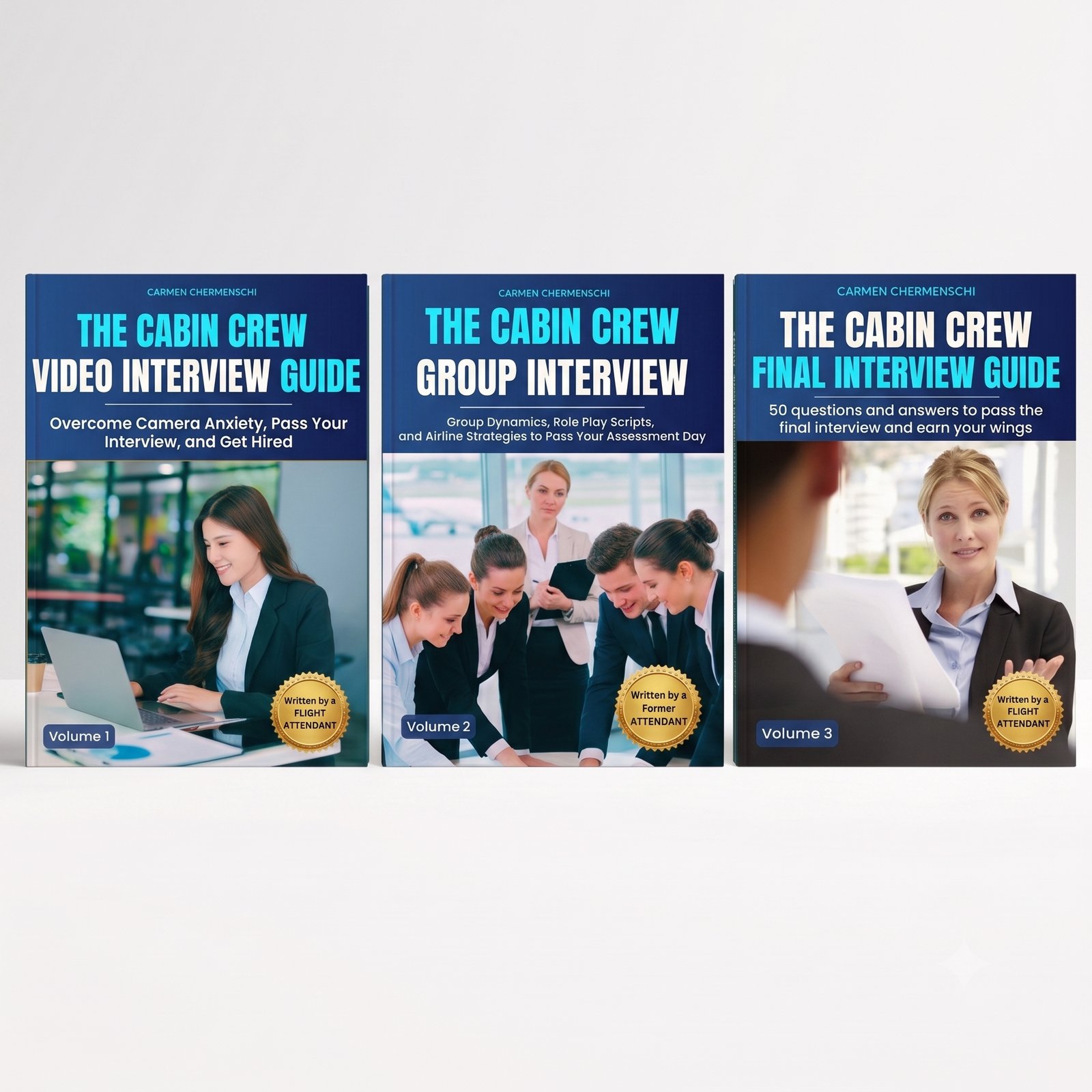
Three selection stages, one book for each
Video interview, group interview with role play, and final interview. Real questions, sample answers, and the mistakes that quietly end an application.
See the booksWant a plan built around your own application? Discover the coaching
Etihad Cabin Crew Salary in 2026

This is the most searched question about the job, so let’s be precise and transparent. The headline base salary is less than half the story, which is why so many published figures look wrong in both directions.
How the Salary Is Built
This is the most searched question about the job, so let’s be precise and transparent. The headline base salary is less than half the story, which is why so many published figures look wrong in both directions.
| Component | Amount (AED) | Notes |
|---|---|---|
| Base salary | 8,000 – 10,000 per month | Fixed, paid regardless of hours flown |
| Flying pay | 50 – 60 per flight hour | Typically 70–90 hours per month |
| Layover allowance | 240 – 384 per day away | Varies by destination region |
| Realistic monthly total | 10,000 – 14,000 | Tax-free. Roughly EUR 2,500–3,500 or USD 2,700–3,800 |
How the Salary Is Built
That figure sits on top of benefits that would otherwise eat straight into your salary.
- Fully furnished shared accommodation in Abu Dhabi, gym included, or an independent-living allowance
- Free transport between residence, training centre and airport
- Worldwide medical and insurance cover, fully paid
- Uniform and world-class training provided
- 30 days of annual leave after probation
- One free annual ticket home, plus friends-and-family travel benefits
The comparison that actually matters. AED 12,000 tax-free with rent, utilities, transport, medical cover and uniform already paid is not the same as EUR 2,900 gross in Europe. Once you subtract European tax, rent and commuting, the Gulf package is worth considerably more than the raw number suggests. That is the calculation to run before you decide, not the headline figure.
Etihad vs Emirates vs Qatar — Salary Compared
| Etihad | Emirates | Qatar Airways | |
|---|---|---|---|
| Base city | Abu Dhabi | Dubai | Doha |
| Minimum age | 21 | 21 | 21 |
| Height rule | 163 cm, no reach test | 160 cm + 212 cm reach on tiptoes | No height minimum, reach test only |
| Monthly total | AED 10,000 – 14,000 | Slightly higher on average | Lower fixed, more roster-dependent |
| Tax | None | None | None |
| Cost of living | Lower | Higher | Middle |
| Accommodation | Provided | Provided | Provided |
Emirates often shows a slightly higher average monthly figure, partly because its ultra-long-haul network generates more high-value layover allowances, and in strong years the group has paid a profit-share bonus. Etihad runs a near-identical structure at slightly different rates.
But a higher number in Dubai does not automatically mean more money in your pocket.
Surprising fact 4
Abu Dhabi has a significantly lower cost of living than Dubai. The same salary stretches further when rent, food and daily life cost less. Crew also consistently describe Etihad as the most people-focused and relaxed working environment among the big three Gulf carriers, with a training culture that feels more personal.
So the smart question is not only who pays more, but where will I actually live better on what I earn. Choose with your head, not with the headline.
Etihad Cabin Crew Training — What the Seven Weeks Look Like
Let’s suppose the email arrives. What happens next?
You complete the pre-employment steps and begin training at the Etihad Aviation Training Center in Abu Dhabi. Training is provided free of charge by the airline and lasts around seven weeks, with some intakes running six to eight weeks depending on the group.
Let me be clear — training is not a relaxed onboarding. It is a full-time job on its own. Days run roughly eight hours, six days a week, with one day off. You cover cabin emergency evacuation, real firefighting, ditching, first aid, aircraft equipment, safety procedures, service standards, and aviation regulations — all of it in technical English.
Surprising fact 5
There is a weekly exam and the pass mark is 80%, which in practice means about three mistakes per test. Fail one and you typically return the next morning before class to re-sit it. This is why crew who have flown before find it manageable, and why newcomers who do not study before, during and after the course can struggle. Read your pre-course workbook before day one.
At the end comes the Wings Ceremony, the graduation day where trainers gather and successful trainees receive their certificate and the wings pin. It is the moment you officially become cabin crew, and nobody who has been through it forgets it.
Surprising fact 6
Your first flights are usually flown as supernumerary — as an extra crew member who observes and learns before being counted as operating crew. You are on the aircraft, in uniform, doing the job, but the cabin is not short-staffed if you hesitate. It is the gentlest possible landing into the role.
Living in Abu Dhabi means a modern, safe city, colleagues from every continent, and friendships that often last a lifetime. It also means night shifts, weekends and holidays away from home, long flights and jet lag. This job is not for everyone. But if you love working with people and you adapt easily, it can be extraordinary.
Can You Become Etihad Cabin Crew at 40?
My answer is a loud yes. And this is the question I get asked more than any other, usually in a message that starts with an apology.
Etihad sets a minimum age of 21 and has no maximum age limit for cabin crew. Applicants in their thirties, forties, and beyond may apply, provided they meet the health, grooming, and fitness requirements.
Let me be more useful than a policy quote, because I know what is really behind that question.
Surprising fact 7
Life experience is an asset in a safety role, not a liability. A cabin is a confined space with 200 strangers, some of whom are frightened, tired or difficult. A candidate who has managed a team, raised children, handled a crisis or worked years in customer service brings something a 22-year-old cannot fake — calm. Recruiters read people for a living, and they know it.

What does change with age is the practical side, and that deserves honesty. Relocating to Abu Dhabi at 40 is a different decision than at 22. You may have a mortgage, a partner with a career, children in school, ageing parents. The airline will not weigh that for you. You have to.
What does not change is your eligibility. If you meet the requirements, you meet them, and nobody at the assessment day will ask your date of birth in a particular tone of voice.
Where I stand on this. I know this question from the inside, not from a policy page. Age was never the thing that stopped anybody I have worked with. Under-preparation was.
Etihad vs Emirates vs Qatar — Salary Compared
At the end comes the Wings Ceremony, the graduation day where trainers gather and successful trainees receive their certificate and the wings pin. It is the moment you officially become cabin crew, and nobody who has been through it forgets it.
Etihad, Emirates or Qatar — Which Gulf Airline Should You Apply To?
The honest answer is that most candidates apply to all three, and that is a reasonable strategy. But if you want to choose where to put your best effort first, here is how I would think about it.
Apply to Etihad first for the simplest eligibility check. The plain 163 cm minimum, with no reach test at all, removes that anxiety entirely. Also, if lifestyle and cost of living matter to you as much as the headline pay, and if a calmer base city appeals more than the intensity of Dubai.
Apply to Emirates first if maximum earning potential is the priority and you are comfortable with the reach test, the larger scale, and the higher cost of living.
Apply to Qatar first if you are shorter than 163 cm but can pass a reach test, since Qatar has no height minimum.
That last point is worth pausing on, because it changes the answer for a whole group of people who assume they are ineligible everywhere.
Your Free Preparation Toolkit
Three tools I use with the people I coach. They cost nothing, and you can start today.
Eligibility Self-Check
Tick every box before you spend money on travel to an assessment day.
- I am at least 21 years old today
- I am at least 163 cm tall, measured without shoes
- I have completed high school or an equivalent qualification
- I can hold a natural conversation in English with a stranger
- I have no tattoos that would be visible in uniform
- I can swim with the aid of a flotation device
- I have a clean criminal record and can travel without restrictions
- I am truly willing to relocate to Abu Dhabi and build a life there
If every box is ticked, you are eligible. Apply.
If one box is empty, do not assume you are out. English improves. Tattoos can sometimes be removed or repositioned. Swimming can be learned in a few weeks — it took me two weeks to go from not swimming at all to being able to bring someone back to the side of the pool. The only box with no workaround is the last one, and that is a decision, not a requirement.
Eligibility Self-Check
Days 1–30 — Documents and foundation
Rebuild your CV in an ATS-friendly format. Get a professional photo taken. Check your passport validity. Run the eligibility self-check above and fix whatever can be fixed. Start a daily English habit, even fifteen minutes — the compound effect does the work.
Days 31–60 — Camera and language
Record yourself answering tell me about yourself at least ten times and watch every one back. It is uncomfortable and it works. Build your three or four core stories using real situations from your own life. Push your English toward conversational confidence rather than grammatical perfection.
Days 61–90 — Assessment day and interview
Practise group dynamics with real people, not alone. Prepare your grooming and outfit and test them in daylight. Work through competency and situational questions out loud. Research Etihad specifically, so that why this airline has a real answer.
ATS CV Checklist
Six things that decide whether a human ever reads your application.
- One column, no tables, no text boxes. Creative layouts confuse the parser, and your experience arrives scrambled or empty.
- Standard section headings — Work Experience, Education, Skills, Languages. Clever headings are not recognized.
- A common font and no graphics. Icons, logos, and photos embedded in the layout are invisible to the system.
- Mirror the vocabulary of the job posting. If the advert says customer service, do not write only client relations.
- Results, not duties. Not responsible for customers, but handled 80+ customers per shift with a 95% satisfaction score.
- Save as PDF unless another format is requested, and name the file with your own name.
How to Prepare for Each Stage
Before the FAQs, let me share the single most important lesson from my own journey, because it is the one I wish someone had told me before my first rejection.
Surprising fact 8
What I always repeat is that recruiters are not looking for perfection, and they place very little weight on it. Candidates arrive from different cultures, accents and backgrounds, and the airline knows that. What they need is someone who communicates and works in a team. A cabin crew member is, first and last, responsible for the safety of passengers. Service comes after safety, always. If you carry that mindset into your interview, you are ahead of most of the room.
Three selection stages, one book for each
Video interview, group interview with role play, and final interview. Real questions, sample answers, and the mistakes that quietly end an application.
See the booksWant a plan built around your own application? Discover the coaching
I applied more than once, and I was rejected, as I said before. I sat there wondering where I went wrong, and no airline ever told me. Looking back, I did not lack ability. I lacked the right information and the right preparation. That is exactly why I do what I do now.
Each of those three books exists because that specific stage is where I watched candidates — including myself, once — lose ground that could have been won.
Your dream of becoming cabin crew is valid. Get informed, prepare properly, ask questions, and do not be afraid to ask for help when you need it.
FAQ
You must be at least 21 years old at the time of application, at least 163 cm tall, a high school graduate, and fluent in written and spoken English. You also need a clean criminal record, a high grooming standard with no visible tattoos in uniform, the ability to swim with a flotation device, and willingness to relocate to Abu Dhabi and serve alcohol including during Ramadan.
In 2026 Etihad cabin crew typically earn a tax-free total of AED 10,000–14,000 per month, roughly EUR 2,500–3,500 or USD 2,700–3,800. That combines a base salary of about AED 8,000–10,000, flying pay of around AED 50–60 per flight hour over 70–90 hours, and layover allowances of about AED 240–384 per day away from base.
Yes. Etihad is recruiting worldwide in 2026 and running invite-only Assessment Days across Europe, the Middle East, Asia and beyond. With plans to roughly double its fleet by 2030, the airline is in an active expansion phase, which generally means sustained hiring. Confirm current openings and Open Day locations on the official Etihad Careers portal, since dates change monthly.
A high school diploma, Grade 12 or equivalent, and fluent English. No university degree is required, no prior flying experience is needed, and you do not need a certificate from a cabin crew academy. A second language is a genuine advantage, particularly Arabic, Russian, Mandarin or a widely spoken European language.
Emirates usually shows a slightly higher average monthly figure, partly because its ultra-long-haul network produces more high-value layover allowances, and in strong years the group has paid a profit-share bonus. Etihad runs a near-identical structure at slightly different rates. Both are tax-free.
It depends on what you want from the life, not just the salary. Crew frequently describe Etihad as more people-focused and calmer, with a training culture that feels more personal and a base city that is quieter and cheaper. Emirates offers a larger network, more long-haul variety and slightly higher average earnings, with a faster and more intense environment.
It is competitive but very achievable with preparation. The process filters candidates through an online application, usually a video interview, an Assessment Day with group activities and English testing, and a final interview. Most candidates who are eliminated are not lacking ability.
Around seven weeks at the Etihad Aviation Training Centre in Abu Dhabi, with some intakes running six to eight weeks. It is provided free of charge, runs roughly eight hours a day six days a week, and covers safety, emergency evacuation, fire-fighting, ditching, first aid and service standards. Expect a weekly exam with an 80% pass mark, and a Wings graduation ceremony at the end.
es. Etihad sets a minimum age of 21 and does not publish a maximum age limit, so applicants in their thirties, forties and beyond can apply provided they meet the health, grooming and fitness requirements. Life experience and maturity are real assets in a customer-facing safety role. The harder part at 40 is usually the relocation decision, not the eligibility. And you can guess why 🙂
Most major airlines, including Etihad, publish no upper age limit for cabin crew. What is checked instead is medical fitness, the ability to perform safety duties, and in some countries a retirement age set by law rather than by the airline. In practice, candidates are hired in their forties and fifties every year.
No. Etihad is in an expansion phase in 2026, with plans to roughly double its fleet by 2030 and active worldwide cabin crew recruitment. The airline went through a significant restructuring in the late 2010s, which is why this question still circulates online, but the current position is growth rather than reduction.
In 2026 the most active recruiters include Etihad, Emirates and Qatar Airways in the Gulf, Riyadh Air as a new entrant, and Ryanair, Wizz Air and easyJet across Europe. European low-cost carriers are the fastest route in if you already hold the right to work in the EU or UK, because they recruit in high volume and do not sponsor visas.
With a Gulf carrier, comfortably, because accommodation, transport, medical cover and uniform are provided on top of a tax-free salary of AED 10,000–14,000. With a European low-cost airline the picture is tighter, since you pay your own rent from a lower gross figure and the first year is the hardest. The base you are assigned matters as much as the airline, because a summer base with high flying hours pays substantially more than a quiet one.
No. Etihad is not affiliated with any cabin crew academy and accepts applicants with no aviation experience. What matters far more than a paid certificate is meeting the published requirements, presenting an ATS-friendly CV, and preparing properly for each interview stage.
The 3-1-1 rule is a hand-luggage guideline for liquids, aerosols and gels. Containers must be 3.4 oz or 100 ml or smaller, they must fit in one clear quart-sized bag, and each passenger is allowed one such bag. It is a general security standard rather than an Etihad hiring topic, but it appears often in searches because both passengers and new crew need to know it. Check the current liquid rules for your specific route and connecting airports.
You may also like
easyJet Cabin Crew Requirements 2026 & Assessment Day
The essentials of easyJet cabin crew requirements To become easyJet...
Read MoreCabin Crew Roster Guide – How It Works (Complete Guide 2026)
Roster in a nutshell — A cabin crew roster is...
Read MoreJet2 Cabin Crew 2027 — Requirements, Selection and Pay
At a glance. Jet2 is recruiting cabin crew now for...
Read MoreCabin Crew Video Interview — How to Pass It in 2026
When I became a flight attendant at 40, the selection...
Read More