When I became a flight attendant at 40, the selection process looked nothing like it does today. I remember walking into that five-star hotel numerous times, nervous, knowing that someone would decide my future. The recruiters were right there in front of me. I could read their expressions, adjust my answers in real time – not easy, actually – and feel the energy in the room.
That world doesn’t exist anymore, or at least, not in the way it used to.

Today, before a single human being looks at you, you sit alone in your bedroom talking to a webcam and a countdown timer. Unfortunately, today the cabin crew video interview is where most candidates are eliminated, after the CV screening, which today has also evolved into an ATS system. A lot of applicants are completely lost at this point, because there is so little information about this stage.
I want to change that for you.
Pass the video interview
The video screening is where most applicants are filtered out, often without ever knowing what went wrong. The Cabin Crew Video Interview Guide shows you how to handle camera anxiety, control your body language and record answers that read as confident on screen.
See it on AmazonWhat a cabin crew video interview actually is
It is called an asynchronous interview, or a one-way interview. Don’t expect someone to interview you, because there is no interviewer. A platform shows you a question on screen, gives you a few seconds to think, then starts recording. You usually have between sixty and ninety seconds, and in most cases you get one attempt.
The two platforms you are most likely to meet are HireVue and Sonru, now part of Modern Hire.
Your recording is then reviewed twice. Software analyses vocal clarity, pace, eye contact and the structure of what you said. Afterwards, a human recruiter watches the shortlisted videos for personality, warmth and cultural fit. So you are being assessed by both at once, and they are not looking for the same things.
This is the reason why so many strong candidates fail here. They prepare for a conversation, but there is no one to talk to on the other side of the screen.
Actually, what you are facing is a three-layer system. Software handles the first screening. A human recruiter reviews personality and fit. And only at the end, if you get there, does someone assess you in a room. Each layer looks for something different, which is why preparing for one does not prepare you for the next. The task is to be entirely yourself while still playing the game correctly, and those two things are harder to hold together than they sound.

Which airlines screen cabin crew on camera
Recorded video screening is now standard across most of the industry. Here is where you are likely to meet it, and what changes between carriers.
Airlines that ask you to record yourself
A question appears on screen, a timer starts, and what you record is what gets judged. No interviewer, and usually one attempt.
| Airline | What happens on camera | Where it sits |
|---|---|---|
| Emirates Emirates requirements and process | Three to five recorded answers on HireVue, roughly 30 seconds to prepare and 90 to answer | After the CV is screened by the applicant tracking system |
| Qatar Airways How to become Qatar Airways cabin crew | Recorded answers paired with an online English test | Before any invitation to the assessment day |
| Etihad Airways How to become Etihad cabin crew | A short recorded interview built around very few questions | After your online application is shortlisted |
| Riyadh Air Riyadh Air recruitment | A recording activity inside the online assessment, which candidates report can freeze without saving | Early screening |
| Ryanair Ryanair interview guide | An online interview you complete whenever suits you, or a recruitment day in person instead | After the personality and situational tests |
| Aer Lingus | A remote interview, reported as video in most cases and occasionally as a phone call | After the numeracy, reasoning and personality tests |
| KLM | Recorded answers, taken after your English level has already been measured | After the online tests and the English test |
| TUI | A virtual interview, and in some markets a recorded video of your motivation filmed on your phone | Straight after the online tests |
| flydubai | A HireVue assessment with an English component | Early screening |
Airlines where the camera works differently
These stages are often described online as video interviews. They are not. Preparing for the wrong one costs you the stage.
| Airline | What happens on camera | Where it sits |
|---|---|---|
| British Airways | Ten video scenarios with multiple-choice answers. You watch, you do not record | First stage, before the application form |
| easyJet | Live video calls with a recruiter on Microsoft Teams | Mid-process, alongside the situational tests |
| Wizz Air Wizz Air requirements | Mostly in person at a recruitment day, with some candidates reporting a final online interview | Recruitment day |
Whatever the airline, the format barely changes. What changes is the tone of the questions and how much weight each carrier puts on brand fit. Prepare for the format once and you are prepared for all of them.
What the software is actually measuring
Let me clear up a myth. The software is not reading your soul and it is not deciding whether you are a nice person. It is more interesting than that. It measures a narrow set of signals, and every one of them can be trained.
Speech pace and pauses. Nervous candidates accelerate all the time, and that is normal. But be aware that a rushed delivery reads as low confidence. A short, deliberate pause reads as composure, which is exactly the quality recruiters and airlines look for in their future cabin crew.
Vocal clarity. Poor audio is the most common technical failure of all. If the system cannot transcribe you cleanly, it cannot score you.
Eye contact with the lens. Not the screen, not your own preview window. The lens.
Answer structure. Whether your response has a recognisable beginning, middle and end, or whether it wanders.
Consistency across answers. If you present yourself as a team player in question two and as a lone problem-solver in question five, that contradiction is flagged.
Notice what is not on that list. There is no place for perfect English, for example, nor for a beautiful face. A dramatic life story changes almost nothing. Airlines hire people who can be understood clearly by a frightened passenger at three in the morning, and the assessment is built around exactly that.
The questions you will be asked on the video interview
The wording changes between airlines, but the substance does not change a lot. You can expect a mix of these four families, and don’t be surprised if you are judged on something different from what you assume.
First of all — motivation. Why do you want to be cabin crew? and Why this airline?
What they are measuring is whether your answer could have been given to any other carrier. Most candidates fail the second question by describing the job, not the company.
Customer situations. Tell us about a time you dealt with a difficult customer. Describe a moment when you went beyond what was expected of you.
What they are measuring is whether you took initiative before being asked, or only reacted once someone complained.
Teamwork and conflict. Tell us about a disagreement with a colleague and how you resolved it.
What they are measuring is whether you criticise the person or the situation. Candidates who name the colleague as the problem lose points here almost every time.
Resilience and safety awareness. Describe a time you stayed calm under pressure. How would you handle a passenger who refuses to follow a safety instruction?
What they are measuring is whether safety comes first in your answer, or somewhere after keeping the passenger happy.
Prepare five real stories from your own life that can be reshaped to fit any of these families. Don’t build scripts. Build real stories that actually happened to you. A candidate with five well-chosen experiences can answer twenty different questions. A candidate with twenty memorised scripts freezes the moment the wording shifts. I have seen so many students fall into the trap of inventing their stories, and when I tried to explore them a little further, to develop a detail on the side, the story was no longer solid.
Structure every answer with STAR
This is essential. When you answer a behavioural question, structure your response using the STAR method. This structure makes your answer coherent and easy to follow, and it shows logical, reflective thinking. Recruiters are trained to listen for it and the software recognises it as organised speech.
I have seen a lot of candidates spend too much time on Situation and Task and rush through Action and Result. My advice is simple. Just flip it. Spend most of your time on what you specifically did and what actually happened because of it. That is where your value shows.
Compare these two answers to the same question.
There was a difficult customer at my previous job who was upset about a delayed flight.
When a passenger became frustrated about a three-hour delay, I approached with empathy, explained the safety reasons for the hold, offered alternative arrangements and stayed with them until they felt heard. They thanked me personally before deplaning.
Same story. Only the second one tells the recruiter who you are.
The answers, not just the questions
This article gives you the questions and what each one measures. The Cabin Crew Video Interview Guide gives you the answers — the three fatal errors that eliminate half of candidates before they speak, the aviation vocabulary that signals you are ready, and a full framework you can rehearse against.
See it on AmazonYour setup matters more than your answers
I am not exaggerating. I have seen perfectly suitable candidates eliminated because of what was behind them, not because of what they say. And this is true for every video-interview-based job you will ever apply for.
Just think about it. A recruiter forms an opinion in the first three seconds of your recording, before you have said anything worth judging. In those three seconds all they have is your face, your light, your room and the way you are sitting. Everything you say afterwards is filtered through an impression that has already been made.
Now think about what that means for this job in particular. Cabin crew work is one of the few professions where a stranger decides whether to trust you in the time it takes you to walk down an aisle. And don’t worry, airlines know this. So when a recruiter looks past your shoulder at your room, they are testing the exact skill they are paying for.
Two things I will give you outright
Test your audio before you record a single answer. Just thirty seconds, played back, listened to properly. If the system cannot transcribe you cleanly, it cannot score you, and no amount of good answers survives bad sound.
And please, never sit with a window behind you. You become a silhouette, and a silhouette has no expression to read.
The rest of it — where the light belongs, how high the camera should sit, how much of you belongs inside the frame, and what your background is quietly telling a recruiter about your attention to detail — is a system rather than a list of tips. Get one element wrong and it undoes the others.
Here is a test you can run tonight, before you touch anything else. Record yourself for thirty seconds answering any question at all. Then watch it back with the sound turned off. Would you trust the person on that screen to run a safety demonstration?
That is the question the recruiter is answering. And they are answering it without your words.
Energy through a screen
We all know, more or less, that screens flatten people. What feels to you like normal warmth arrives at the other end as flat and disengaged. It is like making a YouTube video or a short. You need to be engaging. Don’t take it personally, because it happens to everyone, and it happens most to people who are naturally calm and measured in real life, which is to say the people who would be excellent at this job.
The cruel part is what you have to do about it. The adjustment that reads as warm on camera feels excessive while you are doing it. Every instinct you have in that moment is telling you that you are overacting. The truth is that you are barely reaching normal.
Which means the one thing you cannot use during a video interview is your own judgement about how you are coming across. Surprisingly, it is the only interview format where the feeling in the room and the result on the screen point in opposite directions.
Case study
Last week I saw this pattern in a young woman who had started preparing for her Wizz Air video interview. She was warm, funny, the kind of person you want on a crew. Unfortunately, her first recording looked like, if you will allow me the term, a hostage video. Nothing was wrong with her. Everything was wrong with what a lens does to an unprepared person.
So accept that the first attempt will feel absurd. Talking to a lens with a timer running is strange for everybody. Nobody is born with the skill of speaking to a camera and still coming across as themselves. The goal of practice is not to make it feel natural, because it never will. The goal is to stop reading the strangeness as evidence that it is going badly.
So, why good candidates fail the video interview stage
Failures here mostly fall into three layers.
- The first layer is technical. Backlighting, untested audio, a camera in the wrong place. These are the ones everyone worries about, and they are the least interesting, because you can catch them yourself by watching one playback.
- The second layer is delivery. Where your eyes actually go, what your voice does under a countdown, how a memorised answer looks from the outside compared to how it feels from the inside. You cannot catch these on your own, because from inside your head they all look correct.
- The third layer is content. An answer that is well-delivered, well-lit, perfectly clear, and quietly tells the recruiter the opposite of what you intended. Nobody ever finds out this happened to them. They just receive the rejection email and assume they were not good enough.
They usually were…
Where this fits in the wider process
The video interview sits in the middle of the funnel. Before it come the online application and the aptitude tests. After it, if you pass, comes the assessment day with group exercises and a final interview.
Each stage filters differently, and preparing for one does not prepare you for the next.
The video interview is one stage of three
Passing the recording does not mean you are hired. It only means you have earned the right to be assessed by people.
What comes next is the assessment day, and it works nothing like what you have just done. Instead of a lens and a timer you get a room, other candidates, and a group exercise where recruiters watch how you behave when nobody is directing you. The skills that carry you through a recording are not the skills that carry you through a group. I have written separately about what happens on the cabin crew assessment day and about the five mistakes that cost people the group interview, because that stage deserves its own preparation.
Then comes the final interview, one to one, usually on the same day. That is where everything you have said so far gets tested against the person in front of them.
Three stages, three different filters. Preparing for one does not prepare you for the next, and that is the reason most candidates fall somewhere in the middle without ever understanding why.
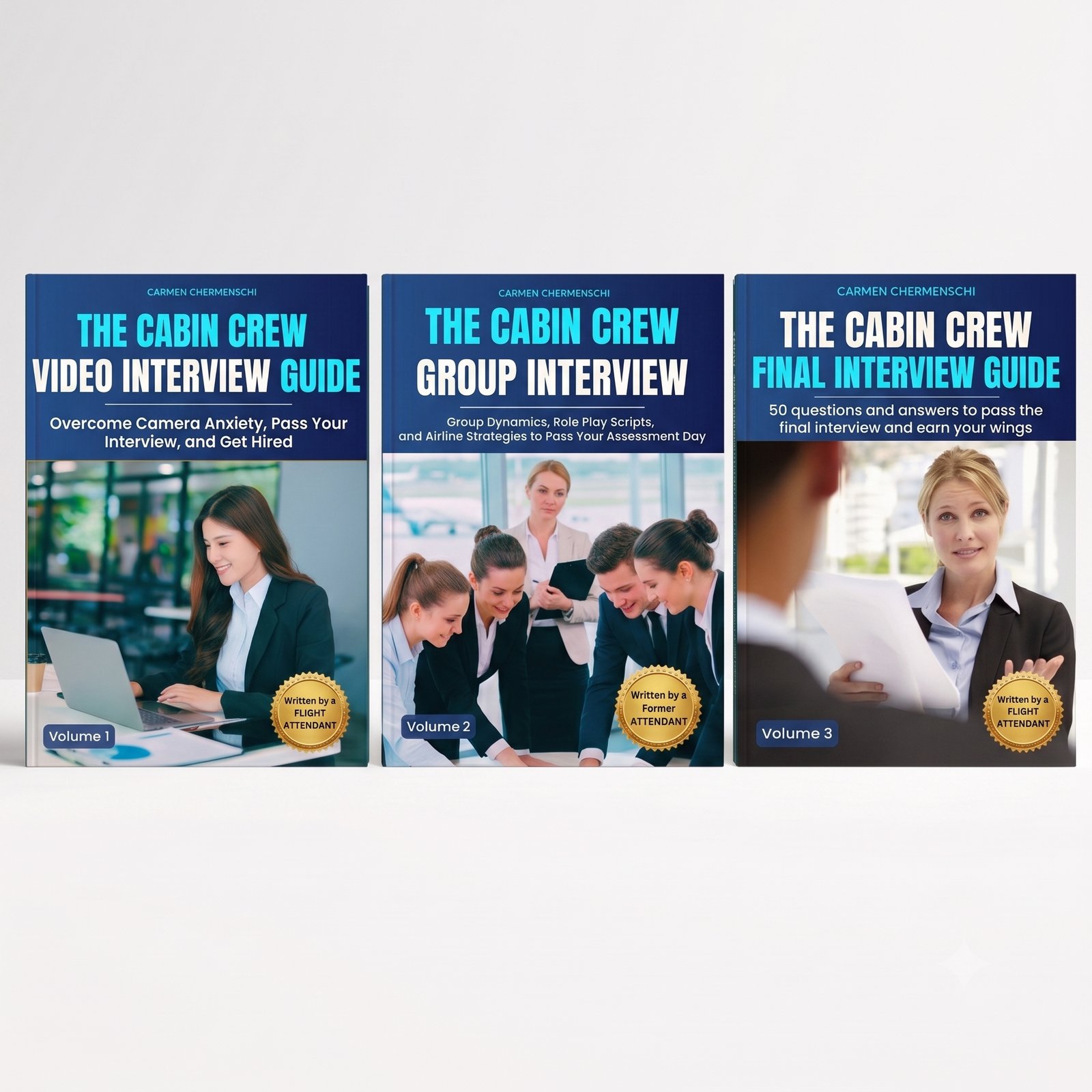
Three selection stages, one book for each
Video interview, group interview with role play, and final interview. Real questions, sample answers, and the mistakes that quietly end an application.
See the booksWant a plan built around your own application? Discover the coaching
Then comes the final interview, one to one, usually on the same day. That is where everything you have said so far gets tested against the person in front of them.
Three stages, three different filters. Preparing for one does not prepare you for the next, and that is the reason most candidates fall somewhere in the middle without ever understanding why.

Final Reflections
The journey is demanding, and I won’t sugarcoat that. But it was designed this way for a reason, because this job requires resilience, clear communication and the ability to manage complex situations in an environment where safety comes first.
The AI is not your enemy. It is a filter with knowable rules, and rules can be learned. The candidates who pass this stage are the ones who understood what was being measured and prepared for it deliberately.
Prepare the setup in advance. Afterwards, prepare five stories. Practise on camera until it stops feeling strange.
Then be entirely yourself, because that part no algorithm can fake for you.
Welcome aboard.
Pass the Video Interview
The video screening is where most applicants are filtered out — often without ever knowing why.
This guide shows you how to handle camera anxiety, control your body language, and record answers that read as confident and credible on screen. By the end, you’ll know exactly what a recruiter is looking for in those first few seconds, and how to give it to them.
FAQ
A one-way recorded interview. A platform shows you a question, gives you a few seconds to prepare, then records your answer against a timer. There is no interviewer and, in most cases, no second attempt.
Emirates, Qatar Airways, Etihad, Riyadh Air and flydubai all record you on camera, mostly through HireVue. In Europe, Ryanair, Aer Lingus, KLM and TUI include a recorded or remote interview after the online tests. British Airways is the exception — its video stage is scenarios you watch, not answers you record.
There isn’t one, in the sense most candidates expect. The British Airways first stage is a suitability screening built from ten video scenarios with multiple-choice answers. You watch situations and choose a response, but nothing you say is recorded. The face-to-face part comes later, at the assessment day near Heathrow.
Emirates screens you on camera before any assessment day invitation, on HireVue. Candidates report three to five questions, around thirty seconds to prepare and ninety to answer, covering motivation, customer situations and teamwork. It comes after an applicant tracking system has already read your CV, so surviving to this stage means the CV worked.
HireVue is the recruitment platform most large carriers use for the recorded stage. It presents questions on screen, records your answers and scores measurable signals such as pace and clarity, before a human recruiter reviews the shortlist.
They fall into four families — motivation, customer situations, teamwork and conflict, and resilience and safety awareness. The questions are predictable. What is not obvious is what each one is measuring.
Usually between sixty and ninety seconds, with a short preparation window before recording starts.
In most cases no. Some platforms offer one unscored practice question, but the recorded answers are final. Prepare as though you have a single attempt, because you almost certainly do.
Yes. Airlines recruit constantly from retail, hospitality and customer service. What matters is showing customer-facing judgement, not aviation experience.
Not meeting the reach or medical requirements, visa and right-to-work issues, visible tattoos depending on the airline, and being unable to swim unaided where that is required. Requirements differ by carrier and change often, so check the current criteria on the airline’s own careers page.
In under 30 seconds, and never as a biography. Who you are, what you do now, one line on why aviation. The order matters more than the content, and getting it wrong sets the tone for every answer that follows.
Full interview dress, not just the upper half. Solid colours, minimal jewellery, hair off the face, and make-up that reads clearly on camera without being heavy.
Light in front of you, never behind. A plain wall or a tidy shelf. Camera at eye level, framed from mid-chest up.
Yes, though not in the way most candidates fear. It scores measurable signals such as pace, clarity, eye contact and answer structure. Human recruiters then review the shortlisted recordings for personality and fit.
Yes. Airlines assess whether you can be understood clearly under pressure, not whether your grammar is flawless. Speaking slowly and clearly matters far more than an accent.
No, and this is the most common confusion in cabin crew recruitment. The British Airways first stage presents ten video scenarios with multiple-choice answers. You watch and you choose. You are never recorded. Candidates who prepare for a recorded interview at this stage prepare for the wrong thing entirely.
In a one-way interview there is nobody there. A question appears, a timer starts, and your recording is reviewed later. Emirates, Qatar Airways, Etihad and Riyadh Air work this way. A live video interview is a normal conversation held over Microsoft Teams or a similar platform, which is what easyJet does. The first is a performance, the second is a conversation, and they need different preparation.
It happens more often than airlines admit. Riyadh Air candidates in particular report screens going black during the recording activity, with nothing saved. Check that your first answer has actually recorded before you continue through the rest, and if the platform fails completely, contact the recruitment team the same day rather than starting again blindly. More in the manual that I wrote.
Ryanair, Aer Lingus, KLM and TUI all include a recorded or remote interview stage, usually after the online tests. Wizz Air still runs most of its selection in person at recruitment days across Europe, and British Airways uses video scenarios rather than a recording.
Between two and three weeks is the range candidates report most often, because a human recruiter reviews the shortlisted recordings after the software has scored them. Silence in the first fortnight means nothing either way. What it does mean is that you should keep applying elsewhere in the meantime.
Related Content You Might Like
Cabin Crew Video Interview — How to Pass It in 2026
When I became a flight attendant at 40, the selection...
Read MoreEtihad Cabin Crew Requirements 2026 | Salary & Process
Quick answer To become Etihad cabin crew in 2026 you...
Read MoreWhich Airlines Are Hiring Cabin Crew | Q4 2026
You may not have realized this yet, but airlines do...
Read MoreThe Cabin Crew Assessment Day – What It Is and How to Pass It
There is a specific kind of silence in a hotel...
Read More