


There is a specific kind of silence in a hotel conference room full of aspiring cabin crew. Forty or fifty people, all dressed in the same dark suits, all smiling a little too hard, all waiting to find out who will still be in the room by lunchtime. I have sat in that silence five separate times before I finally earned my wings — and I can tell you that the candidates who walk out with a job are almost never the ones with the most impressive CV, nor the ones who are best dressed. They are the ones who understood what the day was actually testing.
This is the complete guide to the cabin crew assessment day. What it is, exactly how it unfolds stage by stage, how the biggest airlines in Europe and the Middle East run it differently, and, most importantly, how to pass it. If you read only one article before your assessment, make it this one. By the end, you will understand the day better than most candidates who walk through that door.

What Is a Cabin Crew Assessment Day?
A cabin crew assessment day (often shortened to AD and sometimes called an assessment center) is a structured, full-day recruitment event in which an airline evaluates a large group of candidates through a series of tests, exercises, and interviews.
It is the central gate between submitting your application to become a cabin crew member and receiving a job offer.
The format matters because it is unlike any other job interview. Most jobs assess you in a single conversation, which is easier to prepare for. I can definitely tell you that, this one is like no other. An airline assesses you continuously, from the moment you arrive at reception to the moment you leave, across multiple elimination rounds. After most stages, a portion of the candidates is sent home. Survive every round, and you reach the final interview.
So remember that every stage of the process is eliminatory.
What is the Difference Between Open Day and Assessment Day
First of all, you need to understand the distinction that confuses every beginner:
- An open day is usually a walk-in event. Anyone can attend, no invitation required. You typically bring your CV and may be screened on the spot.
- An assessment day is normally invitation-only. You are invited because your online application or open-day performance passed an initial screen.
Some airlines blend the two into a single recruitment day that starts as an open event and rolls straight into assessment. Either way, the underlying logic is identical — the airline has far more applicants than positions, and the day exists to filter efficiently.
How Competitive Is It?
I want to be honest with you about the numbers, because I think you deserve to know what you are really walking into — and because once you understand it, it stops being scary and starts being useful. For example, when Emirates reopened cabin crew hiring after the pandemic, it received more than 300,000 applications for cabin crew roles alone, during a drive to fill around 6,000 seats. More recently, the wider Emirates Group reported receiving over 3.7 million applications for all its roles in a single financial year.
I remember the first time I really looked around one of those rooms and understood that almost everyone there wanted it as badly as I did. It is a lonely feeling, and I will not pretend otherwise.
But here is the part that changed everything for me, and the reason I am telling you this rather than hiding it. The airline is not sitting there looking for reasons to keep you — there are simply too many of you to keep. It is looking for reasons to narrow the room.
What Recruiters Are Looking For
Here is the single most important mental shift, and it is the thread running through everything below. The assessment day is not an exam where you accumulate points for clever answers. It is a behavioral observation. Remember one important thing — recruiters are not asking what you know! What they are asking is what it would be like to fly with this person at 3 a.m., on a delayed flight, with a frightened passenger and a tired crew. Every exercise is a proxy for that question.
How a Cabin Crew Assessment Day Works

First of all, you need to know that no two airlines pursue identical agendas, but the building blocks are remarkably consistent. A typical assessment day runs roughly from 9 a.m. to 6 p.m. and moves through the stages below, with eliminations along the way.
1. Registration and First Impressions
You arrive at the location, usually a five-star hotel, you register, and you hand over documents (usually a printed CV, your passport, and photos). The first impression is that it feels administrative, but it doesn’t. The assessment has already begun. Recruiters notice how you greet the staff at the desk, how you treat the other candidates, whether you are warm or anxious, and whether you arrived flustered or composed.
Here, a small confession from my own experience — at my very first assessment day, I treated registration as the waiting room before the real thing. I sat in a corner, rehearsed my answers in my head, and barely spoke to anyone because I was literally horrified! I did not make it past the morning. At my fifth — the one that worked — I arrived early, helped someone find the right room, and chatted easily with the people around me. I now know that the recruiters were watching both versions of me — just as they watch every version of everyone in that room.
2. Presentation About the Airline
Most airlines open with a presentation about the company, the role, life at the base, salary, and benefits. It can last an hour or more and it looks like a break. It is partly a sell (the airline is recruiting you too) and partly a filter — some candidates self-select out once they understand the lifestyle. Stay engaged, take it in, and especially resist the urge to switch off. Your body language during passive moments tells recruiters as much as your performance during active ones, so pay attention to your posture.
3. The Reach Test
This is the first hard elimination at many airlines, and it is so simple — for them, pass or fail, no nuance in the middle. You must reach a marker on the wall, typically 212 cm (210 cm at some carriers), usually standing on tiptoes, with shoes off. One or both fingertips need to touch the marker.
If you wonder why this is, it’s purely operational — cabin crew must quickly reach overhead lockers and safety equipment throughout the cabin, in awkward conditions. Many airlines do not publish a fixed minimum height because the reach is what actually matters. As a rough guide, candidates around 160 cm or taller usually clear it comfortably, but the only thing that counts is the reach itself. If you can, I advise you to practice reaching at home so the movement feels natural and you do not waste your one attempt on nerves.
4. The English Language Test
Because aviation operates in English and clear communication equals safety, almost every airline tests your English — and at the Gulf carriers, for example, this is frequently the stage where the highest number of candidates are eliminated. It is usually a written, multiple-choice test covering grammar, vocabulary (often aviation-flavored), and reading comprehension, sometimes with a short essay. The level expected is roughly B2 or above. It is rarely difficult for a confident speaker, but it requires calm and good time management. My advice to you is to read carefully, even twice, work quickly, and do not overthink, because time is ticking.
5. Group Exercises
This is the heart of the assessment day, and the part candidates fear most. I think it’s because of the exposure, and not knowing how you react to others’ reactions. You will be placed in a group — often eight to twelve people — and given a task with a time limit. Classic examples include desert survival and sinking-ship/lifeboat prioritization tasks, building something from limited materials, designing a uniform, creating a radio advert, or discussing who to upgrade on an overbooked flight.
Here is what almost everyone gets wrong. They think the goal is to solve the task perfectly, or to come across as the leader of the group. It is neither. The assessors are watching how you get to the answer. Do you listen to the others? Are the quieter people brought into the conversation? Do you stay calm and warm when someone disagrees with you? Can you move the group forward without steamrolling everyone? I will tell you from experience — the candidate who talks the most is very often the first one cut.
Preparation is King
The group exercise is also where the deepest preparation pays off, because the dynamics are genuinely counterintuitive. Knowing which behaviors recruiters reward — and which mistakes get you eliminated while you think you are doing well — is the single biggest lever you can pull on assessment day. I have broken down exactly how to read and win the group dynamic in The Cabin Crew Group Interview Guide (the group interview manual) because there is far more strategy here than a single article section can hold. If the group stage is the one that scares you, that is the one to study properly.
6. Role-Play and Customer-Service Scenarios
You may be asked to handle a simulated situation — a difficult passenger, a service problem, a disagreement between colleagues. Recruiters want to see structured steps, like, acknowledge, listen, apply the rule clearly, involve senior crew if needed, and follow procedure. At the end, they want someone who stays in control and follows the system, even if you have never worked in the sector. I have also treated this subject in the manual.
7. The Final Interview
If you survive the previous rounds, you reach the final interview — often a one-to-one or panel interview, sometimes a 2:1. This is the final step of the assessment day, when the airline makes its decision, and the psychology of this stage is different from everything that came before.
Throughout the day, recruiters have been looking for reasons to keep you in the room. By the final interview, on the other hand, the maths has flipped, because only a handful of strong candidates remain, and the recruiter is now looking for the one small reason to say no. These are the cruel rules. A single inconsistency, an over-rehearsed answer, a flash of arrogance, an example that does not hold up — any of these can end it.
Understanding this inversion changes how you prepare entirely, and it is the conceptual spine of The Cabin Crew Final Interview — a manual compiled from my experience as an aspiring flight attendant and coach. If you have ever made it deep into a process only to be rejected at the last stage without understanding why, that book exists for exactly that wound.
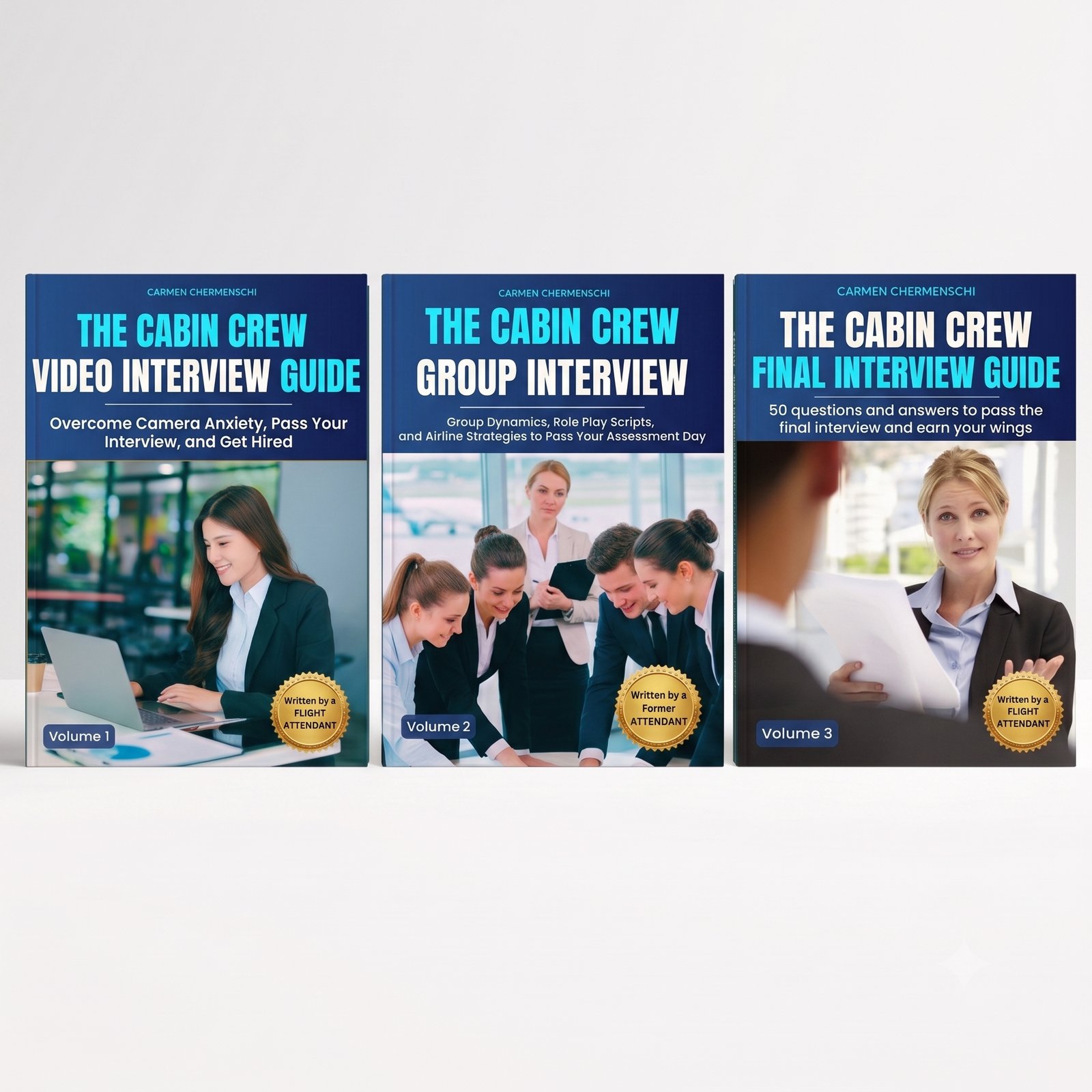
Three selection stages, one book for each
Video interview, group interview with role play, and final interview. Real questions, sample answers, and the mistakes that quietly end an application.
See the booksWant a plan built around your own application? Discover the coaching
8. What Happens After the Assessment Day
Pass, and you typically move to a conditional offer, medical checks (eyesight, hearing, general fitness), and background verification before training begins. The training itself usually runs for several weeks. If, unfortunately, you fail, most airlines impose a waiting period — often six months to a year — before you can reapply. That waiting period is precisely why getting the day right the first time matters so much.
The Six-Month Rule - How Long Before You Can Reapply?
Let me linger on that waiting period for a moment, because it is one of the most searched and most misunderstood parts of this whole journey. If you do not pass, most airlines ask you to wait before reapplying, and the figure you will hear everywhere is the six-month rule.
It really is the norm across both regions. easyJet, for example, openly asks unsuccessful candidates to wait six months from their original application, and the big Gulf carriers like Emirates apply a similar six-month — sometimes up to a year — cooling-off period. But what you should know is that it is not identical everywhere. I strongly believe that knowing the differences can save you a lot of wasted grief.
On the other hand, some airlines have no fixed ban at all — Ryanair simply asks you to keep updating your existing profile rather than starting over, and Qatar Airways does not usually enforce a strict wait, so plenty of candidates who do not pass a CV drop in one city try again at a recruitment event in another a few weeks later.
The point of the cooling-off period, wherever it applies, is for you to come back changed, not just reshuffled.
Never Try to Cheat the System
And here is where I have to be the older sister who tells you the thing your friends in the Facebook groups will not. I know exactly what the temptation looks like, because I have watched it quietly ruin good candidates’ chances. Just make a new account. Use a different email. Change the photos, tweak the name, and go to a recruiter in another country so the system does not recognize me.
Please do not!
Know that airlines today track applicants far more carefully than they did a few years ago, and being flagged for gaming the reapply process is a far worse outcome than an honest rejection. A rejection is a door that reopens in six months, so it is not something to despair over. I recommend you use the waiting time as it was meant to be used — to fix the real gap, whether that is your English, your group dynamic, or your CV. That is the whole reason I am so insistent about getting the day right the first time! Because every attempt costs you months you will never get back, and I would so much rather you spent those months flying than waiting.
The Stage You Should Prepares For - The Video Interview

For more and more airlines, the assessment day does not start at 9 a.m. in the conference room. It can start with a video interview or recorded screening that you complete from home, weeks earlier, and a huge number of candidates are filtered out there, before they ever get an invitation.
Remember that a pre-recorded video interview is its own discipline. You are speaking to a camera with no human reaction to read, often with a time limit per question and no second take. The skills that make you warm in a room can read as flat or rushed on screen if you do not prepare specifically for the format. I have laid out exactly how to perform for a camera — pacing, framing, and sounding natural under a countdown — in The Cabin Crew Video Interview Guide. If your process includes a HireVue, Sonru, or recorded stage, treat it as the first real elimination round, because it is.
Assessment Days - Europe vs the Middle East
Candidates almost always research one airline and then discover their next opportunity is with a completely different one. Time and again, I tell my students not to submit their applications to only one airline, but to several at the same time, and not to be afraid of any overlap. At this point, it is worth understanding how the two big recruiting regions differ in style.
Middle East Carriers: Emirates, Qatar Airways, Etihad, and Riyadh Air

Overall, the Gulf carriers are the most-searched and most-competitive cabin crew employers in the world, and they run the most formal, multi-stage assessment days.
How the Assessment Day Works for Emirates
Emirates (based in Dubai) runs open days and invitation-only assessment days. Expect the 212 cm reach test, an English test that candidates consistently report as the toughest elimination point, group discussions and paired exercises (a common one is presenting three things about a city with a partner), and a final interview often delivered as a hybrid in-person or high-definition video format. For the current intake, Emirates has leaned heavily into cultural intelligence — your ability to work across 160+ nationalities — and remains strict about grooming, with no visible tattoos in uniform and no cosmetic coverings permitted.
Etihad Cabin Crew Assessment Day
Etihad (based in Abu Dhabi) runs invitation-only assessment days worldwide. The published minimums are a minimum age of 21, a minimum height of around 163 cm, fluency in English, and a high-school qualification. The day commonly runs as follows: a reach test, then an English test, then random questions designed to test active listening, then a group exercise (the classic Etihad scenario strands your group in the desert after a 4×4 breakdown), then the final interview. Grooming standards are strict — for example, no visible tattoos or piercings.
Qatar Airways Cabin Crew Assessment Day
Qatar Airways consistently ranks among the world’s top airlines and runs a similarly rigorous multi-stage day, with the same 212 cm reach standard as Emirates and Etihad, and a strong emphasis on service and presentation. You can read more in my full guide to Qatar Airways cabin crew requirements.
Riyadh Air Cabin Crew Assessment Day
Riyadh Air, Saudi Arabia’s brand-new flagship carrier, is the one to watch — and the one where being early matters most. As a digitally native airline still building its very first cabin crew cohorts, its process is front-loaded online. All starts with an application through the official portal, then an online assessment, then a pre-recorded video interview, before you ever reach the in-person assessment day (grooming checks, group activities, the familiar 212 cm reach test, and a final interview).
The published bar sits in line with the rest of the Gulf — minimum age 21, an arm reach of 212 cm, fluent English, basic swimming ability — but the personality they screen for is distinctive: they talk openly about wanting a pioneer mindset, cultural intelligence, and digital fluency, because you would literally be helping shape a brand from the ground up rather than slotting into a decades-old system.
The full journey from application to your first day at the Academy typically runs three to six months. Because the early stages are entirely remote, the video interview is doing a huge amount of the eliminating here, which makes it exactly the stage to prepare for hardest. You can learn more in the full guide I wrote on Riyadh Air cabin crew requirements.
A note on all four – they recruit globally and visit cities across Europe regularly (and screen the first rounds online), so your assessment day may well take place close to home — or from your own living room — even though the base is in the Gulf..
European Carriers: Ryanair, easyJet, Wizz Air, and the Legacy Airlines

European assessment days tend to be a little less ceremonial and increasingly virtual, but the competency focus is just as sharp. For me personally, it is the best place to put a foot in the door of a cabin crew career.
Ryanair Assessment Day
Ryanair (Europe’s largest airline group) has shifted to a largely virtual process: online applications, followed by psychometric tests (personality, verbal reasoning, situational judgment), then interviews. There are also in-person recruitment days for some bases. Training runs roughly six weeks and culminates in supernumerary flights before you earn your wings. They screen hard for character — confident, outgoing, always calm under pressure — and for your right to work in the EU. You can learn more about the Ryanair cabin crew interview in my dedicated guide.
The Eight-Hour Assessment Centre of easyJet
easyJet runs an eight-hour-style assessment centre (when in person; many interviews are now virtual) for groups of up to around 40 candidates. Expect online ability tests first (verbal reasoning, situational judgment, a personality/work-behaviour test), then group exercises — including a sales/presentation element, because in-flight sales matter to them — and a competency-based interview built around their core values (Safety, Simplicity, One Team, Integrity, Passion, Pioneering). Requirements include a height range of roughly 157–190 cm, the ability to swim 25 m and tread water, and tattoos/piercings that can be covered.
Wizz Air Assessment Day
Wizz Air uses an arm-reach test (around 210 cm on tiptoes, barefoot) rather than a fixed published height, and runs a fast-growing recruitment operation across Europe and beyond. If you want to know more, head to my guide on Wizz Air requirements and how to become a cabin crew member in 2026.
The legacy carriers
The legacy carriers (British Airways, Virgin Atlantic, and similar) add extras like swim tests and longer-haul service expectations, but the four pillars — application, online tests, assessment day, training — hold true everywhere.
A final note that applies to all of them – if you understand the reach test, the English test, the group dynamic, the role-play, and the final-interview psychology, you are ready for any of them — and you can apply to several without starting from zero each time.
How to Actually Pass Your Cabin Crew Assessment Day
If I compressed five assessment days, four failures, and one success into a handful of rules, they would be these.
Research the specific airline - not being cabin crew in general
The candidates who fail the “why us” question are the ones who clearly applied to 10 airlines with the same answer. Recruiters can feel it immediately. Know the airline’s routes, fleet, values, and culture, and let it show. Remember that information is power.
Be consistent from the first second to the last
Recruiters watch you when you think you are off-stage — during the presentation, at lunch, when you think you can finally relax, and while someone else is speaking. The candidate who gets hired is the same professional person at 9 a.m. and at 5 p.m. Pretending is exhausting, and your real self leaks out by the afternoon, so do not perform a character.
In groups, move the group forward — do not dominate it
The candidates who fail the “why us” question are the ones who clearly applied to 10 airlines with the same answer. Recruiters can feel it immediately. Know the airline’s routes, fleet, values, and culture, and let it show. Remember that information is power.
Research the specific airline - not being cabin crew in general
Speak early enough to show confidence, then make space for others. It is also more valuable to use people’s names, encourage quieter voices, and handle disagreement gracefully. Even if you disagree with this statement, you are auditioning to be a crew member, not a star. The early mistakes that cost me those interviews were coming across as too timid and reserved — so bring your warmth, and win your wings.
Use real, structured examples
When you are asked about a difficult customer or a conflict, give a true story with a clear shape — the STAR method, which stands for Situation, Task, Action, and Result. Recruiters instantly recognize answers copied from the internet, and exaggeration reads as a red flag.
Lead with SAFETY thinking
Underneath the smile, this is a safety job. Safety is the mantra of airlines, and I always say this to my students before starting a session. Whenever a scenario lets you, show that you think safety first, procedure second, heroics never. This order signals to recruiters that you understand what the role actually is.
Look the part, completely
Impeccable grooming, an outfit that echoes the airline’s style, polished shoes, minimal jewelry, and natural makeup. Decide everything the night before, not in the morning. Appearance is assessed continuously — and if you want more on this aspect, look for my dedicated cabin crew grooming guide.
When You Want a Second Pair of Eyes on Your Assessment Day
Everything above will get you a long way on your own. But there is a limit to what reading can do, because the assessment day is fundamentally about YOU — your specific stories, your particular way of coming across in a group, the blind spots you cannot see in yourself. And this is completely normal, but that is the gap a book cannot close.
This is the work I do one-to-one. Having sat on the candidate’s side of the table five times — and finally crossed it — I help aspiring crew rehearse the group dynamic against real scenarios, sharpen the examples behind their competency answers, get the video interview right before it eliminates them, and walk into the final interview understanding the psychology of that last room. If you want someone to pressure-test your specific case rather than the generic advice, that is exactly what a focused coaching session is for. You can book a 1:1 with me through the site whenever you feel ready for that level of preparation.
I will not pretend it is necessary for everyone, and plenty of people pass with the guides alone. But if you have already failed once and cannot work out why, or you have a single shot at a dream airline coming up, a tailored session is the fastest way to find the thing you cannot see on your own.
The Assessment Day Is Trying to Help You

I want to leave you with something that took me five assessment days to understand, and that I wish someone had told me on day one.
The recruiters are not your enemy. I know it does not feel that way when you are standing against a wall on tiptoes, or when half the room gets sent home before lunch. But the airline truly wants to find good crew, especially because empty cabin-crew positions cost them money, delay their growth, and exhaust the crew they already have. The person assessing you walked into that room hoping you would be the one.
And here is the second thing. The candidate beside you — the nervous one you were comparing yourself to — is very often the one who helps you pass. I am not kidding! This may surprise you, but time and again, the people who get hired are the ones who lifted others up during the group exercise. It feels counterintuitive in a room built on competition, but kindness is not naïve there. The assessment day is the one job interview in the world where being generous to your competition is a winning strategy. I have watched it happen more times than I can count.
So If You Take Nothing Else...
So if you take nothing else from these three thousand words, take this. You do not need to become someone else to pass. You do not need a perfect answer, a good accent, or an extraordinary personality. You need to walk in as the kind, calm version of yourself — the version that already exists on your best days — and let the day do what it is actually designed to do, which is find people exactly like that.
Everything I have written here, you can act on tomorrow, for free, on your own. If at some point you want to go deeper — the exact group-exercise dynamics, the video-interview format, the psychology of that final room — I have put years of it into my guides and my one-to-one sessions, and they are there for you when you want them.
Now go and show them who you are — I will be cheering for you from somewhere over the Mediterranean.
FAQ
Most run a full day, roughly 9 a.m. to 6 p.m. Some Gulf carriers spread the process across one or two days. Some European carriers now compress the early stages into a shorter virtual session.
Formal business attire, like a clean, well-fitted dark suit, polished shoes, neat hair, natural makeup, and minimal jewellery. Aim for an appearance that quietly matches the airline’s own grooming style, and prepare it the night before.
The reach test checks that you can touch a marker on the wall — usually 212 cm (210 cm at some airlines) — on tiptoes with shoes off, because crew must reach overhead lockers and safety equipment. Many airlines publish no fixed minimum height; the reach is what counts. Candidates around 160 cm and above usually clear it.
You solve a timed task in a group of roughly eight to twelve. You stand out not by dominating but by listening, including others, staying warm in the face of disagreement, and moving the group toward a decision. Talking the most is a common way to get cut.
It depends entirely on the airline. Gulf carriers such as Emirates and Etihad require that no visible tattoos be worn in uniform and do not allow cover-up makeup. Several European airlines allow tattoos as long as they can be covered. Always check the specific airline’s grooming policy.
For a confident speaker (around B2 or above) it is manageable, but at the Middle East carriers it eliminates a large share of candidates. It usually consists of multiple-choice grammar, vocabulary, and comprehension questions, sometimes with a short essay. Read carefully and manage your time.
Usually no. Most airlines, including Ryanair and easyJet, explicitly state that no aviation experience is required — attitude and customer service instincts matter more. A paid course or certificate can help your confidence, but it is rarely mandatory.
An open day is generally a walk-in event for everyone, with no invitation required. An assessment day is usually invitation-only and is reached after passing the online application or an open-day screening.
Increasingly both. Many airlines use a recorded video interview or a virtual group stage early in the process, followed by an in-person or hybrid final interview. Ryanair and easyJet lean heavily on virtual formats; the Gulf carriers often hold in-person assessment days.
Expect why this airline, competency questions about teamwork and difficult customers, and scenario questions. By the final interview, the recruiter is looking for a reason to eliminate, so consistency and genuine, specific examples matter more than clever lines.
The most common reasons are not lack of skills. Is is literally arriving flustered, dominating or going silent in groups, speaking negatively about past employers, exaggerating, copying internet answers, inconsistency across the day.
For most airlines, the answer is the six-month rule: you wait roughly six months from your original application before reapplying, and at some carriers, the wait can stretch to a year. easyJet openly asks unsuccessful candidates to wait six months, and Gulf carriers like Emirates apply a similar cooling-off period. It is not universal, though — Ryanair simply asks you to keep your existing profile updated, and Qatar Airways does not usually enforce a strict ban, so candidates often try again at a recruitment event in another city within weeks. Do not try to dodge it with a new account or altered details! Airlines now track applicants closely, and being flagged is far worse than an honest rejection. Use the waiting time to fix the real gap — your English, your group dynamic, your CV, or your confidence.
Typically two printed copies of your CV with up-to-date dates and contact details, your passport, formal and passport-sized photos, and any qualification certificates the airline requested. Pay attention to your passport’s expiry date — it should have no less than 6 months of validity! Check your invitation for airline-specific items.
It varies widely by airline and intake, but assessment days are designed to eliminate the majority through successive rounds. Treat every stage as a real cut, including registration and the presentation.
You will not eliminate nerves — everyone has them. The reliable fix is familiarity — that is, knowing the format of every stage so precisely that there are fewer unknowns to fear. Arrive early, breathe, and remember that the recruiters genuinely want some of you to succeed.
For most airlines, it is the six-month rule – you wait around six months from your original application before reapplying, and at some carriers, the wait can reach a year. easyJet and Gulf carriers like Emirates and Etihad apply this cooling-off period, while Ryanair simply asks you to keep your existing profile updated, and Qatar Airways does not usually enforce a strict ban. Use the wait to fix the real gap — your English, your group dynamic, or your CV — so you come back stronger, not just sooner.
Enjoyed this? Have a look at these too:
The essentials of easyJet cabin crew requirements To become easyJet cabin crew, you need to be at least 18, with no upper age limit, and between 157.5 cm and 190 cm tall without shoes. You must swim 25 metres unaided, speak fluent English, plus the local language for bases outside the UK, and have the right to work in the country of your base. easyJet has announced hundreds of UK roles for 2027, and applications are expected to open soon. The orange livery you could soon be wearing on your uniform too I became cabin crew at 40, and not on my first try. I failed five assessment days before the sixth one finally ended with a yes. Later, I also worked on the ground for a handling company that looked after easyJet flights, so I have seen the orange crews from both sides of the aircraft door. It was during the pandemic, at Lyon-Saint-Exupéry Airport in France, that I first took a close look at easyJet crew members. I loved their relaxed attitude and their elegance, mixed with professionalism. I started to dig a little into their job, and I chatted briefly with one of their crew members, who was waiting to board an aircraft that had just landed from Glasgow for its turnaround. This guide is written for anyone applying to easyJet, whether your base is in the UK or elsewhere in Europe. Most of what you need to know is the same everywhere, and where the rules change for British bases, I tell you clearly. And if you are wondering whether you are too old for this job, keep reading, because easyJet has an answer that might surprise you. In this guide Why apply to easyJet now easyJet cabin crew requirements The easyJet recruitment process Salary and contract Training course and rosters Before you apply FAQ Why You Should Consider Applying to easyJet Right Now Timing always matters, and right now it is on your side. It is a good period! In fact, easyJet has announced a new recruitment drive with hundreds of roles across the UK for 2027, and applications are expected to open in the coming weeks. The airline is also growing its British network, with three new UK routes for summer 2026 and a new base at London Southend. On the European continent, easyJet has been inviting candidates to register their interest for cabin crew roles across France for summer 2027. I want to share a detail that tells you a lot about who easyJet wants on board. Since launching its initiative to recruit older workers in 2022, the number of its cabin crew over 50 has more than doubled, up 127%, while those over 60 have almost quadrupled. Look at the registration. HB means Switzerland, so this aircraft belongs to easyJet Switzerland, one of the group’s three airlines. Today around 12% of easyJet’s cabin crew are aged 50 or over. This is very good news for everyone who still hesitates and keeps writing to me about it. Somewhere in this universe, an airline is looking for people like you, and not only for twenty-year-olds. Know that easyJet is not just one airline; it is three. The group operates as easyJet UK, easyJet Europe (registered in Austria) and easyJet Switzerland. Your base decides which one employs you, which contract law applies, which licence you receive and, in the end, how much you earn. It is completely normal for two crew members wearing the same orange uniform on the same aircraft type to have very different contracts. easyJet cabin crew bases in the UK Region Bases London Gatwick · Luton · Southend South West and Midlands Bristol · Birmingham North of England Manchester · Liverpool · Newcastle Scotland Edinburgh · Glasgow Northern Ireland Belfast easyJet cabin crew bases in Europe Country Main bases Language beyond English Employer France Paris CDG · Paris Orly · Lyon · Nice · Toulouse · Bordeaux French easyJet Europe Italy Milan Malpensa · Naples · Venice Italian easyJet Europe Spain Barcelona · Málaga · Palma Spanish easyJet Europe Portugal Lisbon · Porto · Faro Portuguese easyJet Europe Germany Berlin German easyJet Europe Netherlands Amsterdam Check the advert easyJet Europe Switzerland Geneva · Basel French or German easyJet Switzerland Outside the UK, you need fluent English plus the native language of your base. For example, a base in Berlin requires fluent German as well as English. People sometimes see this as an extra hurdle, and that is perfectly understandable. I advise you to see it as common sense, and I learned why on the ground, not in the air. When I worked at the check-in desk in France, the passengers who needed me most were the ones who barely spoke English. They were the elderly couple travelling for the first time, the parent with a crying child and a missing boarding pass, the passenger who panicked because the gate had changed at the last minute. In those moments, speaking their language was crucial. I quickly learned that a few calm words in pure French could do more than a perfect sentence in English. On board, it is the same, only with less space and less time. English is the language of safety, the one you use with the pilots and in your procedures, the language of aviation. The local language is the one that reaches the passenger in front of you when something goes wrong. Contracts follow the employment law of the base country, so salary, holidays, and conditions change from one country to another. If you are aiming for an Italian base, my Italian guide to easyJet goes into detail on the Italian contracts. Next campaign expected soon Updated 29 September 2026 easyJet has announced hundreds of cabin crew roles for 2027 across its UK bases, but applications are not open yet. The careers page says the airline is finalising its needs for summer 2027. Check it often, because vacancies go live base by base and can close quickly.Read More »easyJet Cabin Crew Requirements 2026 & Assessment Day
Roster in a nutshell — A cabin crew roster is your monthly work plan, with every flight, standby, training day, and day off. In the United States, the same document is called a flight attendant schedule or line. In the UK and Europe, the airline builds your roster and publishes it in advance. Most US airlines let crew members bid on their schedules based on seniority. Wherever you fly, legal minimum rest periods protect you. In the UK and Europe, you get at least 12 hours at home base and 10 hours away from base. In the US, you get 10 hours after any duty of up to 14 hours. There’s quite a bit of confusion around flight attendant roster planning, and in this article, I would like to shed some light on it. I want you to know that my experience will guide you. When I received my first roster after completing the Ryanair Training Course, it was the most amazing feeling of my life! That’s why I can freely tell you that the day you receive your first Roster will be an unforgettable moment. I must also warn you. The first time you open it, it feels like looking at The Matrix. Codes, airport identifiers, strange times… You won’t understand much, despite the intensive study days you’ve just completed. You’ll also wonder whether you’ll ever have a social life again. This complete guide will help you read your roster, whether you fly from London, Dublin, Dubai, Sydney, or Chicago. ✈Your flight plan What is a cabin crew roster? Swaps, requests and annual leave Roster, schedule or line around the English-speaking world Anatomy of a cabin crew roster A cabin crew roster example Typical roster patterns by type of airline How rosters are built — allocation vs bidding Rest and duty limits Standby and reserve Roster apps The work-life balance reality My view — what the roster can really teach you FAQ Flight attendant reviewing her duty Roster What is a cabin crew roster? A roster is simply your crew schedule, usually for one calendar month. In aviation, this document is sacred. It decides where you’ll sleep, when you’ll see your friends and a good part of how much you’ll earn. It is your map, and you should always keep an eye on it. Your roster is built by the airline’s crew planning (or rostering) department. Specialised software combines flights, aircraft, crew qualifications and legal rest limits. Contrary to what some people think, your roster doesn’t depend on anyone’s personal preference. It solves a huge puzzle in which you are one piece among thousands. Behind the scenes — how your roster is really built Few people know this, but your roster is born in two separate stages, often months before you see it. Stage 1 — pairings. Planners first cut the airline’s whole timetable into pairings (called trips or sequences in the US). A pairing is a chain of flights that starts and ends at the same base and respects every legal limit. At this stage there are still no names, only anonymous duties. For example, a pairing might be Stansted – Alicante – Stansted – Dublin – Stansted, or a three-day trip with a layover in New York. Stage 2 — rostering. The software then assigns those pairings to real people, and this part is far from simple, because everything has to match perfectly. It checks your qualifications, your annual leave, your training dates, your requests and your rest from the previous month. It also tries to share out early starts, late finishes, weekends and flying hours fairly across the whole crew. The numbers behind this are huge. With hundreds of daily flights and thousands of crew members, the possible combinations run into the billions. Airlines use mathematical optimisation software, from providers such as Jeppesen, Sabre or Lufthansa Systems, to find the best solution in a few hours. I was really surprised to learn that crew costs are one of an airline’s biggest expenses, often second only to fuel, so saving even 1% can mean millions every year. And this intricate mix of numbers, codes, destinations, and names never stops moving. Once the roster is published, the crew control team takes over and rebuilds it in real time every time a flight is delayed, a storm closes an airport, or a colleague calls in sick. That’s why your roster can change overnight. The puzzle is simply moving again. Swaps, requests and annual leave The swap (shift exchange, trip trade in the US) is your lifeline. Your best friend’s birthday falls on a working day? A family event you can’t miss? A swap can save the day. How it works, though, depends a lot on your airline. Crew-to-crew swaps. At many airlines, especially in the US and at some long-haul carriers, you find the colleague yourself. You post your duty on the crew app or a swap board, you agree with a colleague to exchange duties, and crew scheduling approves the deal. This is exactly where your negotiation skills become fundamental, and believe me, you’ll negotiate a lot throughout your cabin crew career. Swaps through the rostering team. At other airlines, you don’t hunt for anyone. I remember the first time I went on a short trip to Paris. I had the brilliant idea of taking the wrong shoes, walked 14 km with almost no breaks, and by the end of the day I was literally exhausted. The next day I wasn’t able to work, so I called the rostering team. They checked who was available and legally able to take my place, reallocated the duties, and confirmed the change. Your request may look simple, but behind that phone call, they have to respect rest limits, qualifications, and the rosters of every other crew member involved. The earlier you ask, the better your chances. Either way, once you start working, remember one rule. A swap is never guaranteed until crew scheduling or rostering confirms it; until then, yourRead More »Cabin Crew Roster Guide – How It Works (Complete Guide 2026)
At a glance. Jet2 is recruiting cabin crew now for summer 2027. The advertised on-target earnings are £35,200+ (pro rata for the length of the contract), including commission, flight duty and sector pay. The contracts are full-time, fixed-term contracts until the end of the summer season (November 2027), with the potential to return for summer 2028. Training is a 4-week, CAA-approved, paid course with no upfront costs. And the rule most candidates miss is that only one cabin crew application is permitted per recruitment season, so the base you choose is the base you get. I earned my wings at 40, after failing five assessment days before Ryanair finally hired me on the sixth. I flew for Ryanair and Buzz, then went back to airport ground work, where I handled check-in for easyJet, Wizz Air and other carriers. So I know the British-style low-cost selection from the inside. In this guide Jet2 recruitment 2027 and the 14 bases The selection process, step by step Jet2 cabin crew interview questions Jet2 cabin crew salary and wages Jet2 cabin crew requirements in the UK Training and life on the line Before you apply Jet2 cabin crew FAQ Jet2 Cabin Crew Recruitment 2027 — Choose Your Base Carefully Jet2 is a fast-growing company. The group describes itself as the UK’s third-largest airline, with a fleet of 138 aircraft in summer 2026 flying from 14 UK bases. The newest one is London Gatwick, where the first flights departed on 26 March to Tenerife and Alicante, in what the airport called its largest airline launch in more than a decade. The good news is that the summer 2027 campaign is already open. At Stansted alone, the airline has added eight new destinations to its summer 2027 program, bringing the total to 55 routes and more than 2.4 million seats. The current advert covers Gatwick, Luton and Stansted. One application, one base, one season Here is a part you should know, and it makes all the difference. Jet2 asks you to apply only for the airport you wish to be based at, because subsequent applications cannot be considered. In practice, that means one application, one base, one season. So if you apply for Manchester and then realise Liverpool would be easier to reach at 4 am, you cannot switch. The advert also asks that you can travel reliably to and from your airport base for all rostered shifts, and Jet2 really means it. This is because early reports often start before public transport does. The 14 Jet2 cabin crew bases Belfast InternationalNorthern Ireland BirminghamWest Midlands BournemouthSouth West BristolSouth West East MidlandsEast Midlands EdinburghScotland GlasgowScotland Leeds Bradford Yorkshire Head office LiverpoolNorth West London Gatwick South East New · March 2026 Recruiting for 2027 → London Luton East of England New · April 2025 Recruiting for 2027 → London Stansted East of England Recruiting for 2027 → ManchesterNorth West NewcastleNorth East Recruitment open now Updated 22 September 2026 Jet2 is recruiting cabin crew for summer 2027 at London Gatwick, London Luton and London Stansted. Last year, further campaigns and open days followed between October and December, so if your base is not listed yet, set a job alert now and check back regularly. See Jet2 cabin crew vacancies → All Jet2 cabin crew bases are in the UK. Jet2.com is the airline, and Jet2holidays is the tour operator that sells package holidays on Jet2.com flights, so the cabin crew job is the same regardless of which brand you see in the advert. If you find Jet2 jobs in Spain, Portugal or Greece, they are resort and ground roles with Jet2holidays, not cabin crew positions. Jet2 opens its seasonal campaigns base by base, and closes them once places are filled, so apply as early as you can. The fastest way to know when applications open is to set a job alert for the base you want on the official Jet2 cabin crew careers page, not for Jet2 in general. The Jet2 Cabin Crew Selection Process The Jet2 process is shorter than many airlines’ and very British in style. It checks your paperwork almost as carefully as your personality. Online application and online assessment The application form is short. Right after it comes the online assessment. Candidates take a timed reading comprehension and detail-checking test. But this is not an aviation exam — it tests whether you read carefully and spot errors fast, which is exactly what you will do every day with safety paperwork and passenger lists. Do it somewhere quiet, with a clear head, in one sitting. The video or phone interview If you pass, a recruiter contacts you for a short interview by phone or video. Usually, it is by video. Expect questions about the basic conditions of the job (early starts, fixed-term contract, travel to base) and then about your customer service experience. Answer the practical questions with a clear yes, I understand, and I can do that. Recruiters are checking that you have read the advert, not only that you are friendly. If your invitation is for a recorded video interview instead, the rules change completely, from the questions you will hear to the way you look at the camera. I explain them in my book “The Cabin Crew Video Interview Guide” The assessment day The Jet2 selection process is slightly different from other airlines. First, a reach-and-jump seat test; then, introductions and group exercises; and finally, for those who get through, an individual interview in the afternoon. The pair’s presentation The introductions are not the classic “tell us about yourself” but rather a short presentation with a twist. One candidate described a presentation exercise where you went to the front in pairs and had to tell the room about your partner’s most embarrassing moment, then swap stories after a few minutes. The trick is to give your partner a short, light, kind story with a funny ending. Mine would be my first date alone with the man who is now my partner. WeRead More »Jet2 Cabin Crew 2027 — Requirements, Selection and Pay