If you have been refreshing the Wizz Air careers page, waiting for a recruitment day near you, you are not alone. Wizz Air is one of Europe’s fastest-growing low-cost carriers. In 2026, it is still expanding aggressively — flying more than 800 routes across over 50 countries and running cabin crew recruitment days in close to 30 locations across more than a dozen countries. That growth is exactly why so many first-time candidates have a real chance this year, including people with no aviation background at all. Not having prior experience in aviation has never been a problem when it comes to making your dream come true!
What You Really Need to Know
I spent years as cabin crew before I started helping candidates prepare, and there is one pattern I see again and again. Aspiring cabin crew members memorize the requirements list, walk into the assessment day, and are completely blindsided by what actually gets them shortlisted. Remember that the requirements are the easy part. They are written down, they are public, and almost everyone in the room meets them. However, there is something else entirely that separates the candidates who get offers from those who don’t.
So, in this full Wizz Air guide, I am going to give you both halves of the picture. First, the hard facts for 2026 — age, arm reach, tattoos, English, salary, the full recruitment timeline — drawn from Wizz Air’s current criteria. Then the part that matters more for you right now – what recruiters are looking for from the moment you walk through the door, and how I would prepare if I were applying today.
Let’s start with the numbers, because they are an important part of your decision.
Quick Wizz Air Requirements
| Requirement | Details |
|---|---|
| Minimum Age | 18 at the time of application; no official upper limit |
| Minimum Height | No fixed height — assessed by arm reach instead |
| Arm Reach | 210 cm on tiptoes, barefoot |
| English Level | Fluent, spoken and written (whole process is in English) |
| Education | Secondary school diploma / GCSE level or equivalent |
| Swimming Ability | Must swim unaided |
| Tattoos | None visible while in uniform |
| Passport / Right to Work | Valid passport (min. 6 months); legal right to work at the base — Wizz Air does not sponsor visas |
| Customer Service Experience | Not required, but strongly valued |
Wizz Air Cabin Crew Requirements 2026 (Full List)
Here is everything Wizz Air expects from a cabin crew candidate in 2026, with a little context on why each one exists — because understanding the reasoning behind a requirement is the first sign to a recruiter that you actually understand the job. You should know all of these by heart, so you are not caught by surprise at the moment of your application.
One of the biggest mistakes I saw candidates make — and I made versions of it myself early on, when I started my own adventure — is assuming airlines mostly evaluate how you look. It matters, of course, because you are the face of the company. But appearance only gets you in the door. Communication and customer-service orientation are what actually carry you through the day. A recruiter can teach you the uniform standard in an afternoon, but they cannot teach you to be warm and calm under pressure. So that is what they are really screening for.
Age, Passport & Right to Work
You must be at least 18 on the day you apply. There is no published upper age limit, and I will come back to this later, because it matters more than people think.
You also need a valid passport with at least six months’ validity and no limitations, plus the legal right to live and work at your chosen base. This is non-negotiable, and Wizz Air does not sponsor work visas, so your eligibility has to already be in place before you apply.
English & Languages
Fluency in both speech and writing is essential. The entire recruitment process — every conversation, every exercise, every form — is conducted in English, so this is assessed continuously, not just in a formal test. As a rule of thumb in aviation, a solid B2 level is enough to write, understand, and memorize everything you will need during the training course. I learned this the hard way, because without my B2 in place, the door to my cabin crew dream stayed shut until I earned it.
A second European language can be an advantage at certain bases, but it is not mandatory.
Communication, Flexibility & Grooming
Wizz Air openly looks for cheerful, energetic, positive candidates who like working with people — and this may be the single most observed quality on the assessment day.
You also need to be flexible and willing to relocate. You should be able to live within commuting distance of your base, be ready to move there, and be available for early starts, late finishes, and irregular rosters. If you are not willing to relocate, your application can be stopped right there.
Finally, grooming. Professional, polished, in line with company guidelines. Neat is the standard — nothing more complicated than that. You must also be able to swim unaided for 25 meters, which catches some people out. Still, it is a mandatory safety requirement because water evacuation is part of the job, regardless of where you fly.
Wizz Air Height and Arm Reach Requirements
Wizz Air does not publish a fixed minimum height, which surprises many applicants. Instead, it uses an arm reach test in which you must reach 210 cm while standing on tiptoes, barefoot.
This is not about height for its own sake. Cabin crew have to access safety equipment and close overhead lockers across the whole cabin, often quickly and in awkward conditions. The reach test is simply a practical check to ensure you can perform the physical parts of the job safely. It is measured on the assessment day, usually against a marked wall.
A quick, honest tip from my personal and coaching experience – posture matters here, and in a way candidates don’t expect. Standing tall, shoulders back, reaching with confidence — it sends a very good signal. Honestly, I think good posture is the number one requirement for almost any job. Recruiters watch how you carry yourself all day, and, as I wrote in one of my first books in the Cabin Crew series, you are being judged from the moment you step out of your car in the car park.
Wizz Air Tattoo Policy
No tattoos visible while wearing the uniform. Wizz Air’s rule is straightforward, and it covers the arms, hands, neck, and lower legs — anywhere the standard uniform does not reach. And for everyone who asks me this all the time: piercings are treated the same way.
Tattoos in areas the uniform fully covers are generally not a problem. The deciding factor is visibility in uniform, not whether you have ink at all. If you are unsure how your tattoo sits relative to the uniform cut, check the current uniform style before assuming you are fine, and know that policies can be interpreted slightly differently depending on the recruiter and the exact placement. Don’t rely only on what friends tell you they heard about Wizz Air’s tattoo policy.
Overall, grooming follows the same logic as everything else on this list: neat, professional, and consistent with company guidelines. Nothing that pulls focus from the safety-and-service professional you are there to be.
Wizz Air Cabin Crew Salary 2026
Like with any job in the world, salary is one of the most important things when you are deciding whether to work for a company. Wizz Air uses a performance-based pay model with a fixed base salary, plus sector pay for each flight you operate, plus commission on onboard sales.
A good thing to know is that what you actually take home depends on your base country, how many hours you fly, and how well you sell, which means two crew on the same contract can earn noticeably different amounts. I know that can feel unfair at first. Wizz Air’s own published target annual figures for the UK base give a useful anchor (based on an average of 18–28 flights per month):
| Position | Estimated Annual Target (UK base) |
|---|---|
| Junior Cabin Attendant | ~£23,450 |
| Cabin Attendant | ~£26,450 |
| Senior Cabin Attendant | ~£33,850 |
Across the wider European network in 2026, the picture looks roughly like this:
| Component | Typical 2026 range |
|---|---|
| Base salary — Central & Eastern Europe | ~€900–€1,300 gross / month |
| Base salary — Western Europe | ~€1,200–€1,600 gross / month |
| Sector pay | ~€5–€12 per operated flight |
| Onboard sales commission | ~€150–€400 / month (strong performers €500+) |
| Senior responsibility allowance | ~€150–€300 / month |
| Total monthly gross (typical) | ~€1,400–€2,400 depending on base & performance |
Two honest notes on the money. First, the commission element is real, and it rewards people who enjoy interacting with passengers — the same warmth that gets you hired tends to be the thing that boosts your earnings later. Second, training is free of charge, removing one of the upfront barriers that other career paths put in your way. When I started my career, almost every low-cost airline required you to pay for the training course yourself. Today, it is far easier to join the team without going broke before you have even started flying.
Can You Become Cabin Crew Without Experience?
Yes — and this is one of the most encouraging things about Wizz Air for first-time candidates. As I mentioned, previous cabin crew experience is not required. Wizz Air hires new people to the aviation industry all the time, and the training does the technical heavy lifting once you are in.
What it really wants is evidence that you already know how to look after people and work as part of a team. That evidence rarely comes from a flying background — it usually comes from the jobs you may be underselling on your CV. I tell my students to always pay attention to these when they write theirs:
- Hospitality — restaurants, bars, hotels: pace, pressure, reading a room, recovering when something goes wrong.
- Retail and customer service — handling complaints, staying friendly when you are exhausted or frustrated, and hitting targets while staying personable.
- Care, teaching, reception, events — anything where your calm directly affected someone else’s experience.
- Languages — even conversational ability in a second European language can set you apart at the right base.
What if you're a career changer
If you are a career-changer or coming straight out of school, your job is not to invent experience you don’t have. Many older candidates looking to change careers have told me they were so worried about having nothing to do with aviation that they almost gave up on the dream entirely. But you can literally translate the experience you do have into the language of the cabin. The candidates who do this well almost always prepare concrete examples in advance, rather than hoping the right story will surface under pressure on the day. And believe me, that preparation is visible to a recruiter within the first few minutes.
The Wizz Air Recruitment Process, Step by Step
Wizz Air’s process is sequential and elimination-based, as are most airlines’ selection processes. So, candidates are progressively shortlisted throughout the day, and not everyone who starts the morning is still there by mid-afternoon. Here is the full path:
- Online application. Through the Wizz Air careers page. You can register for a recruitment day at any location, regardless of the base you ultimately want.
- Online video interview (in some cases). Depending on the country and the hiring campaign, you may be asked to record a short video interview before being invited to a recruitment day — answering set questions on camera, with no recruiter present. It is not part of every application, but it does happen. If you receive one, treat it seriously — it is a real filter and very reusable. If you want to walk into that video interview already knowing what to expect, I put everything I know into my Cabin Crew Video Interview Guide.
- Recruitment day registration. You book a specific event and bring an updated English CV, an ID photo, and your documents.
- Document verification. The day opens here, and punctuality is critical — latecomers may not be allowed to take part at all.
- Company presentation. Wizz Air representatives explain the role, the salary, the lifestyle, and the benefits.
- Group exercises and role-play. This is the heart of the assessment, and where most eliminations happen. More on this below.
- One-to-one interview. If you progress, you sit down with a recruiter for roughly 30 minutes of questions about your suitability for the role.
- Background and medical checks. Before any offer, Wizz Air follows up on references. It verifies your work history (typically the last five years, including any gaps), runs a criminal record check, reviews financial history, and asks you to complete a medical examination to EASA or UK CAA standards.
- Job offer and training. Once checks clear, you receive an offer and a start date. Training typically lasts 4–6 weeks, is free, and takes place at one of Wizz Air’s main bases.
Is There a Video Interview for Wizz Air?
There is a common belief that Wizz Air only ever assesses candidates face-to-face on its recruitment days. That is largely true, but it is not the whole picture — and getting this wrong has caught people out.
Wizz Air’s process is generally built around in-person recruitment days. The airline notes that recruitment can evolve and may vary by country, hiring campaign, or operational needs. Candidates should always carefully read the instructions they receive after applying. I have personally coached a candidate who, after applying to Wizz Air, was asked to complete an online video interview before anything else — recording answers to set questions alone in front of a webcam, with no recruiter to respond to and no second take once she submitted.
The video stage is the one candidates are least ready for, because talking to a camera feels nothing like talking to a person. It is also, ironically, the most trainable stage of the whole process. The questions are predictable enough to rehearse, and your delivery — pace, eye contact, structure, energy — improves dramatically with practice. Recording yourself answering real questions beforehand is the single highest-return thing you can do if a video stage appears in your application. That is exactly the focus of my Cabin Crew Video Interview Guide, which walks you through the kinds of questions asked at the online video stage and shows you how to deliver your answers to the camera with confidence, rather than freezing up the moment the recording light comes on.
What Really Happens During the Assessment Day
This is the part I wish someone had told me before my first assessment day, so that I could be direct with you.
The exercises — the group discussion, the role-plays, the short interview — are not really separate tests. They are one long, continuous observation, and that observation does not stop when an exercise ends. As a former crew member, what stayed with me was how closely recruiters watch candidates between the official stages – in the waiting area, during the coffee break, and in the small talk before things formally begin. The candidate who is charming during the role-play but cold and dismissive to the person next to them in the queue is sending a far louder signal than they realize. This is the first thing I ask about when a student tells me they failed the assessment day — and nine times out of ten, this is where it went wrong.
So here is what is actually being measured, all day long:
Communication — warmth, and the ability to listen as well as speak.
Teamwork — do you lift the group, or do you compete with it?
Problem-solving under mild-to-high pressure.
Energy and presence — Wizz Air says it openly: cheerful, energetic, positive. It cannot be a performance you switch on for the recruiter and off in the corridor.
Self-awareness — knowing when to step forward and when to make space for someone else.
The group stage is where I see the most capable candidates eliminate themselves, almost always by getting teamwork wrong — either disappearing into silence or steamrolling everyone else to look like a leader. Both read as a risk. The role-play scenarios, similarly, are less about finding the correct answer and more about how you handle a difficult passenger. Knowing in advance exactly how recruiters score these two stages, and rehearsing realistic versions of them before the day, is the difference between reacting on instinct and walking in with a plan. That is precisely the gap my full guide, The Cabin Crew Group Interview & Role-Play, was written to close — it breaks down how teamwork and communication are actually evaluated in the group stage. It gives you realistic scenarios to practice, so the room feels familiar before you ever arrive.
Not sure what actually happens once you walk into the room? I’ve written down everything you’ll face on the Assessment Day, step by step, so nothing catches you off guard.
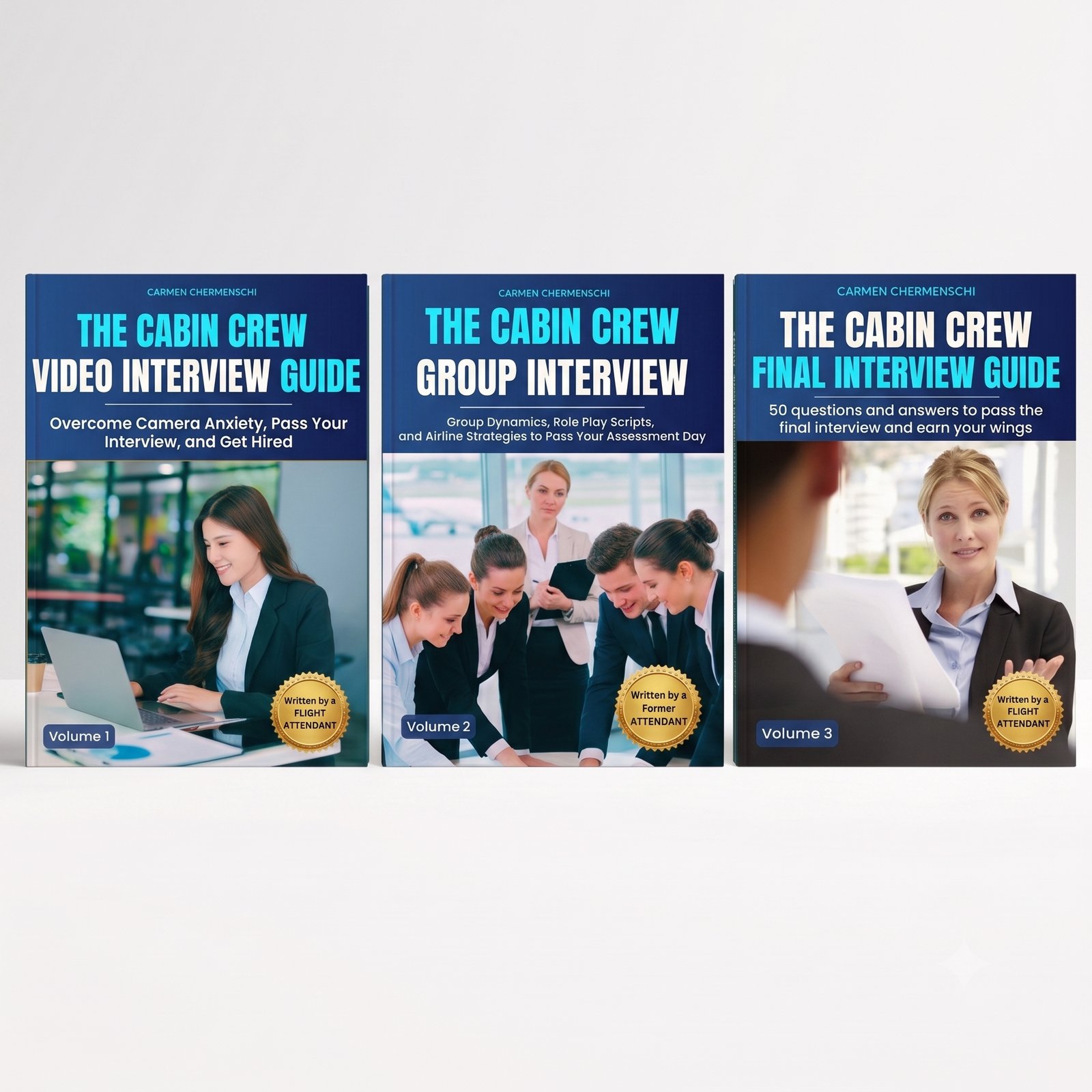
Three selection stages, one book for each
Video interview, group interview with role play, and final interview. Real questions, sample answers, and the mistakes that quietly end an application.
See the booksWant a plan built around your own application? Discover the coaching
Common Mistakes Cabin Crew Candidates Make
From my experience, these are the patterns that quietly end strong applications:
- Memorized, robotic answers. Recruiters hear the same rehearsed lines all day.
- Inconsistent energy. Warm in the interview, flat in the group exercise, dismissive on the break. Consistency is the test.
- Weak teamwork. Dominating the group, or vanishing inside it — both are red flags.
- No airline research. Not knowing that Wizz Air is a low-cost carrier with a sales-driven onboard model suggests the basics haven’t been covered.
- Talking too little — you give them nothing to assess.
- Talking too much — you take up the oxygen others need, which is itself a failure of teamwork.
- Grooming that misses the mark on neatness and professionalism.

How I Would Prepare for a Wizz Air Interview
If I were walking into a Wizz Air assessment day next week, this is exactly what I would do — in this order:
Research the airline properly. Understand the low-cost model, the onboard sales culture, the bases, and the lifestyle. Be able to say why Wizz Air in a way that isn’t generic.
Prepare real STAR examples. Situation, Task, Action, Result — a handful of genuine stories about teamwork, handling a difficult customer, staying calm under pressure. The STAR method is powerful, but your mantra should always be “prepared, not memorized.”
Practice customer-service role-play out loud. Don’t just think the scenarios through — rehearse them with another person until empathy and composure feel automatic.
Sort grooming the night before. Lay everything out so the morning is calm. Nothing is scarier than a pair of trousers that split as you put them on, or a shirt you suddenly can’t find in your wardrobe.
Sleep. It sounds trivial, but it isn’t. Energy and presence are scored all day, and you cannot fake them on no sleep.
You Don't Have to Do This Alone
Let me be honest with you, the way I would with someone sitting right across from me.
You can absolutely do this on your own — and many wonderful crew members did exactly that. But here is what I see again and again. When a candidate doesn’t make it through the assessment day, it is rarely about talent. It is usually one specific, fixable thing – an English level that wasn’t quite ready, nerves that took over during the group exercise, or simply walking in without knowing what the day would actually look like. And the hard part is what comes next — in this industry, a no often means waiting around six months before you can even apply again.
If you would prefer not to lose that time, this is why I built my coaching path. It is designed to get you ready for the day that matters. We work through real interview simulations, group and role-play exercises, your English, your STAR examples — everything, rehearsed until it feels familiar. I take each of my students by the hand from the very first session right up to the day before their assessment, so they walk in calm, prepared, and sure of themselves.
Now it could be your turn. → Discover the coaching path and book a free first chat.
Wizz Air Cabin Crew — Key Takeaways
- Wizz Air is actively recruiting cabin crew across Europe in 2026 and is still expanding.
- Previous experience is not required — transferable customer-service and hospitality skills matter most.
- You must be at least 18, with no published upper age limit.
- There is no fixed height; you must reach 210 cm on tiptoes, barefoot.
- Fluent English (spoken and written) is essential and is assessed all day.
- Tattoos must not be visible in uniform; grooming must be neat and professional.
- Pay is performance-based — base salary plus sector pay plus onboard commission.
- The selection day is eliminatory, and recruiters observe you even between exercises.
- Training is free and lasts about 4–6 weeks.
- The candidates who succeed prepare real examples and rehearse the group and interview stages in advance.
FAQ
Yes. Previous cabin crew experience is not required. Wizz Air regularly hires first-time candidates and trains them from scratch. Transferable skills from hospitality, retail, or customer service matter far more than a flying background.
Usually not — Wizz Air’s recruitment is generally focused on in-person recruitment days and face-to-face assessments. However, the process can evolve and may vary by country, hiring campaign, or operational need, and some candidates have been asked to complete an online video interview after applying. Always read the instructions Wizz Air sends you after your application carefully, and be ready for a video stage in case it applies to you.
Yes. Wizz Air recruits cabin crew continuously throughout the year as it continues to expand across Europe, holding in-person recruitment days in close to 30 locations across 14 countries. New dates are added regularly and fill up fast, so the best move is to check the Recruitment Days section of the official Wizz Air careers page and register for the event nearest you as soon as it opens.
Only if they are not visible while you are wearing the uniform, tattoos on the arms, hands, neck, or lower legs that can’t be covered are not accepted. Covered tattoos are generally fine, though borderline placements can depend on the recruiter.
Fluent English, spoken and written. The entire recruitment process is conducted in English, and it is assessed throughout the day, not only in a formal test. A solid B2 level is a good benchmark.
There is no published upper age limit, so yes. Wizz Air assesses fitness, attitude, and customer-service ability rather than birth year. Maturity and life experience can really work in your favor.
You need a valid passport (at least six months’ validity) and the legal right to work at your chosen base. Wizz Air does not sponsor work visas, so your right to work must already be in place.
There is no fixed minimum height. Instead, you must reach 210 cm on tiptoes, barefoot. This is tested on the day of the assessment.
Yes. You must be able to swim unaided. It is a genuine safety requirement tied to water-evacuation training.
Typically, 4 to 6 weeks. It is free of charge and takes place at one of Wizz Air’s main bases.
Pay combines a fixed base, sector pay per flight and onboard sales commission. Total monthly gross typically lands around €1,400–€2,400 depending on base and performance. Wizz Air’s UK target figures run from roughly £23,450 (junior) to £33,850 (senior) per year.
It is competitive rather than academically hard. The stages are eliminatory, so the challenge is sustaining genuine warmth, teamwork, and energy across the whole day — including the informal moments.
Wizz Air does not generally provide accommodation. You are expected to live within commuting distance of your base or relocate there, so factor local living costs into your decision.
The assessment day itself usually runs until late afternoon. After that, background, reference and medical checks take additional time before an offer and a training start date are confirmed.
An updated English CV with an ID photo, your passport, and any relevant certifications. Arrive early — latecomers may not be admitted at all. consequatur.
Yes. You can join any recruitment event regardless of which base you ultimately want to be based at.
Explore More Cabin Crew Guides
When I became a flight attendant at 40, the selection process looked nothing like it does today. I remember walking into that five-star hotel numerous times, nervous, knowing that someone would decide my future. The recruiters were right there in front of me. I could read their expressions, adjust my answers in real time – not easy, actually – and feel the energy in the room.That world doesn’t exist anymore, or at least, not in the way it used to. Young man ready for the online interview Today, before a single human being looks at you, you sit alone in your bedroom talking to a webcam and a countdown timer. Unfortunately, today the cabin crew video interview is where most candidates are eliminated, after the CV screening, which today has also evolved into an ATS system. A lot of applicants are completely lost at this point, because there is so little information about this stage. I want to change that for you. Pass the video interview The video screening is where most applicants are filtered out, often without ever knowing what went wrong. The Cabin Crew Video Interview Guide shows you how to handle camera anxiety, control your body language and record answers that read as confident on screen. See it on Amazon What a cabin crew video interview actually is It is called an asynchronous interview, or a one-way interview. Don’t expect someone to interview you, because there is no interviewer. A platform shows you a question on screen, gives you a few seconds to think, then starts recording. You usually have between sixty and ninety seconds, and in most cases you get one attempt. The two platforms you are most likely to meet are HireVue and Sonru, now part of Modern Hire. Your recording is then reviewed twice. Software analyses vocal clarity, pace, eye contact and the structure of what you said. Afterwards, a human recruiter watches the shortlisted videos for personality, warmth and cultural fit. So you are being assessed by both at once, and they are not looking for the same things. This is the reason why so many strong candidates fail here. They prepare for a conversation, but there is no one to talk to on the other side of the screen. Actually, what you are facing is a three-layer system. Software handles the first screening. A human recruiter reviews personality and fit. And only at the end, if you get there, does someone assess you in a room. Each layer looks for something different, which is why preparing for one does not prepare you for the next. The task is to be entirely yourself while still playing the game correctly, and those two things are harder to hold together than they sound. AI and Online Interviews Which airlines screen cabin crew on camera Recorded video screening is now standard across most of the industry. Here is where you are likely to meet it, and what changes between carriers. Airlines that ask you to record yourself A question appears on screen, a timer starts, and what you record is what gets judged. No interviewer, and usually one attempt. Airline What happens on camera Where it sits Emirates Emirates requirements and process Three to five recorded answers on HireVue, roughly 30 seconds to prepare and 90 to answer After the CV is screened by the applicant tracking system Qatar Airways How to become Qatar Airways cabin crew Recorded answers paired with an online English test Before any invitation to the assessment day Etihad Airways How to become Etihad cabin crew A short recorded interview built around very few questions After your online application is shortlisted Riyadh Air Riyadh Air recruitment A recording activity inside the online assessment, which candidates report can freeze without saving Early screening Ryanair Ryanair interview guide An online interview you complete whenever suits you, or a recruitment day in person instead After the personality and situational tests Aer Lingus A remote interview, reported as video in most cases and occasionally as a phone call After the numeracy, reasoning and personality tests KLM Recorded answers, taken after your English level has already been measured After the online tests and the English test TUI A virtual interview, and in some markets a recorded video of your motivation filmed on your phone Straight after the online tests flydubai A HireVue assessment with an English component Early screening Airlines where the camera works differently These stages are often described online as video interviews. They are not. Preparing for the wrong one costs you the stage. Airline What happens on camera Where it sits British Airways Ten video scenarios with multiple-choice answers. You watch, you do not record First stage, before the application form easyJet Live video calls with a recruiter on Microsoft Teams Mid-process, alongside the situational tests Wizz Air Wizz Air requirements Mostly in person at a recruitment day, with some candidates reporting a final online interview Recruitment day Whatever the airline, the format barely changes. What changes is the tone of the questions and how much weight each carrier puts on brand fit. Prepare for the format once and you are prepared for all of them. What the software is actually measuring Let me clear up a myth. The software is not reading your soul and it is not deciding whether you are a nice person. It is more interesting than that. It measures a narrow set of signals, and every one of them can be trained. Speech pace and pauses. Nervous candidates accelerate all the time, and that is normal. But be aware that a rushed delivery reads as low confidence. A short, deliberate pause reads as composure, which is exactly the quality recruiters and airlines look for in their future cabin crew. Vocal clarity. Poor audio is the most common technical failure of all. If the system cannot transcribe you cleanly, it cannot score you. Eye contact with the lens. Not the screen, not your own preview window. The lens. AnswerRead More »Cabin Crew Video Interview — How to Pass It in 2026
Quick answer To become Etihad cabin crew in 2026 you must be at least 21 years old, at least 163 cm tall, a high school graduate, and fluent in English. Etihad uses a plain height minimum with no arm-reach test. Selection runs through an online application, a video interview and an invite-only Assessment Day. New crew earn AED 10,000–14,000 per month tax-free, with free shared accommodation in Abu Dhabi. That is the short version, but if you are serious about this, the details are what separate the people who get hired from the people who go home wondering what went wrong. I have been on both sides of that door. I applied, I was rejected, and I sat there with no idea what I had done badly, because airlines never tell you. They rarely reply to rejected candidates, simply because there are so many. Later I flew, and later still I started preparing other people for the same selection. In this guide, I will walk you through every stage the way I wish someone had walked me through it. Let’s get into it. Etihad Cabin Crew Requirements in 2026 Here is exactly what you need, and I have put it all together in clear tables so you know exactly where to look. These are the current minimum requirements published on the official Etihad Careers page. Requirement Etihad 2026 Minimum age 21 at the time of application Minimum height 163 cm (about 5 ft 4 in) Arm-reach test None Education High school graduate, Grade 12 or equivalent English Fluent, written and spoken — around B2 Previous experience Not required Visible tattoos in uniform Not permitted Swimming Must be able to swim with a flotation device Base Abu Dhabi, UAE visa sponsored by the airline Age, Height and the Arm-Reach Question You must be 21 years old at the time of application, and Etihad does not publish an upper age limit. More on that further down, because it deserves its own section. The height rule is where Etihad differs from its neighbors, and where much published information is simply out of date. Surprising fact 1 Etihad has no arm-reach test, and several people have asked me why. Meanwhile, well-known cabin crew websites still state that Etihad runs a 212 cm reach test. That is no longer correct. Etihad uses a plain 163 cm height minimum, which makes it the easiest of the big Gulf carriers to self-assess. Emirates asks for 160 cm plus a 212 cm reach on tiptoes. Qatar Airways publishes no height at all and tests reach only. Etihad simply measures you. So if you are 163 cm, you meet the bar. You do not have to worry about stretching on tiptoes to touch a marked point on a wall, which is the single most stressful thirty seconds of an Emirates or Qatar assessment day. Education and English Level to Work with Etihad You need a high school diploma or equivalent. No university degree, in any subject, at any level. English must be fluent in writing and speaking. The simplest way to know whether your English is ready is to look at the level itself—around B2 is what the job requires in practice. A second language is a real advantage, and Etihad actively values bilingual candidates given the network it flies. The more languages you speak, the better your chances of getting through that first assessment. Now let me reassure you the way I reassure every person I coach. You do not need to sound like a native speaker. Recruiters know this. The airline is not hiring an English teacher. It is hiring someone who can understand a safety instruction under pressure, calm a frightened passenger, and hold a natural conversation with a stranger from any country in the world. If your English isn’t there yet, that doesn’t mean it can’t be there. It means not yet. I invested heavily in my own English before my interviews, and it was one of the best decisions I ever made. Tattoos, Grooming and Appearance This rule is stricter than most applicants assume, and, unfortunately, it catches people out every single recruitment cycle. Remember that grooming is as essential as the interview itself. I put my first effort into grooming and appearance for one simple reason. On the day itself, I did not want to be wondering whether everything was in place. I wanted every bit of attention free for the group exercise and, later, the final interview. It is not enough that a tattoo can be covered. Visible tattoos in uniform are not permitted, and a tattoo hidden with makeup or a plaster does not count as compliant. If you have a tattoo somewhere the uniform does not cover, research this carefully before you spend money traveling to an assessment day. Surprising fact 2 Etihad employs dedicated grooming officers who check crew before they board. Grooming is not a first-day formality that everyone forgets about afterwards. It is checked, routinely, for your whole career. When I applied to a low-cost airline, I saw several candidates disregard the published appearance policy, and their applications were stopped as soon as it was noticed. Nobody argued with them. Nobody gave them a second chance. Read the policy and take it literally. What Etihad Does Not Require This section exists because the aviation training industry has built a business on things you do not actually need. Surprising fact 3 Etihad is not affiliated with any cabin crew academy, and you do not need a diploma from a cabin crew school to apply. Graduates of such academies are welcome. So is everyone else who meets the published requirements. Nobody at the assessment day will ask which school you attended, and no certificate moves you forward in the process. You also do not need previous flying experience, a university degree, a specific nationality, or an expensive grooming course. What you need is to meet the requirements and to prepare properly for each stage of the selection. ThoseRead More »Etihad Cabin Crew Requirements 2026 | Salary & Process
You may not have realized this yet, but airlines do not hire when aircraft are full. They hire backward, from a training calendar decided months earlier. That is why cabin crew recruitment in Q4 matters more than ever for you if you finally want to work in Europe, the UK, or even the Gulf. A cabin crew course runs for four to six weeks, and after that, you still need line training. Work backward from a June 2027 roster, and you land in January. Work backward from a January course, and you land right here, at the application you send this autumn. Not many people know this, and that is exactly why you are reading this article. So when someone tells you the season is over, and you may as well wait until spring, they are reading the calendar upside down. The people who will be flying next summer are applying now, while everyone else waits. I see it every day with the people I coach, convinced that the start of the year is the best moment. The effort you make before the end of the year is what you will see next year, and that holds even if you do not get in on the first attempt. Think about it. You will always have time to adjust and to learn from your own mistakes, because you will keep improving. I made five attempts before I became a flight attendant at 40. So if I managed it, you can manage it too. I have no doubt about that. Cabin crew walking through the airport Why Q4 Is the Best Time to Apply in 2026 Let me share something from years in this industry that changed how I coach every single candidate. The selections happening now are the ones that feed next summer. You do not have to take my word for it because an airline is saying it out loud right now. easyJet’s careers page states that it is finalizing its cabin crew requirements for summer 2027 and is not currently recruiting. That does not mean it has stopped hiring. It means it is counting seats before it opens the doors. And at the end of August 2026, easyJet confirmed that applications would open in September for hundreds of new cabin crew roles across its UK bases for the 2027 season. That is the whole cycle, visible in public, for anyone who knows what they are looking at. This is your time to apply for the best airlines One thing has changed over the years, though, and I will say it plainly. Airlines no longer hire for a nice smile alone. Times have changed, and recruiters are looking for crew who stay clear-headed under pressure and are comfortable with different cultures and technology. And with thousands of applications arriving every week, screening software eliminates most people before a human ever sees them. That comes as news to anyone who thought it was enough to send a CV built for any old job and call it fine. Today, more than ever, knowing how to apply counts as much as knowing where to apply. Let’s start with the where. How to Read a Cabin Crew Recruitment Calendar Before the list, one thing that will save you a lot of time. Recently, I have watched too many people miss events they were perfectly qualified for, simply because they checked the wrong page at the wrong moment. A complete calendar of Q4 selections does not exist, and every airline announces on its own rhythm. For example. Ryanair Group and Lauda — publish assessment days, weeks, or months ahead and keep a permanent events page. This is the one calendar you can genuinely organize around. Wizz Air publishes about 4 to 6 weeks in advance, base by base. In practice, the page shows next month and little else. Check it weekly, not monthly. British Airways and easyJet do not run rolling open days. They open a campaign, fill it, and close it. Registering your interest between campaigns is the only way to know when the door opens. Emirates and Qatar Airways — publish month by month, worldwide, with new cities appearing constantly. There is no annual calendar to wait for. And here is the part I want you to take seriously. Several Wizz Air events this autumn closed early, with registration shut because too many people applied. Pristina, Santiago de Compostela, and Brasov, among others. Registering the same day an event appears is the most sincere piece of advice I can give you. That is exactly why I am building a calendar of the airlines that are hiring, kept up to date, so you will know where to find the right information for your application. Before that, save these links and check them every week. Ryanair Group recruitment events — careers.ryanair.com/recruitment-events Wizz Air recruitment days — careers.wizzair.com easyJet cabin crew — careers.easyjet.com British Airways cabin crew — careers.ba.com/cabin-crew Confirmed Q4 2026 Dates and Campaigns These are published as I write. Treat it as a snapshot of what each airline is doing this quarter, and always check the official page before you travel anywhere. Ryanair Group — assessment days confirmed in October across the network, including Palma de Mallorca on 1 October, Edinburgh on 2 October, Vienna on 6 October, Zagreb on 27 October and Zadar on 29 October. Ryanair openly states that these selections are for the autumn and winter months. easyJet — the summer 2027 campaign is the story of the quarter. Applications open from September for the UK bases, and in France, an expression of interest is already live. British Airways — the Cabin Crew Talent Pool is open now. It is not a job ad; it is the pool BA draws from first when a requirement arises. Wizz Air — recruitment days continue in almost 30 European locations, with Italian bases including Rome, Milan, Naples, Catania and Venice. Dates appear about a month ahead. Emirates and Qatar Airways — Open DaysRead More »Which Airlines Are Hiring Cabin Crew | Q4 2026