

The essentials of easyJet cabin crew requirements
To become easyJet cabin crew, you need to be at least 18, with no upper age limit, and between 157.5 cm and 190 cm tall without shoes.
You must swim 25 metres unaided, speak fluent English, plus the local language for bases outside the UK, and have the right to work in the country of your base. easyJet has announced hundreds of UK roles for 2027, and applications are expected to open soon.
I became cabin crew at 40, and not on my first try. I failed five assessment days before the sixth one finally ended with a yes.
Later, I also worked on the ground for a handling company that looked after easyJet flights, so I have seen the orange crews from both sides of the aircraft door.
It was during the pandemic, at Lyon-Saint-Exupéry Airport in France, that I first took a close look at easyJet crew members. I loved their relaxed attitude and their elegance, mixed with professionalism. I started to dig a little into their job, and I chatted briefly with one of their crew members, who was waiting to board an aircraft that had just landed from Glasgow for its turnaround.
This guide is written for anyone applying to easyJet, whether your base is in the UK or elsewhere in Europe. Most of what you need to know is the same everywhere, and where the rules change for British bases, I tell you clearly.
And if you are wondering whether you are too old for this job, keep reading, because easyJet has an answer that might surprise you.
Why You Should Consider Applying to easyJet Right Now
Timing always matters, and right now it is on your side. It is a good period!
In fact, easyJet has announced a new recruitment drive with hundreds of roles across the UK for 2027, and applications are expected to open in the coming weeks.
The airline is also growing its British network, with three new UK routes for summer 2026 and a new base at London Southend. On the European continent, easyJet has been inviting candidates to register their interest for cabin crew roles across France for summer 2027.
I want to share a detail that tells you a lot about who easyJet wants on board. Since launching its initiative to recruit older workers in 2022, the number of its cabin crew over 50 has more than doubled, up 127%, while those over 60 have almost quadrupled.
Today around 12% of easyJet’s cabin crew are aged 50 or over. This is very good news for everyone who still hesitates and keeps writing to me about it. Somewhere in this universe, an airline is looking for people like you, and not only for twenty-year-olds.
Know that easyJet is not just one airline; it is three. The group operates as easyJet UK, easyJet Europe (registered in Austria) and easyJet Switzerland. Your base decides which one employs you, which contract law applies, which licence you receive and, in the end, how much you earn.
It is completely normal for two crew members wearing the same orange uniform on the same aircraft type to have very different contracts.
| Region | Bases |
|---|---|
| London | Gatwick · Luton · Southend |
| South West and Midlands | Bristol · Birmingham |
| North of England | Manchester · Liverpool · Newcastle |
| Scotland | Edinburgh · Glasgow |
| Northern Ireland | Belfast |
| Country | Main bases | Language beyond English | Employer |
|---|---|---|---|
| France | Paris CDG · Paris Orly · Lyon · Nice · Toulouse · Bordeaux | French | easyJet Europe |
| Italy | Milan Malpensa · Naples · Venice | Italian | easyJet Europe |
| Spain | Barcelona · Málaga · Palma | Spanish | easyJet Europe |
| Portugal | Lisbon · Porto · Faro | Portuguese | easyJet Europe |
| Germany | Berlin | German | easyJet Europe |
| Netherlands | Amsterdam | Check the advert | easyJet Europe |
| Switzerland | Geneva · Basel | French or German | easyJet Switzerland |
Outside the UK, you need fluent English plus the native language of your base. For example, a base in Berlin requires fluent German as well as English.
People sometimes see this as an extra hurdle, and that is perfectly understandable.
I advise you to see it as common sense, and I learned why on the ground, not in the air. When I worked at the check-in desk in France, the passengers who needed me most were the ones who barely spoke English. They were the elderly couple travelling for the first time, the parent with a crying child and a missing boarding pass, the passenger who panicked because the gate had changed at the last minute. In those moments, speaking their language was crucial. I quickly learned that a few calm words in pure French could do more than a perfect sentence in English.
On board, it is the same, only with less space and less time. English is the language of safety, the one you use with the pilots and in your procedures, the language of aviation.
The local language is the one that reaches the passenger in front of you when something goes wrong.
Contracts follow the employment law of the base country, so salary, holidays, and conditions change from one country to another. If you are aiming for an Italian base, my Italian guide to easyJet goes into detail on the Italian contracts.
easyJet has announced hundreds of cabin crew roles for 2027 across its UK bases, but applications are not open yet. The careers page says the airline is finalising its needs for summer 2027. Check it often, because vacancies go live base by base and can close quickly.
Check the easyJet careers page →Why You Should See Short-Haul as the Best School in the Sky
People often tell me they want to start with a low-cost airline “just to get in”, as if it were a waiting room before the real job. I have always seen it the other way round.
On a short-haul network like easyJet’s, you operate between 2 and 4 flights a day.
I usually had four sectors a day, and I loved it because at the end of the day I knew I had done a full day’s work instead of half a day’s. That means several boardings, several safety demonstrations, several turnarounds, and several hundred passengers in a single duty. A long-haul colleague might do one flight in the same time.
After a year of short-haul, you have handled more boardings, more difficult passengers and more tight turnarounds than many people see in several years of long-haul flying. It is all about building experience.
So if you dream of Dubai one day, short-haul is not a detour. Accumulating experience is the fastest way to build the reflexes recruiters look for. When I researched the Emirates cabin crew requirements for my own guide, I noticed how much of what they test is exactly what a low-cost roster trains you to do every single day.
And if you are comparing UK short-haul employers, my Jet2 cabin crew guide explains how their seasonal contracts work, which is a very different starting point.
easyJet Cabin Crew Requirements
easyJet’s requirements are not the hardest in the industry, but they are strict. It is a fast-paced airline, like Ryanair, where everything needs to be done perfectly, on time, and in the right order.
Each requirement exists for a safety reason, and none of them can be negotiated on the assessment day. The core list is the same across the UK and Europe.
| Requirement | What easyJet asks | Why it matters |
|---|---|---|
| Age | 18 or over, no upper limit | Over-50s are actively encouraged to apply |
| Height | 157.5 cm to 190 cm (5'2" to 6'3"), without shoes | You must reach safety equipment and fit the jump seat harness |
| Swimming | 25 metres unaided, tread water, inflate a life jacket, climb into a life raft | Tested again during training |
| Languages | Fluent English, plus the local language for bases outside the UK | All safety communication happens in English |
| Right to work | Unrestricted right to live and work in the country of your base | No visa sponsorship |
| Passport | Valid, with unrestricted travel across the UK, EEA and easyJet network | You fly in and out of several countries a day |
| Tattoos | None visible on the head, face or neck, all tattoos inoffensive | Checked at the assessment day |
| Experience | No flying experience needed, around 6 months in a customer-facing role | Shops, cafés, hotels and call centres all count |
| Where you live | Within 90 minutes of your base | Standby days and early starts |
The Core Requirements
Age. You need to be at least 18, and there is no upper age limit. I started at 40, and I was not the oldest person in my training course.
Height. Your height must be between 157.5 cm and 190 cm, measured without shoes on the day. But why does every company ask those strange physical requirements?
The minimum is there so you can reach the equipment stored in the overhead lockers. The maximum is to move safely in a narrow cabin. You also need to keep fitting the jump seat harness, which has precise measurements across the lap and from shoulder to waist.
Swimming. The swimming test is more than a length of the pool. You must swim 25 metres unaided, tread water, inflate a life jacket and climb into a life raft. If you have not swum in years, I strongly recommend booking a few sessions at your nearest pool now. Climbing into a raft from the water in wet clothes is harder than it looks.
Experience. The good news is on this side. easyJet says you do not need prior flying experience and that it provides all the training you need.
I know that you’ll tell me that recent adverts ask for around six months’ experience in a customer-facing role in retail, hospitality, events, or travel. What they really want is proof that you can handle people, knowing that you will deal with around 200 passengers a day, and sometimes close to 800 when you fly four sectors.
Where you live. easyJet asks you to live within 90 minutes of your base. As I always say, this is a normal requirement, and it will make your life as cabin crew easier.
Why? Because on standby days you must reach the airport quickly, and on early starts you will be driving at hours when public transport is unavailable. Some months my roster was almost full of standby, and living close to the airport made all the difference.
Tattoos and image. easyJet expects a clean, professional look in uniform, and your appearance is checked on assessment day. Visible tattoos on the head, face, or neck are not accepted, and all tattoos must be inoffensive.
Grooming standards are real, and they are checked. At Ryanair, we had regular checks on the colour of our tights, on lipstick that matched our nail polish, and on hair that had to be perfect from the first flight to the last. It is about the company image. We are its representatives, so we have to be polished.
The only rule for my watch was that it had to be a neutral colour. I will explain the easyJet uniform, the tattoo policy, and the grooming standards in a dedicated guide.
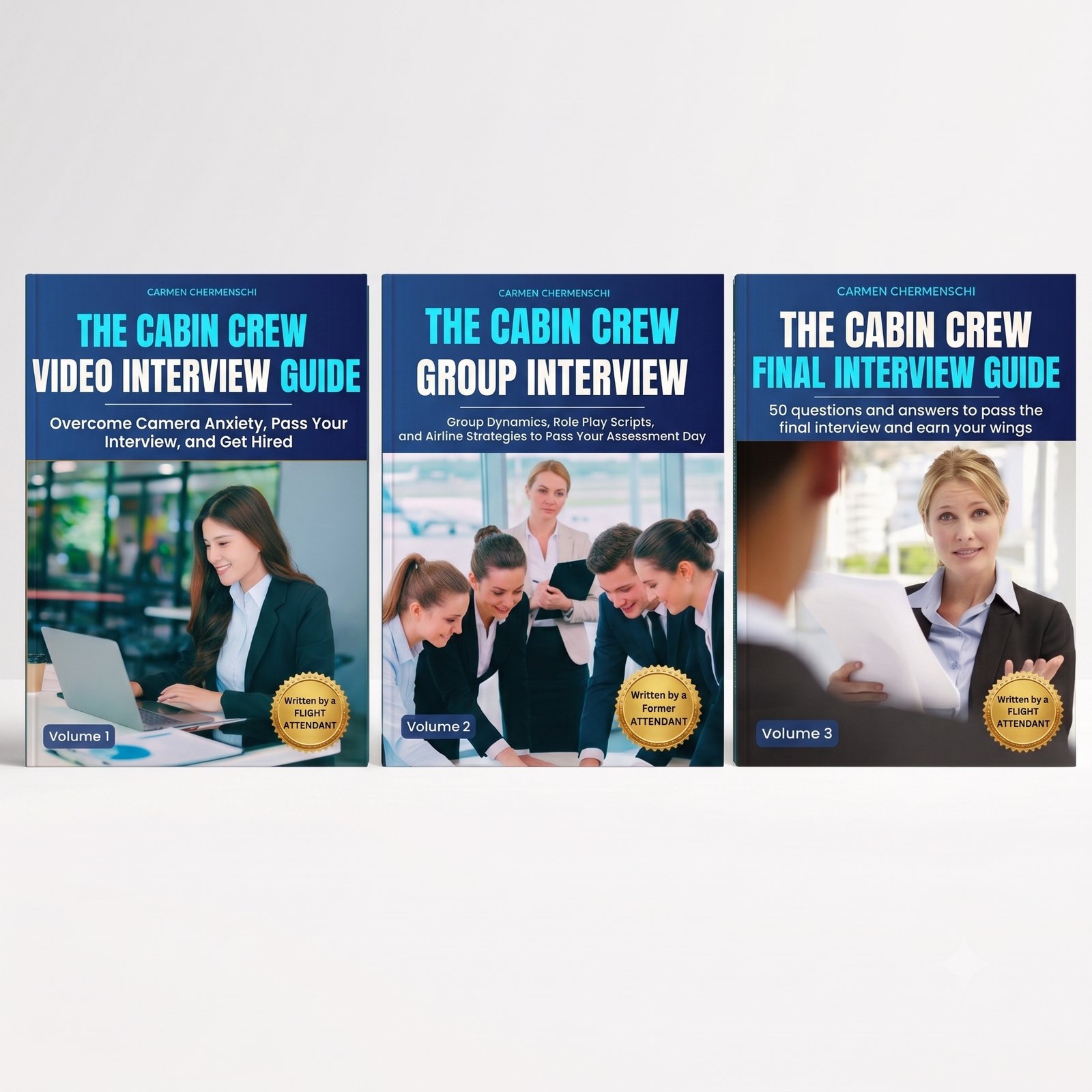
Three selection stages, one book for each
Video interview, group interview with role play, and final interview. Real questions, sample answers, and the mistakes that quietly end an application.
See the booksWant a plan built around your own application? Discover the coaching
The British easyJet Application Details
If you are applying to a UK base, these are the points that can stop an application, often weeks after the assessment day.
Your right to work. You need the unrestricted right to live and work in the UK, and easyJet does not sponsor visas. Since Brexit, this catches out many EU candidates who assume their passport is enough. Check your status before you apply, not after the offer.
The five-year background check. To work airside at a UK airport, you need an ID pass, and for that you must account for the last five years of your life, including employers, studies, and any gaps, plus a criminal record check.
I went through a similar five-year check myself after living in three different countries, so it is possible. But it takes time.
In my case, I was desperately asking friends and family to gather all the necessary documents while I was on my training course in Wrocław. Prepare your addresses, dates, and contacts in advance, and be ready to explain every gap, even a few months of travelling or unemployment.
Your licence will be British, not European. Since the UK left the EASA system, cabin crew working for a UK airline receive a Cabin Crew Attestation issued under UK Civil Aviation Authority rules. Crew at European bases receive an EASA attestation, like the one I earned in Poland.
The training is very similar, but the two documents are not automatically interchangeable, which matters if you plan to move between UK and EU airlines later in your career.
The easyJet Recruitment Process
The easyJet process usually runs in four stages: an online application, online assessments, a virtual interview, and an assessment day, followed by the training course for those who receive an offer.
It is the same logic in the UK and in Europe, although the calendar and the language of the interview change depending on the base.
| Stage | What happens | What they are really checking |
|---|---|---|
| 1 · Online application | CV and application form on the careers site | Customer service experience and eligibility |
| 2 · Online assessments | Behaviour questionnaire and situational judgement test | Your instincts with passengers and colleagues |
| 3 · Virtual interview | Interview on video, usually on Microsoft Teams | Energy, clarity and motivation |
| 4 · Assessment day | Presentation, checks, group exercises and final interview | Teamwork, safety mindset and sales attitude |
Online Application, Assessments and Virtual Interview
As you already know, your CV is the first door.
Keep it short, one page, and build it around the three things easyJet looks for, which are customer service, teamwork, and problem-solving.
Do not just list your jobs, as most candidates do. Show a moment when you calmed an upset customer (for example, when you were a waiter), helped a colleague, or even sold something because you listened well. If you want a second pair of eyes on it before you apply, I offer a CV review built for cabin crew applications.
After the application come the online assessments, where you choose how you would react to realistic cabin situations. Keep a pen and paper next to you, as I advise my students – the best answers put safety first, then the passenger, then efficiency. Sales are part of the job, but always keep safety and security in view.
Most interviews now take place virtually on Microsoft Teams, although some bases still hold in-person days. In those cases, know that on camera, energy is everything.
I often notice that the video interview is the stage where many strong candidates lose their place without even understanding why. My book Cabin Crew Video Interview goes through the questions and the small mistakes that make a recruiter stop listening.

The easyJet Assessment Day
If you are invited in person, you will go to the base you applied to, and your travel will be at your own expense.
This important day can last between five and eight hours, with shortlisting points along the way. That means some candidates are thanked and sent home even before lunch. I know that feeling very well. I desperately wanted to understand why it had happened, where I had gone wrong, and what I should have done.
It feels like another era now!
easyJet describes the in-person day as a presentation on the life of cabin crew, followed by a group exercise and a competency-based interview. Before any of that, there are physical checks. Your height is measured, and your appearance is checked against the uniform standards.
The group exercises are where easyJet sees how you behave when nobody is interviewing you directly.
Candidates usually go through at least three of them, which have included a matching exercise, a customer journey scenario, and a creative task such as redesigning the in-flight magazine. That last one is not a random choice. easyJet, like all low-cost airlines, places a lot of focus on in-flight sales, and crew members earn a small commission on them.
A creative task about the magazine is also a quiet test of whether you think like someone who can sell.
My advice for group exercises is the one I give every student. Treat them as a collaborative game, not a competition with the others. This is the key!
The recruiters are not looking for the person who takes control in the first minute. They are looking for the one who listens and keeps the group moving towards a decision. It will be like that on board also! At this stage, your grammar matters much less than you think.
Group exercises have their own rules, and most people learn them too late. My book Cabin Crew Group Interview explains the role plays, the exercises, and the behaviours recruiters note down.
The last part of the day is the individual interview. The majority of questions are competency-based, which means they ask what you did in a real situation, not what you would do in theory. Prepare four or five stories from your working life that you can adapt, and tell each one with a clear beginning, action, and result. Think of the STAR Method.
This final conversation is where you meet your recruiter for a discussion about your motivation and a little walkthrough of your CV. My book Cabin Crew Final Interview covers 50 real questions with sample answers.
easyJet Cabin Crew Salary and Contract
Salary is the question I receive most often, and it is one of the most important things to know when you apply for any job. Here is how easyJet pay works and why the numbers you find online can vary so much.
How Your Pay Is Built
Basic pay has also moved in recent years.
After a 20% rise in basic pay agreed with the Unite union in 2024, a new deal signed in autumn 2025 added further increases linked to inflation, with the biggest rises going to crew with the longest service.
For new joiners, the increase over the whole deal is estimated at around 10%. easyJet offers fixed-term, seasonal and permanent contracts, and the one you receive depends on the base and the season you join.
You can apply to become a Cabin Manager after just 12 months as a crew member, which is a fast path compared with many airlines.
At easyJet, a newly recruited crew member can expect roughly £1,800 to £2,300 a month once basic pay, sector payments, and variable earnings are added up. That places the first year at around £22,000, with total earnings growing with experience and the number of sectors flown.
I recommend that you double-check those numbers because they can change.
| Part of your pay | How it works | What changes it |
|---|---|---|
| Basic salary | Fixed amount every month | Rank and length of service |
| Sector pay | Paid for each flight you operate | Your roster, busier in summer |
| Sales commission | A share of what you sell on board | You |
| Allowances | For nights away from base, depending on destination | Rare on a short-haul roster |
Why the Salary Figures Online Don't Agree
Search for easyJet cabin crew salary, and you will find numbers that seem to describe three different jobs. Take into account that they are all real, but they measure different things.
| Source | Figure | What it really shows |
|---|---|---|
| Indeed UK | About £19,900 a year | Estimated from job adverts, so mostly basic pay |
| Aviation A2Z (2026) | £22,000 to £30,000 a year | Total earnings including sector pay and commission |
| Glassdoor UK | About £44,600 a year on average | Self-reported by staff, including senior crew and managers |
Figures checked in September 2026. Salaries change with every pay agreement.
Salary websites based on employee reports mix new joiners with crew who have ten years of service, cabin managers, and busy summer months, which pushes the average up.
My advice is simple. Budget your first year on the lower figure, and treat everything above it as a bonus you earn in the air, sector by sector and sale by sale.
In this case, let me give you an example. I have always managed my money carefully, because I am passionate not only about aviation but also about investing. My contract guaranteed 40 hours a month, which was a good thing.
So whenever I had a very busy month, I set aside everything above my usual monthly pay and split it almost immediately into three buckets: fixed costs, investments, and money to enjoy. Throughout my time as cabin crew, I invested in my future instead of buying all sorts of things and ending up with nothing at the end of the month, as I saw some people do.
Be smart with your money, because today everything is fine, but tomorrow you never know!
Training Course and Rosters
Once you accept the offer, the real selection begins.
easyJet trains its UK and Italian recruits at its academies at London Gatwick and Milan Malpensa, and pays for your hotel if your base is elsewhere. Candidates joining a Swiss base train in Geneva. The initial course lasts about four weeks. You spend your days between classrooms, simulators, and practical drills, and the swimming and life raft tests come back here. Pass every exam, convince your trainers, and you receive your wings.
My own initial training lasted six weeks, with exams every single day and two eliminatory ones, one halfway through and one at the end. I will not pretend it was relaxing. But it is the most useful pressure you will ever go through, because on board you will not have time to look anything up.
Every day after training, I went home, ate something and got back to studying, because another exam was waiting for me early the next morning. It was a great experience, even if the pressure was real.
What a Typical easyJet Roster Looks Like
Because easyJet flies short-haul, you almost always come back to your base at the end of the day, and rosters are flexible. You might fly two days and rest one, or work six days in a row with three days off afterward. Here is what a week can look like. It is an example I built to show the logic, not an official roster.
| Day | Duty | What it means for you |
|---|---|---|
| Monday | Early · 4 sectors | Alarm before 4am, home by early afternoon |
| Tuesday | Early · 2 sectors | One return flight, a shorter day |
| Wednesday | Late · 4 sectors | Start at lunchtime, home after midnight |
| Thursday | Late · 2 sectors | Your body starts asking for rest |
| Friday | Day off | Sleep, laundry, life |
| Saturday | Day off | The weekend you share with nobody else |
| Sunday | Standby | Uniform ready, phone on, 90 minutes from base |
Rest is a serious matter in aviation. When a delay cut my rest below the legal minimum of 12 hours, even by five minutes, the next day’s flights were removed from my roster and assigned to another crew. The rules protect you, but they also mean your plans can change overnight.
Swaps are another surprise. If you need a particular day, you do not simply ask a colleague.
At Ryanair, we called the rostering team, who found someone available and moved the duties. It works, but it teaches you that your calendar belongs, in part, to the airline. I explain how cabin crew rosters work at any airline in my complete guide to cabin crew rosters.
This Is My Honest View on Working for easyJet or Ryanair
It is the question I see everywhere, and I can only answer it honestly from my side of the story. Both airlines fly short-haul, both bring you home most nights, and both rely on onboard sales. The biggest differences are in the contract and in how the roster is protected.
| Topic | easyJet | Ryanair (my experience) |
|---|---|---|
| Contract | Direct employee under local law, fixed-term, seasonal or permanent | Self-employed contract with 40 guaranteed hours a month |
| Sales commission | Share of onboard sales | 10% on my own sales |
| Nights at home | Almost always | Almost always |
| Upper age limit | None, over-50s actively recruited | None, I joined at 40 |
Before You Apply — What I Wish I Had Known
The tiredness you’ll experience during your shifts isn’t just physical. I expected sore feet and early alarms. What I did not expect was the mental fatigue of being “on” for hundreds of passengers a day, smiling, checking, selling, watching.
This kind of tiredness can arrive very early, even when your body feels fine. That is why, in the months when my roster was full of standby, I learned to see them as a gift, and I took advantage of the free time to improve myself.
Keep in mind that your life will run on a different clock. For a long time, my friends and family could not understand why my hours were always upside down, why I could not promise Saturday dinner, or why I slept at four in the afternoon. But one day, they accepted it, and I felt a huge sense of relief.
Prepare the people you love before you start. It makes everything easier.
If your base is abroad, learn your crew’s language, not only the language of the job. In Poland, almost everyone spoke English, but there were often two Polish colleagues on my crew who would switch to Polish with each other. It is completely normal; everyone does it like this.
So I set myself a small goal: two new Polish words every day. I can say that it changed the atmosphere on board more than any training module.
And look after your body on your days off. Your health should be taken very seriously throughout your career as cabin crew. On my first little trip to Paris, I walked 14 kilometres in the wrong shoes, almost without a break. The next morning I was unable to work and had to call the rostering team. So take care of your health, always!
If you want to wear the orange uniform, you have to prepare. You will face a series of tests you may never have seen before.
But here is something to remember. Nobody is born ready. With the right preparation, you will not only save time by avoiding one mistake after another, you will also be able to face one of the most demanding selection processes in the world of work.
Where are you right now?
Or prepare on your own with my three books.
Carmen 🩵✈️
easyJet Cabin Crew FAQ
A new easyJet cabin crew member in the UK earns roughly £1,800 to £2,300 a month once basic pay, sector pay, and variable earnings are added together. The exact amount depends on how many sectors you fly and how much you sell on board, so summer months usually pay more than winter. Double-check these numbers!
There is no upper age limit, you just need to be 18 or over. Most airlines have no upper age limit either, although the minimum age can be higher elsewhere. For example, 21 at some Middle Eastern airlines. The good news is that around 12% of easyJet cabin crew are now aged 50 or over, and the airline actively encourages later-life career changers to apply.
Yes, as long as they are not visible on the head, face, or neck, and all tattoos must be inoffensive. Your appearance is checked on the assessment day, so read the latest policy on the careers page before you go.
Yes, because the minimum height is 5’2″ (157.5 cm) and the maximum is 6’3″ (190 cm), measured without shoes. Your height will be checked on the day of the assessment.
No, easyJet, like other airline companies, does not require a university degree or prior flying experience. What matters is fluent English, about six months of customer-facing experience, and meeting the physical requirements.
The initial training lasts about four weeks, and it is very intense. It takes place at easyJet’s academy at London Gatwick or Milan Malpensa for UK and Italian recruits, and in Geneva for Swiss bases.
No, the training is free, and easyJet has described it as paid training in its recruitment adverts. If your home base is not London Gatwick or Milan Malpensa, where the training academies are located, easyJet also provides hotel accommodation for the entire four-week course.
easyJet recruits mainly in autumn and winter for the following summer. It has announced hundreds of UK roles for 2027, and applications are expected to open soon, so check the careers page regularly.
It is usually a set of online questionnaires that follow your application, typically a work-related behaviour test and a situational judgement test. You choose how you would react to situations on board.
The requirements are accessible, but the competition is very strong. Just to give you an idea, in 2022 easyJet received over 18,000 applications for about 2,000 roles, so preparation makes a real difference.
Rarely, because easyJet flies short-haul and crew almost always return to their base at the end of the day. Nights away are an exception.
The main perks are discounted staff travel and a share of onboard sales. easyJet crew have also been reported to receive a free easyJet Plus membership, with benefits such as priority boarding and free seat selection.
There is no strike affecting UK bases at the time of writing. Crew disputes happen at many European airlines from time to time, so check the latest news for your base before you apply.
Yes, as long as you have the right to live and work in the country where your base is located, because easyJet does not offer visa sponsorship. For bases outside the UK, you also need to be fluent in English and the local language.
You choose the base you apply for, but it does not guarantee a position there. In some registration campaigns, you can only register once, so pick the base where you can realistically live within 90 minutes.
Keep reading