

Hardly anyone passes a cabin crew selection on the first attempt, and it’s hard to reach someone in the company’s HR to ask why you were turned down.
This full guide helps you figure out which stage stopped you, what the recruiters were measuring at that point, and what to do in the months ahead.
If you only read one paragraph
You need to know from the very beginning that airlines never tell a candidate why they were turned down. In nearly every case the selection stops at one specific, recognisable point — the CV screening, the video interview, the group exercise, the role play or the final interview. Each of those points measures something different.
Figuring out which one stopped you is the only way to prepare for the next attempt on what actually matters, instead of redoing everything and hoping it goes better. And then there is the key factor everyone overlooks – time. Most airlines let you apply again after six months, and six months (cool-down period) is more than enough time to arrive ready.

Why no airline tells you why you failed
The part that hurts most is not the no, but not knowing and having no clue why, even if you did everything right, you still received a rejection letter.
And if you dream of becoming cabin crew and making it a career, you cannot live with doubts all the time.
You should know that airlines do not give individual reasons. A single assessment day puts dozens of candidates in a hotel conference room, often more than a hundred, and a written reason is a position the company would then have to defend. Most carriers have an explicit policy of giving no feedback, precisely so they never have to argue about a decision already made. What reaches you is a standard email, identical to the one everyone else received that day.
Three things are worth knowing straight away.
Being turned down is the rule
Throughout my career as cabin crew, and later as a coach for aspiring candidates, I’ve seen that very few candidates make it from the morning briefing to a contract. At a British Airways assessment day, half the room going home at lunch is normal, and candidates sent home report being given no reason at all, or a reason that made no sense to them.
Almost everyone wearing a uniform today has at least one “no” behind them. You have not landed in a separate category.
I have written separately about how many candidates actually get through, because the numbers surprise not only me, who works inside the industry, but most of the people I speak to.
What changes the game is the preparation

I failed five assessment days with Ryanair before they hired me on the sixth. I was 40 when I finally put on the uniform.
But wait, I’m not telling you this to make you feel better. I tell you because those five times taught me something I see confirmed with every candidate I prepare—what separated my fifth attempt from my sixth wasn’t motivation, which I already had, and it wasn’t my CV, which was the same document. It was knowing exactly what the day would ask of me.
The waiting period is always administrative
Most European airlines ask you to wait before applying again, usually six months from the selection date. Rules vary by carrier and change over time, so check the careers portal for the airline you care about. The wait applies only to that airline, so nothing stops you from applying elsewhere tomorrow.
I often recommend it to candidates who arrive convinced their career is over because the one airline they applied to said no.
Where they actually stopped you in the selection process
Before you ask yourself what you did wrong, you need to know where the process ended. This is not a little detail. Someone who was never invited and someone who reached the final interview face two completely different problems. Knowing exactly where you stopped gives you the certainty you need to prepare for the next Assessment Day attempt.
Find your row.
| Where it stopped | How you know | What they were measuring |
|---|---|---|
| CV screening | You were never invited, or the application went to inactive. It is happening more often than you think. | Your CV, the formal requirements and the tracking system |
| Video interview | You recorded your answers and then heard nothing | How you come across to a camera, with nobody answering back |
| First hour of the day | You were sent home before the group exercise started | Documents, grooming, reach and height checks, basic English |
| Group exercise | You were sent home at lunch, along with half the room | How you behave inside a group of strangers |
| Role play | You made it to the afternoon but not to the one to one | How you react to a difficult passenger |
| Final interview | You reached the end of the day and then the email came | Consistency, motivation and English under pressure |
If you want a full walkthrough of the day, from the morning briefing to the final interview, I have laid it out in the cabin crew assessment day guide. What follows here is the diagnosis of what went wrong on your day.
You were never invited to the Assessment Day
If your application sat there or moved to a status like inactive, a person didn’t assess it – it was filtered long before that.
Airlines receive thousands of applications per campaign and use systems that scan CVs for keywords, formats, and requirements. Think of it as a robot. A CV laid out like a retail job application, written in your own language when the selection runs in English, with customer-facing experience buried in the middle, or set in two columns so the parser reads the lines in the wrong order, never reaches a recruiter. The CV has changed a lot today.
What upsets me most is that this happens to people who have everything it takes, and nobody ever says a word to them.
There is nothing to reproach yourself for here. There is only a document to rebuild. That’s it!
After the video interview
I think the pre-recorded video interview is the most underestimated stage of the whole process, and it’s become the real barrier.
Video interviews feel unnatural, and that is the problem. You speak to a camera with nobody answering back, often on a timer, in one take, and everything that normally helps you in an interview is missing. You will not have the other person’s eyes, or an encouraging smile, or the chance to correct course halfway through a sentence. Candidates who cut here usually didn’t give wrong answers. They gave flat ones, looking at the wrong part of the screen, with poor audio or a room behind them that said anything but professional.
In the first hour of the day
If you were sent home almost immediately, it was for a formal or visual reason.
For example, you might be missing a document or have a passport with insufficient validity left. You could bring a CV that doesn’t match the one you uploaded, have a visible tattoo, fail a reach or height check, or look like you don’t belong. I got this wrong for a long time myself. The first time I thought black trousers and a white shirt would do, and I wore whatever shoes were by the door. I repeated the same mistake several times by copying what the other candidates wore, and I only found the right look after many attempts. At every selection I attended, at least one person wore jeans, trainers, or something that didn’t belong in the room, and those people were never there in the afternoon.
Grooming is an important step of the selection process.
After the group exercise
Unfortunately, this is the stage that sends the most people home.
Almost everybody walks into the group exercise believing the task is to stand out. To say more, to lead, to be noticed. But recruiters are watching for the opposite — they are watching whether the crew works with you in it. Talking over people gets you cut just as fast as saying nothing, because both behaviours say the same thing, which is that you were thinking about yourself rather than the group.
The advice I give every candidate is to treat it as a collaboration game. Your grammar matters far less than the attitude you bring. I have written up the mistakes candidates make in the group interview in more detail.
Something mysterious happens here that almost nobody tells you. In this exercise, you can be cut without having done anything wrong. One easyJet candidate described being sent home purely because everyone in the group was scrambling to speak and there was no way in. It really happens, and it is unfair. But you can also prepare for it, because there are ways back into a conversation that don’t involve raising your voice.
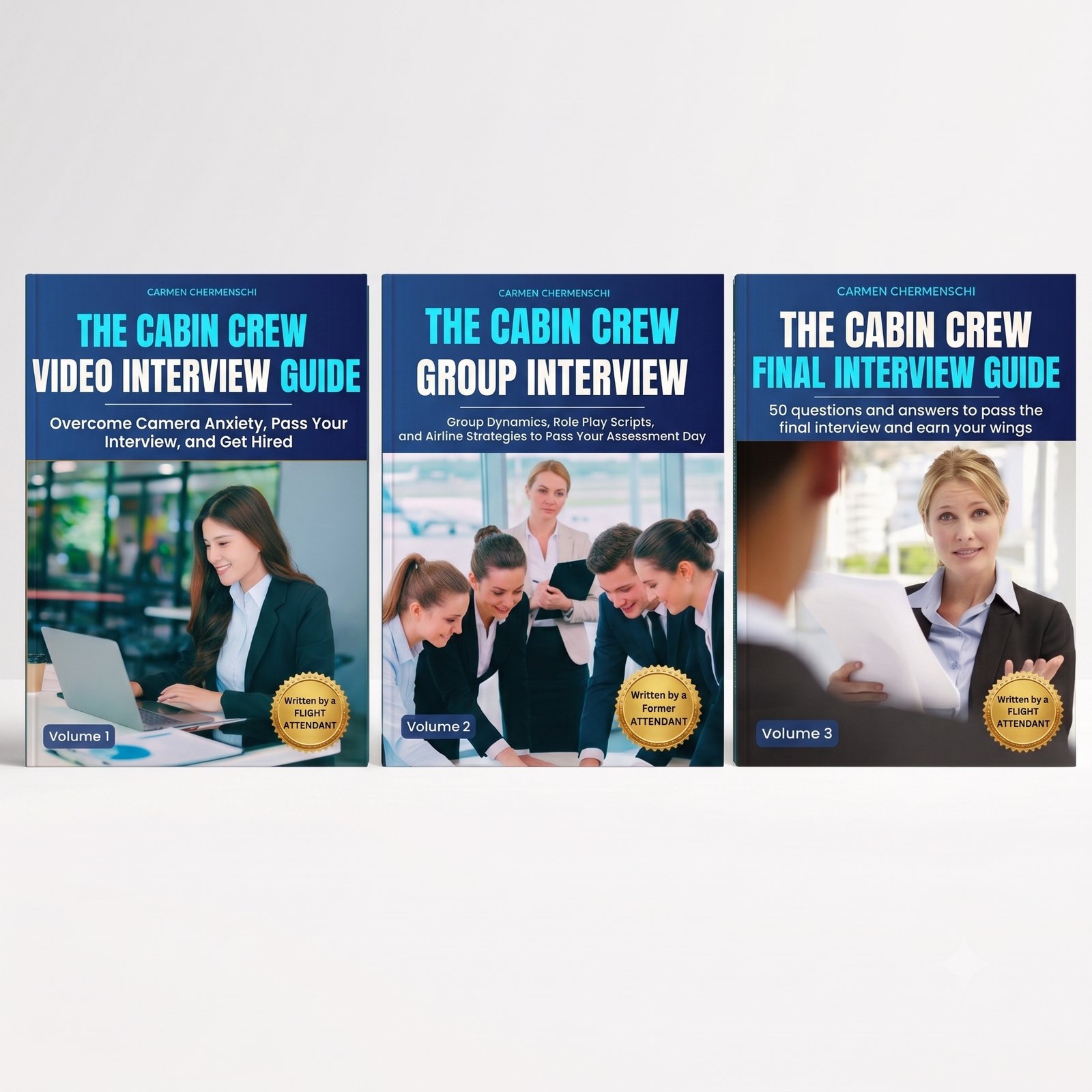
Three selection stages, one book for each
Video interview, group interview with role play, and final interview. Real questions, sample answers, and the mistakes that end an application.
See the booksWant a plan built around your own application? Discover the coaching
After the role play
In the role-play, a recruiter plays a passenger, and you play yourself in a uniform you do not have yet.
The typical mistake isn’t giving the wrong answer, as most people assume. It is giving a textbook answer, visibly rehearsed, or trying to solve the problem before acknowledging the person in front of you. Anyone who has worked a cabin knows an angry passenger wants to be heard first, and recruiters check whether you already have that reflex.
I know what you are about to say. You cannot pretend to have a crew member’s experience, but you can step into the character, and that is what gives a recruiter a reason to pick you over somebody who produced a grammatically perfect but generic reply.
In my check-in agent career, I learned the most valuable lesson of my life in training – giving two solutions to the passenger gives both you and the passenger a choice. So one solution is good, but two is better. Try it in day-to-day life to see the results!
At the final interview
If you got this far, your profile was fine. I mean that. They took you to the end of the day because they were considering you.
Whoever falls here falls for one of two reasons. The first is an off-script question about your own CV — a gap of a few months, a change of industry, a job that lasted only weeks — that you had not prepared and that knocked you off the answer you had in your head. The second is English under pressure, which is not the English you use on holiday. I have watched candidates with a solid level tangle their words and ask twice for the question to be repeated, not because the vocabulary was missing but because tension takes the part of the brain you need for a second language.
If you were stopped here, the distance between you and a contract is far shorter than it feels today.
Why strong candidates fail a cabin crew assessment day
Here is the part almost nobody explains, and it is the real reason so many well-prepared people go home.
Remember – a recruiter isn’t assessing your qualities. They are assessing your behaviour inside one specific situation, over a handful of minutes, while you are under high pressure. The problem is that, for you, that situation is happening for the first time.
Your first time in the room steals your attention
When you are somewhere you have never been, much of your attention goes into decoding the place itself. Where do I sit, for example. What do they want now, and why are they asking me something I never thought to prepare. How much am I supposed to say. That one is watching me. Did I understand the question, or do I need to ask them to repeat it.
All of that is silent, exhausting work, and it consumes exactly the capacity you need to answer well, smile naturally, and speak English without stumbling.
That is why learning another twenty questions doesn’t fix it. The candidate who memorised fifty answers and has never lived the day still freezes, because the answers are filed in the wrong place. It is not a content problem. It is a familiarity problem.
The principle behind the The Simulator Method

Psychologists have worked on this mechanism for decades. To take power away from a situation that intimidates you, don’t reason about it; go through it in advance, somewhere safe, until it no longer feels new. It is called exposure, and it is the principle my whole method is built on.
The simplest way I know to say it is this.
The day of the selection must not be the first time.
That changes what preparing even means. It doesn’t mean knowing more, because you probably already do. It means walking into that room already carrying the feeling of having been there—having already heard those questions aimed at you, already had that passenger in front of you, already introduced yourself in English to somebody assessing you. When the day comes, your brain spends nothing working out where it is, and all of your attention stays available for the thing that counts, which is being yourself.
That is the difference between my fifth assessment day and my sixth. I had not become a better person in the meantime. I had lived that day so many times that it held no surprises left.
Doing it alone is hard because nobody can play the recruiter for themselves, and because the order in which you go through the stages, how far from the date you do it, and how you take apart what went wrong matter as much as the exercises themselves. But the principle is yours to take from this page, and it is the most important one there is.
What can you do right now?

- Write down everything you remember within two days. This is the most urgent thing on the list, and almost nobody does it. We all say it isn’t worth our time. Write down everything you remember: the questions you were asked, the exact words where you got stuck, who was sent home and at what point, what the people who got through were wearing, and how long your interview lasted compared to everyone else’s. In two weeks those details will be gone, and since the airline will never give you feedback, those notes are the only feedback you will ever get. They are worth more than any general advice.
- Work out the stage, honestly. Go back to the table above and find the exact point. It is an uncomfortable step because it makes you look the thing in the face, but without it everything else is guesswork.
- Apply elsewhere in the meantime. We should all know that the waiting period belongs to that airline, not the industry. Selections run all year across different carriers, and every process resembles the others — CV, video interview, a day in a room with a group exercise, a role play and a final interview. A second attempt somewhere else is also the cheapest way to make the situation less new.
- Fix only one thing. If you were filtered at the screening, studying final interview questions does nothing for you — you need a CV that gets past the systems. If you fell at the final interview, rewriting your CV changes nothing. One weak point stopped you, and that is the one to close.
- Train the English of the job, not English in general. A general course moves your level very little in six months and doesn’t address the real problem – speaking English while someone is assessing you. What works is rehearsing out loud, in front of another person, what you will actually have to say—who you are, why that airline, how you handled a difficult customer.
- Do not repeat the same preparation and expect a different result. If you prepared by reading and revising and got cut, the material wasn’t the problem. Preparing the same way again, with more effort, almost always ends the same way.
Which airline next?
The waiting period belongs to one airline, not to the industry. Requirements, bases and selection processes differ a lot between carriers, so check what the one you are considering actually asks before you apply again.
Gulf carriers
Not sure which airline fits your profile? That is exactly the work we do together in the Clarity Call.
If it was a Ryanair assessment day
I am going to spend a section on Ryanair because I sat in that room six times. Five of those ended with me going home, asking myself what happened, and having no idea where to point the finger.
The Ryanair recruitment process has its own shape, like many other airlines around the world. I really love Ryanair because it focuses heavily on on-board safety and punctuality. The Ryanair recruitment process is among the most rigorous in the world because it puts passenger and crew safety at the center of the company.
How the day is built
The DAY usually starts with a written English exercise, before anything else. It’s not a grammar exam – you are given a situation and asked to write about it, and what they are reading is whether you can follow instructions and make yourself understood in writing. People are already sent home at this point, which surprises candidates who had been preparing interview answers.
Then comes the company presentation, where the recruiters go through the airline, the contract, and the low-cost model. In all the presentation phases I attended,d I saw candidates treat this stage as a break. You are in the room, you are visible to the recruiter, and asking questions can put you on the recruiter’s radar in a positive way because you seem interested.
After that is the group exercise, and finally the one-to-one, which is short, about 20 minutes. If a candidate doesn’t understand the recruiter’s questions or has no idea how to phrase an answer, the final interview will last 5 minutes.
The questions that come back every time
Two of them are almost guaranteed. Why Ryanair and why cabin crew. Apparently they sound easy, and that is exactly what makes them dangerous. You cannot give a generic answer about loving travel and meeting new people around the world because the recruiter has heard this answer a thousand times that month.
On one assessment day, I was asked how I would present the menu to a passenger looking for a sandwich. On a low-cost carrier, onboard sales are part of the business model, not an afterthought, and how you handle that question shows whether you understand the job you are applying for. I have set out the Ryanair cabin crew interview in full separately.
How long it takes before you hear back
This is the question I get most from candidates who have just come out of a Ryanair assessment day, and the honest answer is that it varies. Some people are told on the day. For example, mine came the day after the interview. I mean the positive one. Others wait days or a couple of weeks for an email, and a few never receive anything at all, which is its own kind of answer.
If you are in that waiting period right now, don’t spend it desperately refreshing your inbox. I know the feeling, and it is mind-consuming to think about not checking your mail every 5 minutes, but you should know that checking it that often doesn’t change the outcome. Spend this precious time instead on the notes from point 1 above, while the day is still fresh in your memory. If the answer is yes, you lose nothing. If it doesn’t, you have just given yourself the only feedback anyone will ever hand you.
What exactly Ryanair tends to stop people on
From the candidates I prepare, three things come back more than anything else.
First, the written English test, which people don’t expect and therefore don’t prepare for. Aspiring cabin crew don’t expect an English test because they think the only English test is the one they took when they submitted their CV. Then comes the group exercise, where the room is large and competitive, and it is easy to either disappear or overcompensate. Then comes an off-script question about the CV in the one-to-one, which is where two of my own candidates were stopped—one in Dublin at the final interview, one in Catania during the personal introduction—both on something in their work history they had never been asked to explain out loud. We fixed that afterward.
Ryanair also generally asks you to wait six months after selection before applying again. To be sure, check the current terms on the Crewlink or Ryanair careers portal, because recruitment partners and timings change.
So where to start again with your application
Not everybody reading this article needs a coach. If you have worked out where you fell and you know how to close that gap, take the notes from point 1 and get to work. That is exactly the right thing to do, and six months is plenty of time. But don’t waste it.
If you are stuck because you cannot see what went wrong, or because you know the weak point but have no way of training it alone, this is the work I do with aspiring cabin crew.
There are three routes, and which one is yours depends on where you were stopped.
Cabin Crew CV Review
Your profile is not the problem, the document is. I rebuild your CV so it survives the tracking systems and reads like a crew application rather than a general one.
See the CV ReviewClarity Call
In an hour we look at your real profile, work out why the applications are stopping, and choose together the three airlines where you really have a chance.
See the Clarity CallComplete Programme
Three one-to-one sessions. You live the whole day in advance, we prepare every stage, and we run the final interview in full with me as the recruiter.
See the Complete ProgrammeIf you are not sure which of the three
Just write to me at carmen@surprising-aviation.com. Tell me which stage stopped you, which airline you’re considering, and what worries you most. I will tell you honestly which of the three fits, or whether you need none of them.

What a rejection could mean to you
Firstly, a rejection is a date, not a verdict on your value as a person. It tells you what happened on one morning, on a selection day, in front of recruiters who had a hundred other people to listen to. It doesn’t tell you who you are, or what you will be wearing a year from now.
I know how the next few days go. You will replay it over and over and ask yourself whether you can keep hoping. You will find the moment you are sure ruined everything, and you will probably be wrong about which moment it was. That’s why the notes I told you to write down are worth more than replaying.
It took me so many attempts, but I never, never let the idea of giving up on my dreams cross my mind.
So write your notes, find your stage, and close that one thing.
And when the next date comes, make sure it is not the first time.
Carmen 🩵✈️
FAQ
You can ask, and in almost every case you will not get an answer on the substance. Airlines and recruitment agencies withhold individual feedback by policy. But a short, courteous thank-you message does no harm and leaves a good impression—just don’t expect it to open a door.
It means that the process for that application has been closed. In most cases, it means you didn’t pass an automated filter, or the recruitment campaign ended.
The most common rule among European airlines is six months from the selection date, but it varies by airline and changes over time. I recommend checking the careers portal of the airline you care about.
No. Airlines do not share selection outcomes with each other. The exception is when several carriers use the same recruitment agency; in that case, your application stays in that agency’s system. Otherwise, you start from zero, and that is good news.
Not in itself. Plenty of people flying today were turned down before, some of them more than once. What counts against you is turning up identical—same CV, same preparation—because the result tends to repeat itself, too.
It depends on where you were stopped. If you reached the final interview, the airline took you seriously, and trying again makes sense. If you were never invited, first figure out whether the problem is your CV or whether the airline simply doesn’t fit your profile, because requirements, bases, and the experience they look for vary widely between carriers.
Yes. Several airlines have no upper age limit, and previous work experience often helps rather than hurts. I was hired at 40, and the recruiter told me they were looking for people who were mature, reliable, and responsible.
Write down everything you remember about the day, today or tomorrow at the latest. The airline will never give you feedback, as I said before, so those notes are the only record you will have of what actually happened, and they are what the next attempt is built on.
Keep reading
Start hereIs cabin crew the job for you?
SelectionGetting through the selection
Low-cost & UKLow-cost airline careers
Middle EastGulf airline careers
Life on the linePay, rosters and daily life
Practical flyingTips for passengers




Carmen flew for Ryanair and Buzz, then worked check-in on the ground for easyJet, Wizz Air and Turkish Airlines. She writes about what happens on both sides of the desk, and coaches future cabin crew from the application to the assessment day.
More about Carmen →