

Flight delay compensation
If your flight arrived more than 3 hours late and the airline was at fault, you are owed £220- £520 in the UK or €250- €600 in the EU. This amount depends on how far you flew, not what you paid for your ticket.
Two things determine every claim. The delay is counted when you arrive, not when you take off. And the reason for the delay matters more than its length, because, as we all know, weather is nobody’s fault, and a broken aircraft is usually somebody’s.
I flew as cabin crew first, then worked check-in on the ground. I have handed out vouchers, rebooked the queue, and told people things they didn’t want to hear, so this guide is written from behind the desk as well as from the aisle of an airplane.

How long can a flight be delayed?
The rule is 3 hours. That is the number everyone is looking for, and it is the right one. But it is measured in a surprising place.
At 2 hours, the airline already owes you things, just not money, as most people think. Food, drinks, 2 phone calls, and a hotel if you are stuck overnight.
On short flights, duty starts at 2 hours; on medium ones, at 3; on long-haul, at 4. This literally applies regardless of what caused the delay.
The first time a flight of mine was cancelled, and it was only my first ever flight, yes, I was unlucky, I went straight to the information desk and asked for a hotel. It was a spontaneous pilots' walkout that paralysed Rome Fiumicino airport for 3 days.
At 3 hours, the money starts. Below 3 hours, you get no compensation, no matter how long the day feels.
One exception is worth knowing. On flights over 3,500 km, a delay between 3 and 4 hours pays half, so £260 instead of £520. The EU works the same way.
Why it is your arrival time that counts, and not your departure
This is the single thing that most often costs people their claim.
The clock stops when the aircraft gets there, not when it leaves. So a flight that pushes back 4 hours late, makes some of it up in the air, and lands 2 hours 50 minutes behind schedule pays nothing. And a flight that leaves almost on time, holds somewhere for hours, and lands 3 hours 10 minutes late pays in full.
What about arrivals? Arrival has a precise meaning too. It is the moment a door opens, and people can get off, not when the wheels touch the runway. On a busy night, the wait for a free stand can be 20 minutes, and sometimes that’s the whole claim.
Why the rule works that way
Compensation covers the time you lost, not a late departure. If the aircraft pushes back 4 hours and the crew claws back 90 minutes in the air, you lose less of your day, so you are owed less. I know it feels wrong when you spend those 4 hours sitting in a departure lounge, but the rule measures what the delay cost you, not how it felt.
In my experience, this single rule caused more arguments at a check-in desk than anything else. People were completely mad at us. Passengers were right about everything except which clock the law was reading.
Before you do anything else, I advise you to find the actual arrival time. It is in the airline’s app, and it is the only number that matters.
Does your airline count on all this?
This is the question more people are really asking than any other. The rule is 2 lines long and super simple.
If the flight leaves the UK or the EU, the rule covers every airline. BA, Emirates, United, Ryanair — it makes no difference. If the aircraft left a UK or EU airport, the rules apply.
If the aircraft arrives in the UK or the EU, only UK and EU airlines are covered.
What does this mean? It means the same route costs differently depending on which direction you fly.
| Your flight | Airline | Covered |
|---|---|---|
| London → New York | United | Yes |
| New York → London | United | No |
| London → New York | British Airways | Yes |
| New York → London | British Airways | Yes |
| Paris → Dubai | Emirates | Yes |
| Dubai → Paris | Emirates | No |
Iceland, Norway, and Switzerland are also considered within the system, so a flight departing from Oslo is covered the same way as one departing from Manchester.
One booking can rescue the leg that was not covered
If the uncovered flight was part of a single booking that ended in the UK or the EU, it can be covered even if the airline isn’t.
What matters is that it was 1 booking, not 2 that happen to connect. If you bought the long-haul leg and the short hop separately because it was cheaper, you have 2 bookings, and the protection doesn’t carry over. I have watched that conversation happen at a transfer desk more times than I can count. In the end, the cheaper ticket is almost never cheaper.
What happens if your flight was delayed
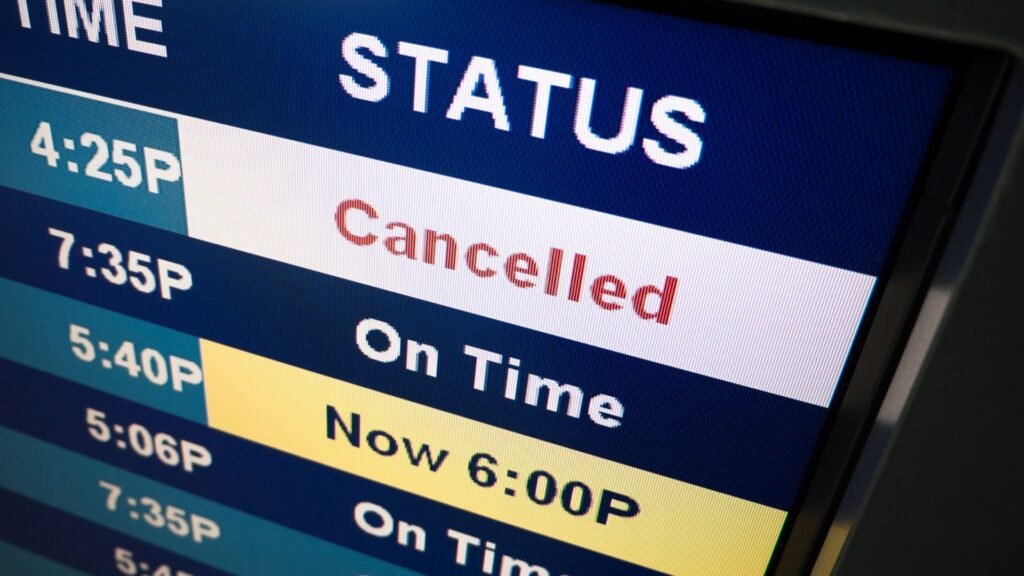
A 5-hour fog delay pays nothing. A 3-hour delay caused by a failed part pays in full. The length matters, and the cause determines whether you get anything at all.
The law asks only one thing. Could the airline have prevented it? Everything else, including how awful the day was, changes absolutely nothing.
Weather, snow, and fog
The most searched cause of all, and the one that pays least.
Weather is outside the airline’s control, so they don’t compensate you. Whether you are talking about snow, fog, storms, or ash — the answer is the same.
But you should know this, because you are entitled to ask for it. The airline still owes you food, drinks, and a bed. That duty does not depend on the cause. A blizzard can cancel your flight, and the airline still has to feed you and put you up. In winter, flying out for Christmas in December, that is worth more than anything. For us, it is the situation we dread most at the check-in desk. Tension can build in a moment, and we are there to resolve it and lift spirits, but sometimes it is very difficult.
Technical faults
In this case, the answer flips.
The aircraft belongs to the airline, and it maintains it, so a technical fault is normally within its control. Which means compensation is usually (normally) due.
Airlines do not volunteer this. You’ll hear operational reasons or safety concerns, and both can mean a part failed. If an engineer came to the aircraft, write that down.
Strikes at the airport, and whose strike it was
This one is counterintuitive, and it is worth getting right, because remember when I told you about the spontaneous strike I had to manage as a simple passenger in Rome? Let’s dig into the 2 distinct situations that make clear where your rights are.
If the airline’s own staff walked out, you are owed compensation. Pilots, cabin crew, engineers. It holds whether the walkout was sudden or a properly called strike with union notice. In 2021, the Court of Justice ruled that a strike organized by an airline’s own trade union is not an extraordinary circumstance, because industrial relations are part of running an airline (CJEU C-28/20, summary).
If someone else walked out, you are not. Air traffic control, ground handlers, security, baggage. Those sit outside the airline’s control.
So ask who was striking. I know it is never easy to spot, because information is confused during strikes. You may be told it’s industrial action and nothing more, but that detail decides whether they pay.
You get a refund or a seat on the next flight
You make this decision standing at a desk, with 200 people behind you, in about 90 seconds. It is where most of the money gets lost.
What the desk will offer you first, and why
I have been the person on the other side of that counter, so let me tell you what is happening while you decide.
The agent is working a queue with a system that wants it cleared. The quickest way to clear the queue is a refund, because it ends the conversation and everybody is happy. The second quickest is whatever seat the screen offers first, which is always their own airline's seat.
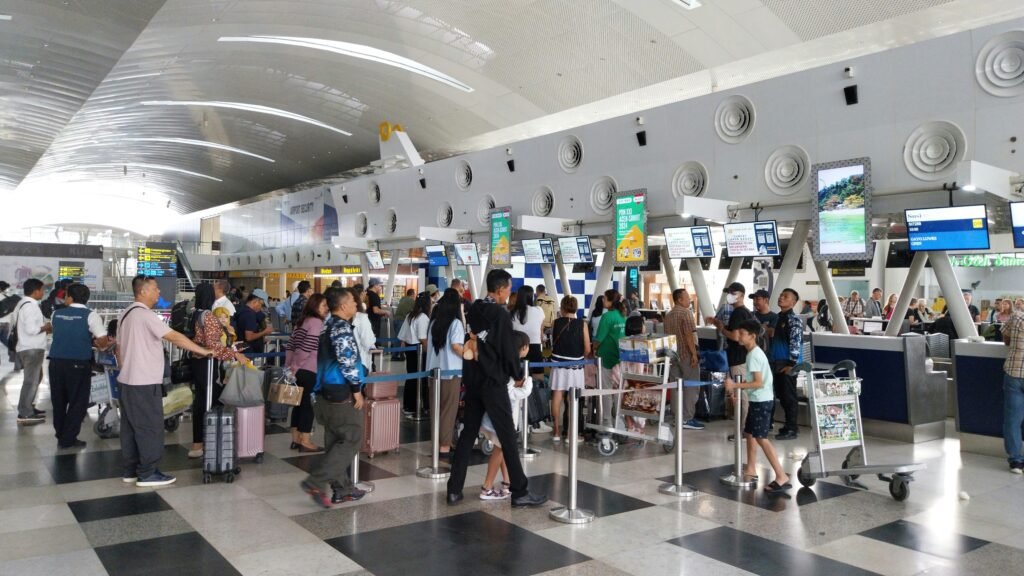
In the end, nobody is hiding anything from you. They have 200 people, a shift that should have ended, and a screen that shows their own flights. But the fastest option in the queue isn’t automatically the best for you, so you need to know what you want before you get to the front.
You have 2 different options
- If you still need to get there, ask to be re-routed as soon as you can, and say those words. You can be re-routed on another airline, but you usually have to ask, because the screen doesn’t show the agent that first.
- If the trip has lost its point, take the refund. If the trip is cancelled or delayed by more than 5 hours, you can walk away and get your money back within 7 days, including the other unused flights in the same booking.
A refund and a voucher are not the same thing
You can encounter these 2 look-alike situations at the desk.
A refund is your money back for a flight you did not take. Taking it does not cancel your right to compensation if the flight qualified. They are 2 separate payments under 2 separate rules, and the airline has no reason to explain the difference while the queue is moving.
A voucher is where it can get expensive. If they offer credit in place of your cash rights and you accept it, you may be signing those rights away. The amount often looks generous, which is the point. But read carefully what you are agreeing to before you tap accept. If you cannot read it properly in the moment, don’t accept it then.
What you are owed, UK and EU
| Distance | Delay on arrival | UK | EU |
|---|---|---|---|
| Under 1,500 km | 3 hours or more | £220 | €250 |
| 1,500 to 3,500 km | 3 hours or more | £350 | €400 |
| Over 3,500 km | 3 to 4 hours | £260 | €300 |
| Over 3,500 km | 4 hours or more | £520 | €600 |
I took the UK figures from Citizens Advice and the EU ones from Regulation 261/2004. The amounts are reviewed periodically, so if you are claiming for an older flight, check what they were on the day you flew.
4 things to know about that table
It is per person, not per booking. A family of 4 on a long-haul flight owes 4 x £520. Children with their own seat count. An infant on a lap does not.
It has nothing to do with what you paid. People refuse to believe this because it is completely counterintuitive. Somebody who paid £29 for a seat and somebody who paid £1,400 for the row in front are owed exactly the same amount. So you will be surprised to know that compensation is for your time, not your ticket.
The distance is the whole journey, not the leg that went wrong. For example — if you were booked London to Bangkok through Doha on 1 booking, the distance is London to Bangkok.
Cancellations work a bit differently. If the airline tells you more than 14 days ahead, you get no compensation. If the airline tells you within 14 days, it depends on how far the replacement flight moved your arrival, and the amount can be halved.
What happens if you were not flying in the UK or EU
Most online advice assumes European rules apply everywhere, but that is far from true. Here is what the 4 other systems passengers ask me about actually pay, as of October 2026.
| Where you flew | Delay that triggers it | What you get | Worth knowing |
|---|---|---|---|
| United Kingdom | 3 hours, measured on arrival | £220 to £520 | Fixed amounts by distance. Covers every airline leaving the UK, and only UK and EU airlines flying in. |
| European Union | 3 hours, measured on arrival | €250 to €600 | Same system as the UK. Iceland, Norway and Switzerland are inside it too. |
| Canada | 3 hours, measured on arrival | CAD $400 to $1,000 | Large carriers pay $400, $700 or $1,000 by delay length. Small carriers pay $125, $250 or $500. What to do in a Canadian disruption |
| United States | — | Nothing | No federal cash compensation for delays. A rule that would have paid $200 to $300 was withdrawn in September 2025. You can still get a refund if you choose not to fly. |
| Australia | — | Nothing | No compensation scheme. Meals and hotels depend on each airline's own policy. New consumer protection laws are before parliament, intended to start before the end of 2026. |
Checked October 2026. The UK and EU pay a fixed amount whatever your ticket cost. Canada pays by how late you arrived and how big the airline is. The United States and Australia pay nothing for a delay, which surprises almost everybody who assumes the rules travel with them.
Food, phone calls and a hotel in case of strikes, delayed and cancelled flights
This is the part you are most likely to actually use, because it starts long before the 3 hour mark.
| Distance | Assistance starts at |
|---|---|
| Under 1,500 km | 2 hours |
| 1,500 to 3,500 km | 3 hours |
| Over 3,500 km | 4 hours |
The airline owes you food and drink appropriate to the length of the wait, 2 phone calls or emails, and, if you are stuck overnight, a hotel room and transfers.
Here’s the line worth knowing, because I’ve seen different situations in my life, not only as a passenger but also behind the desk. It applies regardless of what caused the delay. Fog, strike, broken aircraft — it makes no difference at all. The compensation disappears in bad weather. The care does not.
When nobody is handing anything out
In a real disruption, which is rare but does happen, the airline often cannot physically cope. Nobody comes round, the queue for the desk is 300 people long, and whoever was doing hotels has gone home.
Know that you are never left on your own, and there is always a solution. You can sort yourself out and claim it back afterward. I advise you to buy a sensible meal, book a sensible room, and keep every receipt somewhere you will still find it in 3 months.
With that in mind, keep every document you have for this trip, and keep the time, so you have everything you need to show you were within your rights.
I handed out those meal vouchers for a living, through more strikes and delays than I can count. Actually, they were almost never enough for a real dinner, and nobody ever told passengers they could top them up themselves and claim the difference.
How to claim your rights
First of all start with the airline, because it costs nothing and you keep the whole amount.
Claiming directly, and what to send
Most airlines have a form to fill out. Find it on their site under customer service or complaints, rather than searching, because claim-form results often include companies that aren’t the airline.
What you need to send.
- The booking reference and the flight number
- The scheduled arrival time and the actual arrival time
- The names of everyone claiming
- Boarding passes, if you still have them
- Anything the airline put in writing about the cause
Keep it short and keep the temperature down. You’ll be clearer, and everything will be better afterward. The person reading it is working through a queue, exactly like the agent at the desk, and a clear claim moves faster than an angry one.
If the refusal cites extraordinary circumstances without explaining them, write back and ask. They have to be able to show it, and a surprising number of refusals do not survive that question.
Using a claim company, and what it costs you
AirHelp and Flightright will handle everything and take a share of what they recover, usually between a quarter and a third.
That is worth it when the case is complicated, when you want to push back on a refusal, or when you know yourself well enough to admit you will never get round to filling in the form. It is not worth it for a straightforward claim the airline would have paid anyway, which is most claims.
If the airline refuses and you think they are wrong because you’ve read this article and know the law, you don’t have to accept it. In the UK, you can escalate to the Civil Aviation Authority or to an approved dispute body. In the European Union, each country has a national enforcement body for this exact purpose.
Is it too late to claim?
Probably not, and you have longer than you think in this case. The clock starts on the day of the flight, not the day the airline said no.
For example, for a flight from or into England or Wales, you have 6 years from that date to take the airline to court. In Scotland it is 5.
That does not mean they will be gracious about a flight from 3 years ago. Many airlines reply that the claim is too old, and some say it in a tone that sounds legal. Know that it is not. Until those years run out, the right is still yours, and a firm second email often changes the answer.
In the EU, it depends on the country, and it is usually far shorter. In some places you have only 1 or 2 years, so it is worth dealing with an old European flight now rather than next winter.
Airline by airline
| Airline | Leaving the UK or EU | Flying back |
|---|---|---|
| United | Covered | Not covered |
| American Airlines | Covered | Not covered |
| Emirates | Covered | Not covered |
| Qatar Airways | Covered | Not covered |
| British Airways | Covered | Covered |
| Virgin Atlantic | Covered | Covered |
| KLM | Covered | Covered |
| easyJet | Covered | Covered |
| Ryanair | Covered | Covered |
Now I want you to see what I mean. The clearest way to read that table is to pick 1 route, let’s say London to New York and back.
On British Airways or Virgin Atlantic, both legs are covered. On United or American, only the outbound leg is covered. Same 2 airports, same ocean, same 5-hour delay, and on the way home, one ticket is worth up to £520 while the other is worth nothing.
Emirates and Qatar catch out more British travellers than anybody, because so many people fly them in both directions and assume the protection travels with them. Manchester to Dubai is covered. Dubai to Manchester is not.
KLM is worth a word because of Schiphol. Many of its passengers are connecting, and if the whole journey sits on 1 booking, the protection covers the journey rather than the leg.
Ryanair pays, but it is strict about the process. Use their form, give them exactly what they ask for, and don’t expect a conversation.
easyJet flies point to point, so there is no protected connection. If you booked the onward flight separately to save money, you’re on your own for that second flight, and nobody will help you.
Where the money is really decided
All 5 have one thing in common – you decided on the booking screen, not at the gate.
I worked a check-in desk, and the hardest conversations were always the ones where I had to explain that something that had just cost someone £520 happened weeks earlier, when they clicked the cheaper option. Handling these situations put me in the middle, between a rule I hadn’t written and a passenger with every right to be angry. You learn a regulation fast when you say it out loud 40 times a day.
Before you do anything else
Worldwide, most people never claim their rights. I think this happens all the time. Probably, this actually happens not because they weren’t owed anything, but because the day was exhausting. On the other hand, the form looked tedious, and by the time they got home, it already felt like it belonged to last week.
Airlines aren’t hiding anything from you; it’s just arithmetic. A share of people claim, and the rest never do. Believe me, the rest is a VERY large number.
So if you take one thing from this article today, take this. Find the real arrival time of your flight, the one in the app and not the one printed on your ticket. Write it down next to the flight number and the date.
The 2 minutes that turn the situation around
That takes 2 minutes, and it is the only piece of evidence that ever really matters.
The claim can wait until you have the energy, because you have years. But the arrival time gets harder to find as the weeks pass, and without it you have a feeling instead of a case.
And if you spent today in an airport, I hope whoever was behind the desk was kind to you. Most of them (my colleagues) are trying to be, but they’re stuck with a queue they cannot fix and a system that was never built for the day they are having. I always try to stay gentle and solve the situation as best I can, because tomorrow I could be the passenger.
FAQ
In the UK, it’s between £220 and £520, and in the EU, between €250 and €600, depending on how far you are flying. It is a fixed amount per person, and it has nothing to do with the price of your ticket.
You cannot claim money. Compensation starts at 3 hours late on arrival, and 2 hours is below that.
But 2 hours is exactly when the airline has to start looking after you on a short flight. You are owed food, drinks, and phone calls even though you are not owed cash.
You don’t get any compensation because the weather is outside the airline’s control. You still get everything else. You get your money back or a seat on another flight, plus food and a hotel while you wait.
Not the compensation, because that is a legal right you claim from the airline, and no insurer is involved. Insurance can cover the damage that happens later. For example, the hotel night you paid for and never used, or the connection you missed.
Yes, you can. They come from 2 different rules, and they are paid separately. Getting your money back for a flight you didn’t take doesn’t cancel your right to compensation for the disruption.
On the other hand, a voucher is different. If you accept credit in place of your rights, you may have given those rights away.
In England and Wales, you have 6 years, and in Scotland, 5, so most probably not.
In the EU, it depends on the country and can be as short as 1 or 2 years, so check before you assume.
The airline that actually operated the flight, not the agent and not the website you booked on. If one airline sold the flight and another operated it, which happens constantly with codeshares, it is the one whose crew was on board.
If both flights were on 1 booking, yes. What matters is how late you reached your final destination, not which leg went wrong.
If you booked the 2 flights separately, they are 2 separate journeys, and the first airline owes you nothing for the second.
I recommend rebooking yourself before anything else, by phone or app while you’re in the queue, because seats go in minutes and the desk is the slowest door.
Then photograph the departure board and screenshot whatever the airline sent you, because you can wait to file the claim until tomorrow.
Because 1 aircraft flies 4 or 5 sectors a day with almost no slack, a 7am fault can ground it until midnight, often at airports hundreds of miles apart.
That is the reason why a foggy morning in one city can cancel a flight somewhere sunny that afternoon.
I know it is a bit complex, but if both flights were on 1 booking, the airline has to get you to your final destination; the delay counts against your original arrival time, and they feed you while you wait. If you booked them separately, you have no connection, and the second airline owes you nothing because, from where they are sitting, you simply didn’t show up.
You get both, not one instead of the other. The airline still owes you flight compensation, just like anyone else, and the tour operator owes you separately for the holiday part, like the hotel night you paid for but never slept in.
Allow a few weeks for a simple claim, and longer if they decide to argue it. But if 8 weeks pass without a response, stop waiting and escalate, because silence usually answers.
Keep reading
Start hereIs cabin crew the job for you?
SelectionGetting through the selection
Low-cost & UKLow-cost airline careers
Middle EastGulf airline careers
Life on the linePay, rosters and daily life
Practical flyingTips for passengers




Carmen flew for Ryanair and Buzz, then worked check-in on the ground for easyJet, Wizz Air and Turkish Airlines. She writes about what happens on both sides of the desk, and coaches future cabin crew from the application to the assessment day.
More about Carmen →