


The flight attendant interview is the last step of airline selection, after the online application and, almost everywhere, a recorded video interview. In practice, you sit in front of one or two recruiters, often for 20 to 30 minutes, and answer questions about your motivation, the airline, and real situations you have handled—usually using the famous STAR method.
The names change — Event Day at Delta, assessment centre at British Airways, final interview at Emirates — but the questions are almost the same everywhere.
What if you haven’t been invited yet? Start with the airlines that are hiring right now. I keep them in my cabin crew hiring calendar, with dates and bases.
I reached the final interview three times, with three different recruiters. One was from the UK, one from Portugal and one from Poland, and each had a different English accent. Some days, understanding the question was already half the test, and I know many candidates go through the same thing. At my sixth Ryanair assessment day, the answer was finally yes, and I got my wings at 40. I flew as cabin crew for Ryanair and Buzz, and today I prepare candidates for airlines across Europe, the Gulf and beyond.
This guide is what I learned in those interviews—and what I see every week with the people I coach. Their stories are gold for anyone who wants to know what really happens in today’s recruitment.
What the final interview is and what airlines are looking for
The final interview is the last filter, and only prepared candidates make it this far.
In the video interview, airlines look at how you come across on camera and how motivated you are. In the group exercise, they look at how you work and collaborate with others (collaboration). At the final interview, recruiters want to answer one question: Can I put this person on board, in front of passengers, and trust them to keep everyone safe?
To answer it, they look first at 4 things.
- Motivation. Do you know why you want this job, and why you want it with them?
- Service. Have you already dealt with customers, problems and complaints, even in a café or a shop?
- Safety. Do you stay calm when something goes wrong and needs to be fixed right now?
- English. They expect you to be understood and to understand questions asked in different accents.
How the flight attendant interview works around the world
I have coached airline candidates on several continents, and I have read the careers page of every airline in this table.
What I have noticed is that the core of the interview is pretty much the same everywhere. What changes is the name of each stage and what happens once the selection is over.
| Airline | Before the interview | The interview | After the interview |
|---|---|---|---|
| Delta (USA) | Online assessments and a recorded HireVue interview | In-person Event Day in Atlanta | Conditional job offer, background check, drug screening, 7 weeks of training in Atlanta |
| United (USA) | Online assessment, pre-recorded interview, 30-minute live virtual interview | In-person day in Houston with group and one-on-one assessments | Conditional training offer, background checks, drug screening, fingerprinting, 6.5 weeks of training |
| American Airlines (USA) | Recorded video with 3 situational questions, live virtual 2-on-1 | In-person day at Dallas Fort Worth, with a 2-on-1 interview | Conditional job offer, drug screen, background check, 2-year employment verification, about 7 weeks of training |
| Southwest (USA) | One-way virtual interview | Face-to-face in Dallas, individual panel with a recruiter and a flight attendant. No group interviews | Employment screening, 4 weeks of training |
| Air Canada | Video assessment for some roles | Not published | Background check, medical with drug and alcohol test, 8 weeks of training |
| Qantas (Australia) | CV, questionnaire, online assessment | Assessment day with a one-on-one behavioural interview, group activity, written test and reach test | References, background and security checks, medical, up to 8 weeks of training |
| Virgin Australia | Phone screen or HireVue for some roles | Recruitment or assessment day | Not published |
| British Airways (UK) | Application and online situational assessment | Assessment centre with group and individual exercises and an interview | Offer, then criminal record and 5-year employment checks, medical, reach test, 12 to 16 weeks in total |
| easyJet (UK and Europe) | Online ability test | Mostly virtual on Teams, group exercise and competency-based interview | 4 weeks of training at Gatwick or Malpensa |
| Jet2 (UK) | Online assessment and recorded video with 3 questions | 4-hour assessment event near an airport | Talent pool, checks, 4 weeks of paid training |
| Ryanair (Europe) | English test and situational judgement test online | Invitation-only assessment day | 6 weeks of free training |
| Emirates (Gulf) | Open day or invitation-only event | Recruitment day with group activities, an online test and a final interview | Medical forms, visa, about 7.5 weeks of training in Dubai |
| Etihad (Gulf) | Online application | Assessment day with group activities, aptitude test, English test and final interview | Not published |
| Qatar Airways (Gulf) | Walk-in event with CV | Assessment centre and final interview over 2 to 3 days | Not published |
| Singapore Airlines | Online video interview | Final interviews for shortlisted candidates | Not published |
| Cathay Pacific | Video interview and language assessment | Group assessment, then final interview | Medical, background check, drug test |
Checked on the airlines' careers pages, November 2026. Processes change, so always read your invitation.
As you will notice in this table, three things stand out when you put them side by side.
- A recorded video interview comes first almost everywhere. Not every airline uses it, but most do. If that is your next step, here is how the cabin crew video interview works.
- The face-to-face part has many names. Event Day, assessment centre, recruitment day, final interview. It is the same moment and the same situation, you and a recruiter talking about you.
- What follows is stricter in the USA. There, flight attendants are safety-sensitive workers under federal rules, so a negative pre-employment drug test is required by law before you can start (14 CFR 120.109). In the UK, British Airways runs criminal record checks and five-year employment checks before you join.
Latin America
Airlines like Avianca and LATAM select their crew in Spanish or Portuguese, with an English test along the way. Avianca’s official process includes an English test, an assessment center and medical exams. The questions in this guide still apply, you will just hear many of them in your own language.
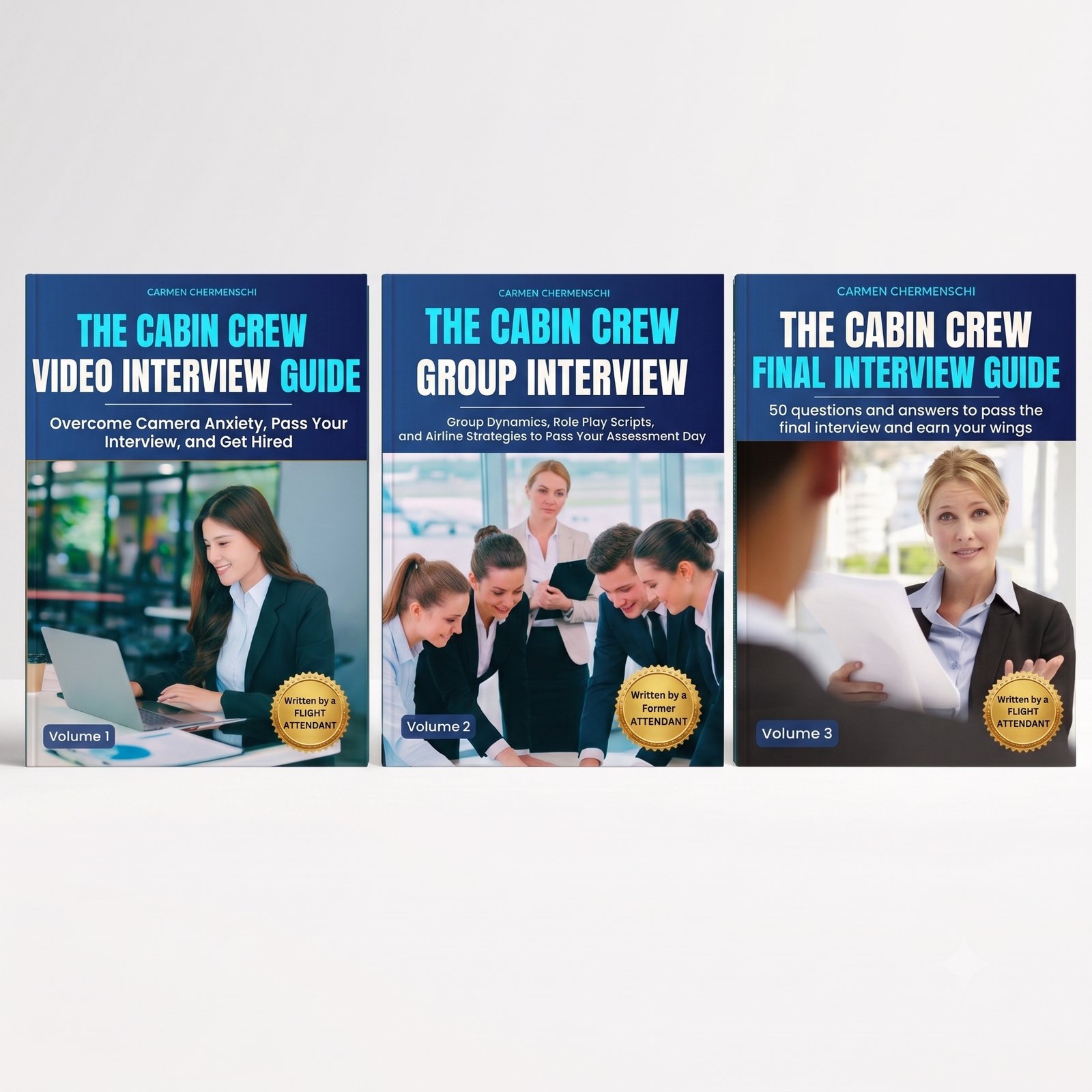
Three selection stages, one book for each
Video interview, group interview with role play, and final interview. Real questions, sample answers, and the mistakes that quietly end an application.
See the booksWant a plan built around your own application? Discover the coaching
How the final interview works
Who will interview you on the selection day
Expect one or two recruiters, sometimes a panel. Southwest, for example, puts a recruiter and a current flight attendant side by side. Airlines that hire across Europe send recruiters from different countries.
At my last assessment days, I had three—from the UK, Portugal, and Poland—and each spoke a different English.
Get ready for accents you never hear in films (even if, in some films, the slang is impossible to follow).
How long it lasts and which language is used
A one-to-one interview usually lasts about 30 minutes. United’s live virtual interview, for example, lasts 30 minutes. The interview is in English with almost every international airline. Some airlines test your English separately, like Ryanair online at the application stage, or Etihad on the assessment day.
Be aware that airlines needing a second language, like Delta for its language-qualified roles or Cathay Pacific, may test that too.
Same day or another day
Sometimes the final interview comes at the end of a very long assessment day.
You arrive at 9 and sometimes leave at 6 pm, and if you are still there in the evening, it means you made it to the recruiter.
Other airlines invite you back on a different day, or bring you to their base. British Airways asks you to book a slot at one of its assessment centres, Jet2 holds a four-hour assessment event near an airport, Delta flies candidates to Atlanta, and United flies them to Houston. Sometimes, Neos, the Italian airline, does the final interview on a second day.
If it is the same day, prepare for it, because tiredness is part of the test. The recruiter sees you up close after six or seven hours, and it shows who still has energy.
On board, you will fight to stay focused at the end of a long day too, and that is part of this wonderful job.
Online or in person
Some interviews are now virtual. Lighting, framing, and sound matter just as much as they do in a recorded video interview.
Why are airline selections moving online?
When I was going through selections, everything happened in person.
Think of a hotel in a big city, a waiting room full of dark suits and smiles, and a whole day there, from 9 in the morning to 6 in the evening. Today, a lot of that has moved online. easyJet runs most of its interviews on Microsoft Teams, for example, and the big US airlines open with recorded and live video interviews before they ever meet you.
The reason is simple.
An airline that hires hundreds of crew members a year receives thousands of applications. Flying recruiters to a hotel in another country, renting rooms and asking every candidate to travel costs a lot of money and takes many weeks.
A video call, on the other hand, costs almost nothing, fits into a recruiter’s diary between two other calls, and lets the airline meet candidates from ten countries in the same afternoon. A recorded interview goes one step further. Every candidate gets exactly the same questions, and more than one recruiter can watch the same answer before deciding.
Why the final step still happens in person
A question is going through your head right now. I can feel it! How can airlines do everything online if the requirements still include physical checks? You’re right! A screen cannot measure your arm reach or show how you deal with a situation in a group of strangers. That is why so many airlines still keep the last step in person. British Airways meets you at its assessment centres, Jet2 at its assessment events, Delta in Atlanta, United in Houston, and Emirates face-to-face at its recruitment days.
So online is usually the filter, and the final test still happens in front of a recruiter.
The most common flight attendant interview questions

The interview questions barely change from one airline to another. What changes is how they ask them. Here are the families of questions you will encounter almost every time.
| Question | What the recruiter wants to know |
|---|---|
| Tell me about yourself | Whether you can introduce yourself in about a minute, in order, without reciting your CV |
| Why do you want to be a flight attendant? | Whether you know the real job, not just the travel around the world |
| Why our airline? | Whether you really know this airline and its mission |
| What are your strengths and weaknesses? | Whether you know yourself and how you improve |
| Tell me about a mistake you made and how you fixed it | Whether you take responsibility for what you did |
| Tell me about a difficult customer | How you would handle a difficult passenger |
| Tell me about a time you worked in a team under pressure | Whether you stay calm and cooperate |
| Do you have any questions for us? | Whether you are curious about the airline and the job |
In my book, The Cabin Crew Final Interview Guide – 50 Questions and Answers to Pass the Final Interview and Earn Your Wings, you will find 50 questions in 5 categories, with answers built with the STAR method. It draws on my own experience and six years of preparing candidates.
But over the years, I have found three questions that cause the most trouble for anyone preparing to become a flight attendant.
Why do you want to be a flight attendant?
At first glance, it looks like the easiest question, but it is the trickiest. The answer recruiters hear 50 times a day is “because I love travelling”. Maybe it is true, but for the airline it is a problem, because travel is the part of the job you see least.
As crew, you often never leave the airport, and you spend the day serving, checking, and reassuring passengers—and sometimes colleagues too.
What works here is talking about the real job. Talk about the pleasure of looking after people, about teamwork and safety. Then link it to something you have already done, in a restaurant, a shop or an office.
The recruiter should think this person knows what the job is, and has already done it on a small scale. If you think two summers as a kids’ entertainer at a holiday resort do not count, think again. That is exactly the kind of experience that earns you points.
The two questions that trip people up
I see it in 90% of the people I prepare, and I lived it first.
- Tell me about your strengths and weaknesses. Strengths immediately become a list of adjectives, I am outgoing, reliable, friendly, without a single example. Weaknesses become fake flaws, like I am too much of a perfectionist. Recruiters spot them at once.
- Tell me about a mistake you made and how you solved it. Many people freeze here, because they think they must confess something serious. Others tell a story about someone else’s mistake. Never do this. You cannot develop the story, and you walk straight into a trap. The recruiter wants a real, small mistake, and above all, what you did next.
Both are prepared the same way – with a true story told with the STAR method below.
The awkward questions
Some questions are not hard, but they feel uncomfortable. Better to know they are coming.
- Tattoos. Do you have any tattoos that would be visible in uniform? Answer honestly. Rules change from airline to airline, and Emirates and Etihad, for example, state that visible tattoos are not accepted in uniform. Finding out at training is worse, and many training courses include a swimming test that reveals everything.
- Your last job. Why did you leave your previous job? Never speak badly about the company or your manager. Talk about what you were looking for and could not find there.
- Gaps in your CV or résumé. Explain any gap without apologising, even if it was just a short break to rest. Nobody is there to judge your career choices or your decision to take time off after a job that wore you out.
Airline-specific questions
People search for Delta interview questions, British Airways interview questions or Emirates interview questions as if each airline had its own list.
In my experience, about 90% of the questions are the ones in the table above. What is truly airline-specific is Why us?, and the only way to answer it well is to know the airline. Read its careers page, its values, where it flies, and what makes it different.
The airline guides on this site will help you with that.
How to answer with the STAR method

Most final interview questions ask for a story like, ” Tell me about a time when…” That story must be told clearly, logically and in the right amount of time.
Many airlines say it openly. Qantas describes a behavioural-based interview, easyJet a competency-based interview, and United advises candidates to answer with a story that covers the situation, the task, the action and the result. That is the STAR method.
- S, Situation. Where you were and what was happening, in one sentence.
- T, Task. What your responsibility was.
- A, Action. What you did, not what the team did.
- R, Result. How it ended, ideally with a number or a concrete consequence.
The mistake almost everyone makes with STAR
I have seen it countless times, almost everyone goes wrong on the A. They describe the situation for 2 long minutes and squeeze the action into one sentence. But the action is exactly what the recruiter wants to hear, to understand how you coped, and how you would cope with what happens on board every day.
In the book, I show you how to build your STAR stories for each category of questions – answers that work and answers that get candidates rejected all the time.
Here you only need one thing. I always tell my students to prepare at least 5 or 6 true stories before the interview. With them, they can answer almost anything.
Tell me about yourself
Strange as it sounds, the interview starts before the first question. It starts when you walk into the room or when they call your name in the waiting area, often a hotel lobby.
- A natural smile, eye contact, a handshake if it is offered.
- Always wait to be invited to sit down.
- Sit up straight, hands relaxed, no crossed arms.
- Your tell me about yourself lasts about a minute, a minute and a half at most. Who you are, what you have done in public, and why you want this job. Do not summarise your CV, the recruiter already has it.
Which questions to ask the recruiter at the end
Almost every final interview ends with Do you have any questions for us? Never answer no, thank you. It sounds like you are not interested in the airline or the job. And yes, as you may have guessed, in two of my own selections I asked nothing.
Two questions are enough, and they should show that you are already thinking about the job.
- What does the training course look like?
- What do you enjoy most about working for this airline?
- What are the next steps after today?
I would not ask about salary or days off. They are not wrong questions, it is just not the moment.
What to wear to a flight attendant interview
Here is the one rule to know, and it is super simple. Dress as if it were already your first day at work on board. A dark suit, a white shirt, closed shoes, hair neat and away from your face, and natural makeup.

Some airlines write it down.
American Airlines asks for professional business attire, with a suit, tie and closed-toe dress shoes for men, and a trouser suit, skirt suit or a dress at least to the knee with closed-toe shoes for women. Delta asks for clean, pressed and professional clothing, and internal candidates must not wear the Delta uniform. Emirates and Etihad publish their own image guidelines for selection events, and they are worth a look before you buy anything.
I tell you this because for years I got it wrong. At my first interviews, I looked at the other candidates in the waiting room and tried to copy them. Then I found my own style—formal and always the same—and I stopped improvising. I bought everything new, and I bought it online, because finding the right suit, shirt, tights and shoes together in a shop was almost impossible.
| Piece | Choose | Avoid |
|---|---|---|
| Suit | Navy, black or dark grey, skirt to the knee or trousers | Bright colours, short skirts, casual fabrics |
| Shirt | White or light, ironed | Prints, low necklines |
| Tights | Skin-tone, plus a spare pair in your bag | Patterned or dark tights with a skirt |
| Shoes | Closed, mid heel, rounded toe, or classic dark polished shoes | Open shoes, stilettos, new shoes never worn |
| Hair | Bun, low ponytail, or short and tidy, away from the face | Loose hair over the face |
| Make-up and nails | Natural make-up with a discreet lipstick, short nails, nude or classic red | Heavy make-up, nail art |
| Accessories | Few, small, a simple watch with hands | Big jewellery, strong perfume |
Skirt or trousers?
In all the European selections I attended, I never saw anyone in trousers, and in the photos of its official selection guide, Emirates shows a skirt suit with heels.
But rules are not the same everywhere.
American Airlines lists the trouser suit as fully acceptable. Read what your airline writes. If it says nothing, a knee-length skirt with skin-tone tights is the safest choice for women, because it helps the recruiter imagine you in uniform.
Which colours?
Navy, black or dark grey for the suit, white for the shirt. They are the colours of uniforms, and that is exactly what you want to show. If you want a touch of colour, keep it to a small detail, a pocket square or a scarf in the airline’s colours.
Which shoes?
Choose closed shoes with a medium heel that are comfortable, ideally with a rounded toe.
You often reach the final interview after a whole day on your feet, and recruiters notice who walks badly. With comfortable shoes, you avoid the constant thought of sore feet that keeps you from concentrating.
For men, choose classic dark, polished shoes.
Never wear new shoes on interview day, break them in at home first.
Hair, make-up, nails and accessories
Think like a future cabin crew member. Keep your hair in a bun or low ponytail, or keep it short and tidy, always off your face.
British Airways, for example, asks its crew to tie long hair back—no higher than the top of the head and no longer than the base of the collar—and to keep any hair colour natural.
Keep make-up as natural as possible, but present, with discreet lipstick. Short, groomed nails, nude or classic red.
Minimal jewellery and a simple watch with hands, which also helps you keep track of time during group exercises. Perfume light—almost imperceptible—or none.
What if English is not your first language?
Most international airlines interview in English, and the recruiter may not share your accent. My advice? If you do not understand a question, ask them to repeat it. Sorry, could you repeat the question, please? never costs you points. Answering a question you were not asked does. With three recruiters and three accents, I asked many times.
If English blocks you when you have to speak out loud, believe me, that theory is no longer enough.
You need the habit of speaking, and of hearing accents different from yours.
The candidates I prepare who arrive most prepared and calm are the ones who have had regular conversation practice with a native speaker. That is why I recommend Preply, where you can choose a native English tutor to talk with every week.
And if you want to know what level airlines really ask for, here is the English level flight attendants actually need.
The mistakes that can cost you the job at the last step
- Memorised answers, recited. Recruiters are sharp judges of people, and they recognise an answer learned word for word. Delta even asks candidates not to read pre-written answers. Learn the key ideas and build your answer around them.
- Talking only about travelling the world and meeting new people. Remember that this job is about two things above all, service and safety.
- Not understanding the question and answering anyway. Ask them to repeat it.
- Switching off. Many people reach the final interview exhausted and fade. At my last interview, the sixth, I never let the conversation die, and the recruiter noticed. Determination shows, and it counts.
- Speaking badly about a previous job. Avoid it always, not only at airline interviews.
- Having no questions at the end.
- One detail of your look out of place. Laddered tights, open shoes, coloured nails. Always carry a spare pair of tights.
The day before and the day of the interview
It is no secret that interviews are also won with organisation. Arriving in a rush, with laddered tights and a crumpled CV, takes away your calm when you need it most.
| When | What to do |
|---|---|
| The week before | Reread your CV line by line, prepare your 5 or 6 STAR stories, study the airline |
| The day before | Prepare your outfit and a spare pair of tights, print your documents, check the route |
| The night before | Sleep, no last-minute studying |
| On the day | Arrive early, bring water and a light snack, switch off your phone in the room |
| In your bag | Passport or ID, printed CV, invitation email, anything the airline asks for |
Once your application passes the CV screening, each airline tells you in the invitation what to bring. For example
- Emirates asks for your ID and, on your phone, your CV in English, your education certificate and your passport.
- British Airways checks your right to live and work in the UK at the assessment itself. Without it, your application is withdrawn, so bring the documents that prove it.
- Delta looks further ahead. Your passport must still be valid for at least 30 months on the day you report to training.
So read the invitation more than once. One small detail you miss can put your future cabin crew career on pause!

After the interview, the wait and the golden call
Like any interview in the world, an airline interview ends with we will let you know. And then the wait begins, and believe me, it is nerve-racking.
I lived it three times, and it was a nightmare. Not so much because of the yes or the no, but because of the total silence. If they had told me straight away that it had not gone well, I could have understood what to improve. Instead, I waited and knew nothing.
What happens while you wait for an answer
Here is what you need to know about that silence, so the wait feels a little lighter.
- Timing. Between the interview and the answer, there can be days or weeks. Silence does not mean you have been rejected. American Airlines is an exception, with an electronic offer within 24 to 48 hours.
- The golden call. It is the call, or the email, in which the airline offers you the job. The expression is used above all for Gulf airlines like Emirates. It usually comes with the contract conditions and the training date.
- The conditional offer. In the USA, the offer is conditional. Delta and American call it a conditional job offer. United calls it a conditional training offer. You start only after the checks are cleared.
- The checks. Almost every airline checks something before you start. British Airways runs criminal record checks and 5-year employment checks, which take 12 to 16 weeks, together with the medical. US airlines add a pre-employment drug test, background checks and fingerprinting. Nearly everyone asks for a medical.
- If the answer is no. It happens… It happened to me several times. Ask for feedback, even if they do not always give it, write down straight away what you think you could have done better and… get ready for your next selection.
My final interview, at the sixth attempt
I reached the final interview three times, with three different recruiters. The first time, I watched the other candidates in the waiting room to work out how to dress. I copied them, and I kept changing. Only much later did I find my own style and stop going in blind.
At my sixth Ryanair assessment day, I went in with one idea in my head, this time I don’t give up. And I did not give up, not even when a question caught me off guard. The recruiter asked me how many times I had already tried. I kept looking for the answer, explaining, staying in the conversation, and the recruiter noticed.
It was my determination that changed the course of my life.
I had never really believed my yes would come, and at the same time I kept telling myself never to give up. I was flying home from Rome to Cagliari as a passenger, and when I switched my phone back on after landing, there it was, the email inviting me to the training course.
I’ve never been so happy as I was then!
The last few metres
If you are reading this, you are already at the last step.
Stop for a moment and look at how far you have come. The online application, the video interview, the assessment day, the group exercises. Many people stopped before you. You did not.
The final interview is the last stretch, and I know it is when your legs start shaking the most—especially when you realise that of the 20 people who arrived in the morning, only 6 are left. It is also the moment when you can lose everything, because tiredness, emotion or an unexpected question makes you forget who you are. I know it well, it happened to me too.
Remember, the recruiter wants to see the person passengers will meet on board. Someone calm, kind and reassuring. If that is you, go in there and take your place. And if it does not work this time, it is not the end.
How to prepare for your final interview
The last few metres are not run alone. If you want someone beside you who asks the real questions a recruiter will ask, listens to your answers, and tells you honestly what to change, we can prepare together.
I coach in English, French, Italian and Romanian, so you can practise in the language you feel strongest in, or in the one you will be interviewed in.
Your next step
Let me walk the last few metres with you
Clarity Call
€60
Sixty minutes on video to understand where you stand and where to start.
- We check that you meet the requirements
- We choose which airlines to apply to
- You leave with a written plan
- My ATS-friendly cabin crew CV template
Complete Programme
€150
Three one-to-one sessions to reach selection day fully prepared, from your CV to the final interview.
- ATS-friendly CV
- Video interview
- Assessment day, group exercise and role play
- Mock final interview
- My Final Interview book included
My books give you the method step by step, for every stage of the selection. Paperback on Amazon.
Good luck!
And when your golden call arrives, write to me—I want to celebrate it with you.
Carmen 🩵✈️
FAQ
Questions about you, your motivation, the airline, and real situations you have handled—like a difficult customer, a mistake, or teamwork under pressure. The most common are: Tell me about yourself, why do you want to be a flight attendant, and why do you want to work with us?
Usually about 30 minutes for the individual interview. United’s live virtual interview, for example, lasts 30 minutes. If it comes at the end of an assessment day, you reach it after a whole day, and your energy is part of the assessment.
Talk about the real job, service, safety and teamwork, and link it to experience you already have with the public. Avoid answering only because I love travelling.
A way to describe a real experience in four steps: situation, task, action, and result – STAR. Airlines use behavioural or competency-based questions, tell me about a time when…, and recruiters listen for those four steps. Some airlines, like United, explicitly advise candidates to answer this way.
Usually, it is best to consider professional business attire. A dark suit, a white shirt, closed shoes and neat hair. American Airlines, for example, accepts a trouser suit, a skirt suit or a knee-length dress for women, and a suit and tie for men. Dress as if it were your first day at work on board.
Yes, unless the airline says otherwise. American Airlines lists the trouser suit as acceptable. In Europe and the Gulf, most candidates still choose a knee-length skirt with skin-tone tights because it is closest to the uniform.
Closed, comfortable shoes with a medium heel and a rounded toe, or classic dark polished shoes. Avoid open shoes and new shoes you haven’t worn, because selection day is long.
With almost every international airline, yes. Some airlines also test your English separately, and airlines in Latin America or Asia may interview partly in another language. If you do not understand a question, ask the recruiter to repeat it, it is allowed.
Both. Most airlines start with a recorded or live video interview, then hold the final stage in person. easyJet runs most of its interviews on Microsoft Teams, while British Airways and Jet2 still meet candidates in person at their assessment events.
A group exercise in which recruiters watch how you work with others. They focus less on your grammar than on how you listen, communicate, and help the group reach a decision.
Two are enough, in my experience. You can ask the recruiter questions about the training course or next steps. Prepare them in advance, and avoid questions about salary and days off at this stage.
From a few days to a few weeks, depending on the airline and the training location. American Airlines sends an electronic offer within 24 to 48 hours. With other airlines, including some European low-cost carriers, candidates report waiting up to two months.
In the USA, an offer becomes final only after background checks and a pre-employment drug test. Delta and American call it a conditional job offer, United a conditional training offer.
The call or email in which the airline offers you the job. The expression is used above all for Gulf airlines like Emirates. It usually comes with the contract and the training date.
The truth is that no airline requires one, and many candidates pass on their own. A course or a coach is worth it if you keep reaching the final stage without getting the job, or if English or nerves hold you back in front of a recruiter.
At home, record yourself answering the questions in the table above. Then watch it back and check the length, eye contact, and action part of your STAR stories. For a real mock interview, you need another person to play the recruiter, ideally someone who knows airline selection from the inside. That is what I do in my one-to-one interview coaching, online and in four languages.
Some links on this page are affiliate links. If you sign up through them, I may earn a commission at no extra cost to you.
Keep reading
Start hereIs cabin crew the job for you?
SelectionGetting through the selection
Low-cost & UKUK and low-cost airline careers
Middle EastGulf airline careers
Life on the linePay, rosters and daily life
Ground staffWorking at the airport
Practical flyingTips for passengers




Carmen flew for Ryanair and Buzz, then worked as a check-in agent with Alyzia, at the desks of easyJet, Wizz Air, Tunis Air, Royal Air Maroc and Turkish Airlines. She writes about what happens on both sides of the desk, and coaches future cabin crew from the application to the assessment day.
More about Carmen →